
[Paper Review] Trust AI Regulation? Discerning users are vital to build trust and effective AI regulation
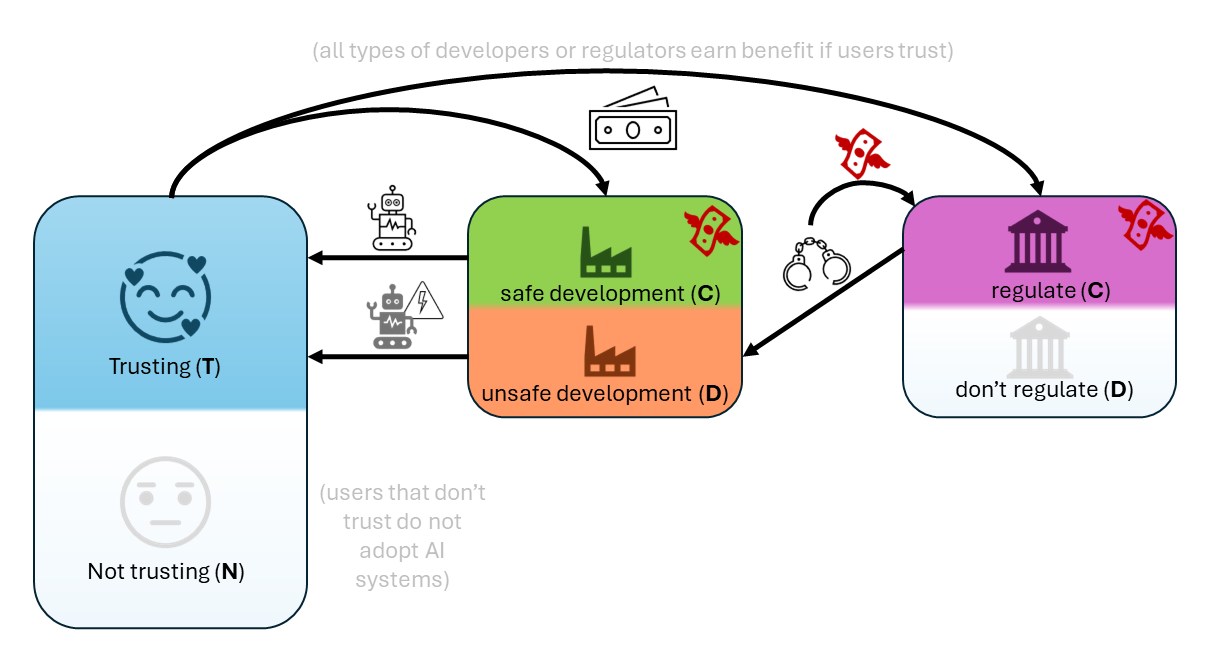
The paper models AI governance as a three-population evolutionary game (users, creators, regulators) to predict how different regulatory incentives and conditional trust affect trustworthy AI and user trust.
There is general agreement that some form of regulation is necessary both for AI creators to be incentivised to develop trustworthy systems, and for users to actually trust those systems. But there is much debate about what form these regulations should take and how they should be implemented. Most work in this area has been qualitative, and has not been able to make formal predictions. Here, we propose that evolutionary game theory can be used to quantitatively model the dilemmas faced by users, AI creators, and regulators, and provide insights into the possible effects of different regulatory regimes. We show that creating trustworthy AI and user trust requires regulators to be incentivised to regulate effectively. We demonstrate the effectiveness of two mechanisms that can achieve this. The first is where governments can recognise and reward regulators that do a good job. In that case, if the AI system is not too risky for users then some level of trustworthy development and user trust evolves. We then consider an alternative solution, where users can condition their trust decision on the effectiveness of the regulators. This leads to effective regulation, and consequently the development of trustworthy AI and user trust, provided that the cost of implementing regulations is not too high. Our findings highlight the importance of considering the effect of different regulatory regimes from an evolutionary game theoretic perspective.
Motivation & Objective
- Motivate regulatory design by formalizing the interactions among users, AI creators, and regulators.
- Develop an evolutionary game-theoretic model to predict when trustworthy AI and user trust emerge under different regimes.
- Assess mechanisms that incentivize regulators and allow user behavior to adapt to regulator performance.
Proposed method
- Propose a three-population evolutionary game-theoretic framework (users, creators, regulators).
- Define strategies: Users trust (T) or not (N); Creators cooperate (C) or defect (D); Regulators cooperate (C) or defect (D).
- Use payoff structures linking benefits to trust, safety costs, and regulatory costs (e.g., b_U, b_P, c_P, b_R, c_R).
- Derive fitness differences and formulate replicator dynamics for infinite populations (ODE system) and stochastic dynamics for finite populations (fixation probabilities, Markov chain).
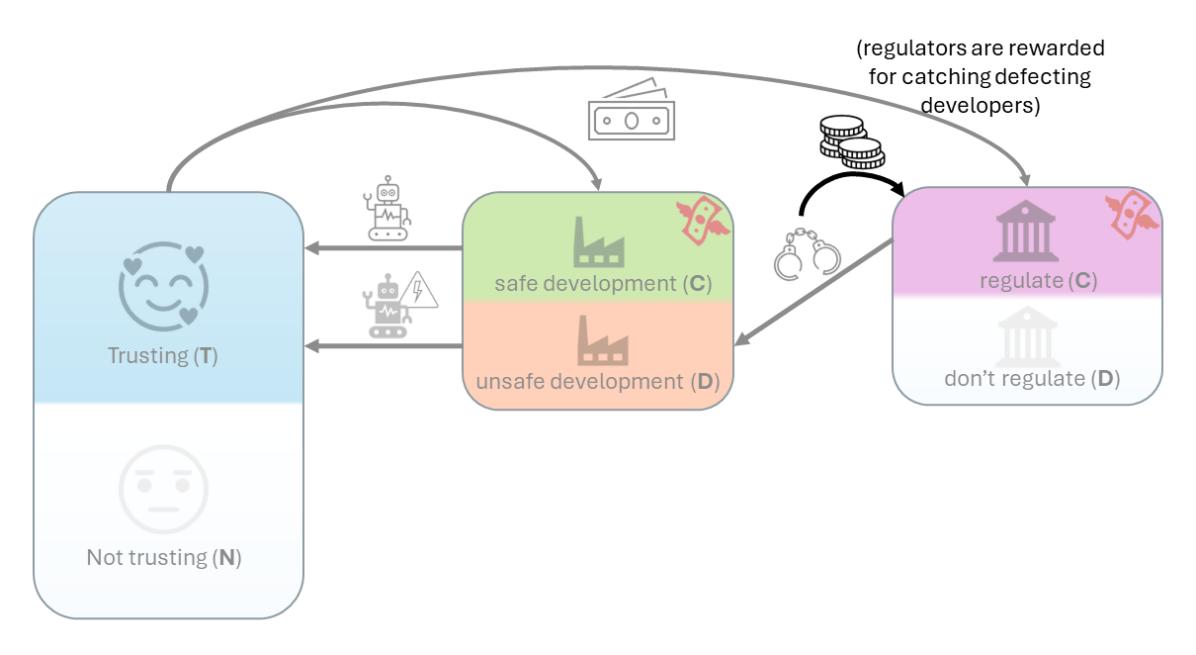
- Analyze vertex and non-vertex equilibria; extend with regulator rewards (b_fo) and conditional trust (regulator reputation).
- Explore outcomes via numerical simulations illustrating cycles and regimes of trust, regulation, and safe development.
Experimental results
Research questions
- RQ1Under what regulatory incentive structures do trustworthy AI development and user trust emerge?
- RQ2 Can rewards to regulators or conditional trust by users foster effective regulation and safe AI, and under what costs and risk conditions?
- RQ3How do baseline and extended models differ in predicting equilibrium outcomes (trust, regulation, safety)?
Key findings
- Regulators are rarely incentivized to cooperate in the baseline model, making trust difficult to achieve.
- Rewarding regulators for capturing unsafe developers can promote some level of trustworthy development and user trust when user adoption risk is not too high.
- Conditioning user trust on regulator effectiveness (public reputation) can lead to effective regulation and trustworthy AI if regulation costs are not too high.
- Extended models show possible interior equilibria and cyclic dynamics where trust, regulation, and safety fluctuate depending on incentives (e.g., b_fo, v, c_R).
- Numerical results demonstrate scenarios with full trust and cooperative regulation, limit cycles between regulation and unsafe development, or persistent non-adoption (NDD) depending on ε (risk factor) and costs.
- Conditional trust can mitigate issues of high regulation cost, enabling safer development and adoption in many parameter regimes.
Read this paper
Open the full text in the Nubint reader and ask about any passage as you read.
Read this paper on NubintThis review was generated by AI from the original paper. Please check the paper before citing it.