
[Paper Review] Two-qubit logic between distant spins in silicon
This paper demonstrates coherent two-qubit iSWAP operations between two distant electron spin qubits in silicon, separated by 250 nm, using a superconducting resonator to mediate spin-spin coupling via virtual photons in the dispersive regime. The experiment achieves controllable anti-phase oscillations and ten-nanosecond entangling gates, enabling scalable on-chip quantum networks with long-range connectivity beyond direct exchange coupling.
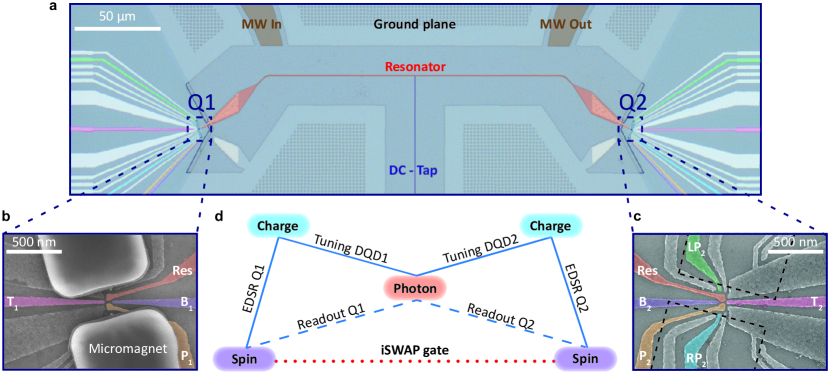
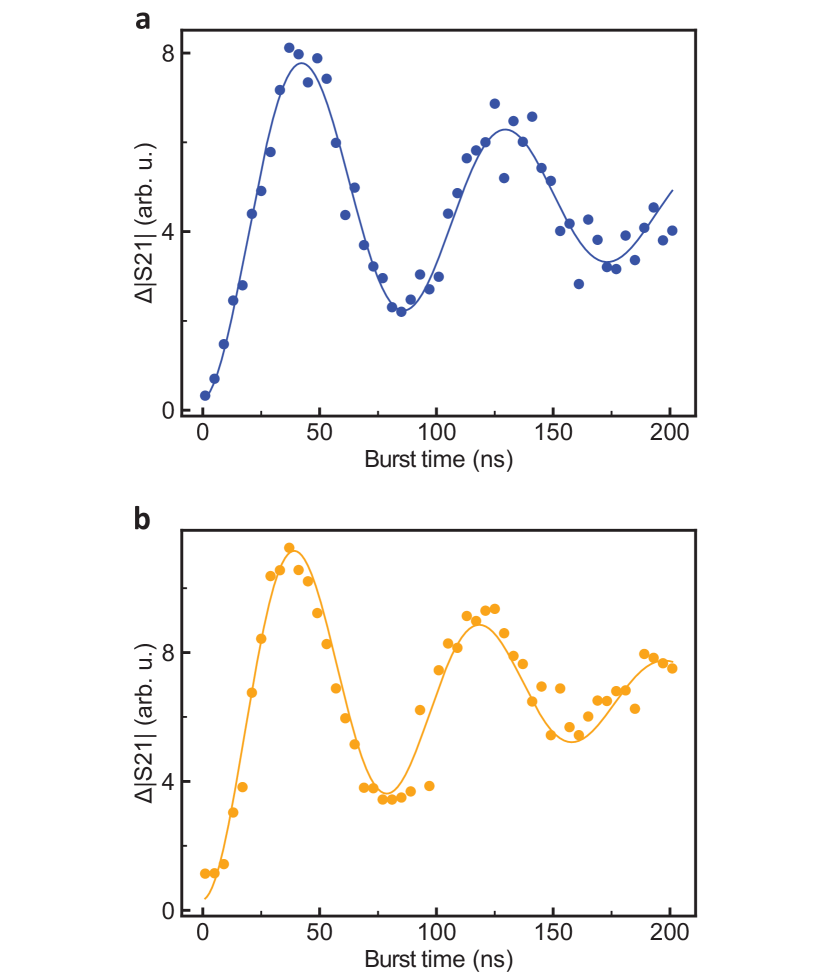
Direct interactions between quantum particles naturally fall off with distance. For future-proof qubit architectures, however, it is important to avail of interaction mechanisms on different length scales. In this work, we utilize a superconducting resonator to facilitate a coherent interaction between two semiconductor spin qubits 250 $μ$m apart. This separation is several orders of magnitude larger than for the commonly employed direct interaction mechanisms in this platform. We operate the system in a regime where the resonator mediates a spin-spin coupling through virtual photons. We report anti-phase oscillations of the populations of the two spins with controllable frequency. The observations are consistent with iSWAP oscillations and ten nanosecond entangling operations. These results hold promise for scalable networks of spin qubit modules on a chip.
Motivation & Objective
- To enable long-range two-qubit entanglement between spin qubits in silicon beyond the limits of direct exchange interaction.
- To demonstrate coherent spin-spin coupling over 250 nm using a superconducting resonator as a mediator in the dispersive regime.
- To achieve high-fidelity two-qubit quantum gates (iSWAP and √iSWAP) with nanosecond-scale operation times.
- To validate the feasibility of modular, on-chip quantum architectures using resonator-mediated spin interactions.
Proposed method
- Utilizes a superconducting NbTiN on-chip resonator to mediate coherent spin-spin coupling between two distant single-electron spin qubits in silicon quantum dots.
- Operates in the dispersive regime, where qubit frequencies are detuned from the resonator frequency to suppress photon leakage and enable coherent virtual photon exchange.
- Employs microwave probing and dispersive readout to monitor individual qubit states and tune to the flopping-mode operating point for optimal coherence.
- Applies time-domain control to induce iSWAP oscillations between the two spins, with frequency controlled by spin-cavity detuning and qubit frequency differences.
- Uses a full master equation model with experimentally measured parameters to simulate and fit the observed exchange oscillations, including relaxation, dephasing, and spin-photon coupling.
- Estimates gate fidelity via quantum process tomography of simulated process matrices, comparing ideal iSWAP and √iSWAP gates to the simulated dynamics.
Experimental results
Research questions
- RQ1Can two distant spin qubits in silicon be coherently entangled over 250 nm using a superconducting resonator as a mediator?
- RQ2What is the achievable fidelity and operation time of a resonator-mediated two-qubit gate in the dispersive regime?
- RQ3How does the iSWAP oscillation frequency depend on spin-cavity detuning, spin-photon coupling strength, and qubit frequency detuning?
- RQ4To what extent do experimental deviations from ideal behavior—such as frequency drift or magnetic field gradient uncertainty—affect gate performance?
Key findings
- The experiment demonstrates anti-phase oscillations of the two spin qubit populations with controllable frequency, consistent with iSWAP dynamics.
- A √iSWAP gate with a fidelity of 82.5% was achieved, and the iSWAP gate reached 70.3% fidelity, indicating high-fidelity two-qubit operations.
- The iSWAP gate operation time is approximately 10 nanoseconds, enabling fast entangling operations suitable for scalable quantum computing.
- Spin-spin coupling strength was measured up to 21.2 MHz, with spin-photon coupling strengths reaching 29.7 MHz, indicating strong resonator-mediated interaction.
- The observed oscillation frequencies match theoretical simulations when accounting for experimentally measured parameters, including qubit relaxation and dephasing times.
- Fidelity estimates are based on full model simulations that include relaxation, dephasing, and single-qubit phase evolution, validating the robustness of the gate protocol.
Read this paper
Open the full text in the Nubint reader and ask about any passage as you read.
Read this paper on NubintThis review was generated by AI from the original paper. Please check the paper before citing it.