
[Paper Review] Two shell- and wing-shaped supernova remnants. Investigating the molecular environments around VRO 42.05.01 and G 350.0-2.0
This study investigates the molecular environments of two mixed-morphology supernova remnants, VRO 42.05.01 and G 350.0-2.0, which exhibit strikingly similar shell-and-wing radio morphologies. Despite this morphological similarity, CO observations reveal that only VRO 42.05.01 shows strong evidence of shock interaction with dense molecular gas, while G 350.0-2.0 shows minimal molecular interaction, suggesting the shell-and-wing morphology is not primarily driven by ambient ISM density gradients but may instead stem from progenitor stellar wind or intrinsic explosion dynamics.
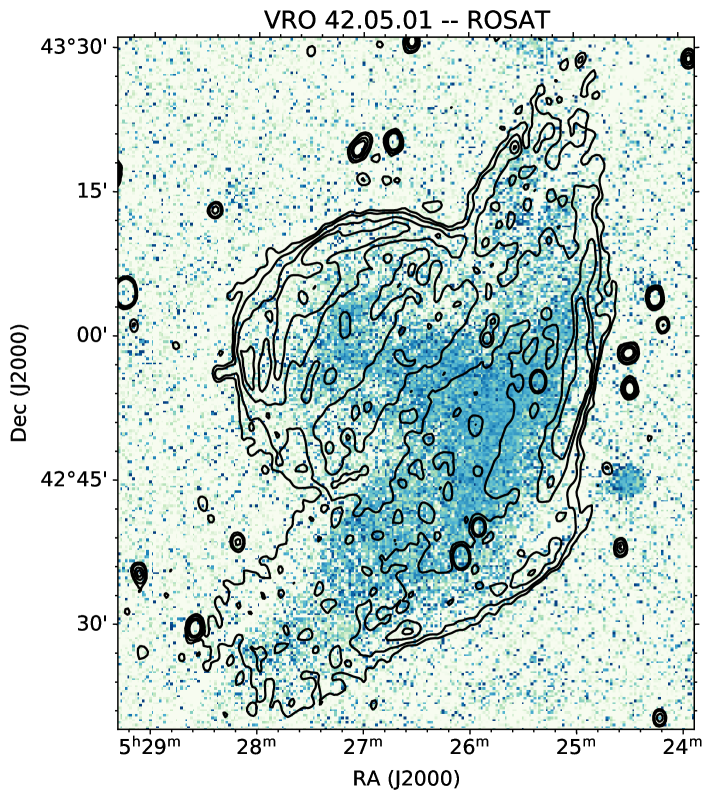
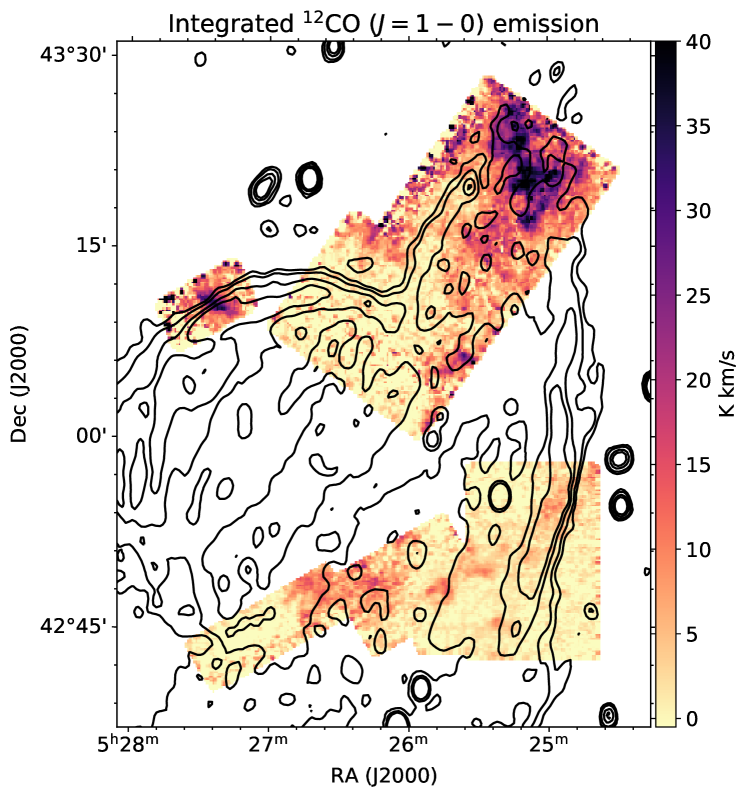
Supernova remnants (SNRs) are profoundly affected by their ambient medium. We present carbon monoxide (CO) observations around two mixed morphology SNRs, VRO 42.05.01 and G 350.0-2.0, that look remarkably similar in continuum radio emission, showing what we refer to as a shell and wing shape. It has been proposed that the shell and wing shape is the result of environmental effects, in the form of a sharp density gradient or discontinuity. Our motivation for studying these two sources jointly is that if the dense molecular environment causes the development of these sources' shell and wing shape, then these two sources' environments must be similar. This is contrary to what we observe. In the case of VRO 42.05.01, we have found direct evidence of an interaction with its molecular environment, in the form of broadened $^{12}$CO line profiles, high $(J=2-1)$ to $(J=1-0)$ line ratios, and arc features in position-velocity space. We interpret some of these features to be associated with the SNR shock, and some of them to be due to the presence of a pre-supernova stellar wind. We have found no such features in the abundant molecular gas surrounding G 350.0-2.0. We have also made a spectral index map of G 350.0-2.0, and we see that the radio spectrum of G 350.0-2.0 steepens significantly at frequencies $<200$~MHz, much like that of VRO 42.05.01. In spite of their spectral and morphological similarities, these two sources look substantially different in their optical and infrared emission. The lack of large-scale correspondence between the radio continuum and the molecular material, as well as the differences in the excitation and morphological properties of the molecular gas surrounding both sources, lead us to conclude that the shell and wing morphology of these two sources is not due to interactions with a similar ambient molecular ISM.
Motivation & Objective
- To test the hypothesis that the shell-and-wing morphology of mixed-morphology SNRs arises from environmental density gradients in the ISM.
- To compare the molecular gas environments of VRO 42.05.01 and G 350.0-2.0, two SNRs with near-identical radio morphologies.
- To determine whether shock-induced molecular excitation and kinematic features in CO lines correlate with SNR morphology.
- To assess whether differences in optical, infrared, and radio emission morphology between the two SNRs indicate distinct environmental interactions.
- To evaluate whether the morphology may instead be driven by progenitor stellar wind or internal explosion dynamics rather than external ISM conditions.
Proposed method
- Conducted 12 CO (J=1-0), 12 CO (J=2-1), and 13 CO (J=1-0) line observations toward VRO 42.05.01 using the IRAM 30m telescope to probe molecular gas kinematics and excitation.
- Performed 12 CO (J=2-1) line observations toward G 350.0-2.0 using the APEX telescope to assess molecular environment interaction.
- Analyzed position-velocity diagrams to identify shocked gas, swept-up material, and features suggestive of stellar wind interaction.
- Computed 12 CO (J=2-1)/(J=1-0) line intensity ratios to identify regions of elevated excitation, indicative of shock heating.
- Generated a spectral index map of G 350.0-2.0 using archival GLEAM and 1.4 GHz radio continuum data to study low-frequency radio spectral behavior.
- Compared morphological and spectral properties of optical, infrared, and radio emission across both SNRs to assess environmental correspondence.
Experimental results
Research questions
- RQ1Is the shell-and-wing morphology of VRO 42.05.01 and G 350.0-2.0 caused by a common ambient molecular ISM density gradient?
- RQ2To what extent is molecular gas around these SNRs shocked or compressed by SNR forward shocks?
- RQ3Are there kinematic or excitation signatures in CO lines indicating interaction with pre-supernova stellar winds?
- RQ4How do the low-frequency radio spectral properties of G 350.0-2.0 compare to those of VRO 42.05.01, and what does this imply about their emission mechanisms?
- RQ5Why do the two morphologically similar SNRs show such different morphological correspondence between radio, optical, and infrared emission?
Key findings
- VRO 42.05.01 exhibits broadened 12 CO line profiles (Δv > 10 km s⁻¹) and 12 CO (J=2-1)/(J=1-0) line ratios exceeding 1.8, indicating shock heating and compression of molecular gas.
- Position-velocity diagrams of VRO 42.05.01 reveal arc-like features interpreted as evidence of SNR forward shock interaction and possible pre-supernova stellar wind effects.
- No significant shock or excitation features were detected in the molecular gas surrounding G 350.0-2.0, despite extensive CO observations with APEX.
- The radio spectral index of G 350.0-2.0 steepens from α ≈ -0.4 at frequencies >200 MHz to α ≈ -0.7 between 88 MHz and 200 MHz, similar to VRO 42.05.01.
- The optical and infrared emission of G 350.0-2.0 shows no large-scale morphological correspondence with its radio continuum emission, unlike VRO 42.05.01.
- The lack of molecular interaction in G 350.0-2.0 and differing environmental morphologies suggest that the shell-and-wing morphology is not primarily due to ambient ISM density gradients.
Read this paper
Open the full text in the Nubint reader and ask about any passage as you read.
Read this paper on NubintThis review was generated by AI from the original paper. Please check the paper before citing it.