
[Paper Review] Type II t-J model and shared antiferromagnetic spin coupling from Hund's rule in superconducting La$_3$Ni$_2$O$_7$
The paper develops a Type II bilayer t-J model for La3Ni2O7 under high pressure, showing Hund’s coupling mediates inter-layer spin exchange and yields robust inter-layer s-wave pairing up to x≈0.5 hole doping.
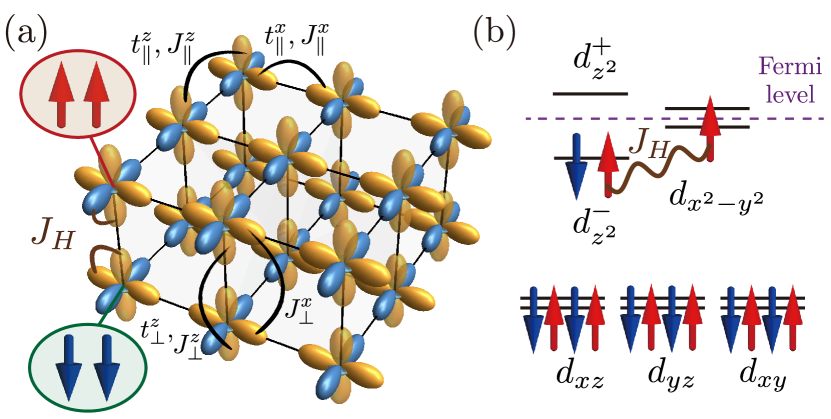
Recently, a 80 K superconductor was discovered in La$_3$Ni$_2$O$_7$ under high pressure. Density function theory (DFT) calculations identify $d_{x^2-y^2}$, $d_{z^2}$ as the active orbitals on the bilayer square lattice with a $d^{8-x}$ configuration of of Ni per site. One naive expectation is to describe this system in terms of a two-orbital t-J model. However, we emphasize the importance of Hund's coupling $J_H$ and the $x=0$ limit should be viewed as a spin-one Mott insulator. Especially, the significant Hund's coupling shares the inter-layer super-exchange $J_\perp$ of the $d_{z^2}$ orbital to the $d_{x^2-y^2}$ orbital, an effect that cannot be captured by conventional perturbation or mean-field approaches. In this study, we first explore the limit where the $d_{z^2}$ orbital is Mott localized, dealing with a one-orbital bilayer t-J model focused on the $d_{x^2-y^2}$ orbital. Notably, we find that strong inter-layer pairing survives up to $x=0.5$ hole doping driven by the transmitted $J_\perp$, which explains the existence of a high Tc superconductor in the experiment at this doping level. Next, we uncover the more realistic situation where the $d_{z^2}$ orbital is slightly hole-doped and cannot be simply integrated out. We take the $J_H ightarrow +\infty$ limit and propose a type II t-J model with four extit{spin-half} singlon ($d^7$) states and three extit{spin-one} doublon ($d^8$) states. Employing a parton mean-field approach, we recover similar results as in the one-orbital t-J model, but now with the effect of the $J_\perp$ automatically generated. We propose future experiments to electron dope the system to further enhance $T_c$.
Motivation & Objective
- Motivate minimal low-energy modeling for superconducting La3Ni2O7 with two active Ni orbitals (d_x2−y2 and d_z2).
- Highlight the role of Hund’s coupling J_H in sharing inter-layer exchange J_perp between orbitals.
- Investigate how large J_perp and spin-state constraints influence pairing and superconductivity.
- Explore limits where one orbital is Mott localized and when both orbitals are active.
- Connect microscopic model to experimentally observed Tc≈80 K under high pressure.
Proposed method
- Construct bilayer bilayer bilinear models with two Ni orbitals on a square lattice.
- Derive and analyze a one-orbital t-J limit with inter-layer J_perp using slave-boson mean-field theory.
- Introduce a Type II t-J model with four spin-1/2 singlon and three spin-1 doublon states under large Hund’s coupling.
- Apply a three-fermion parton construction to handle the constrained Hilbert space.
- Perform self-consistent mean-field decoupling to obtain intra- and inter-layer pairing order parameters.
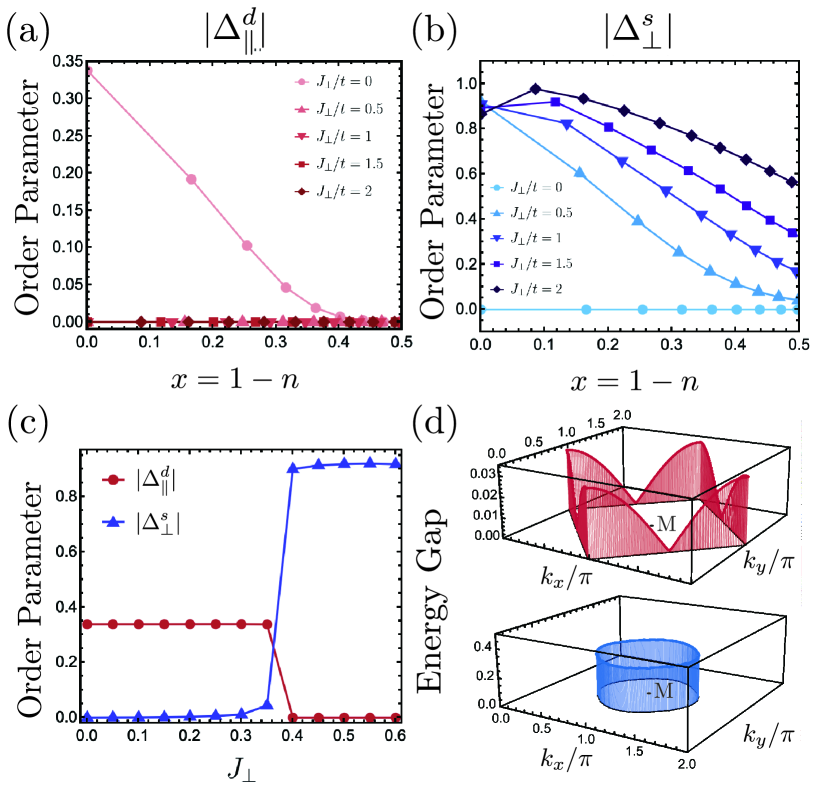
- Demonstrate how J_perp can induce a first-order transition from d-wave to inter-layer s-wave pairing.
Experimental results
Research questions
- RQ1Does Hund’s coupling enable sharing of inter-layer exchange between nickelate orbitals?
- RQ2Can a bilayer or Type II t-J framework support inter-layer s-wave pairing at high hole doping (x≈0.5)?
- RQ3How does inter-layer exchange J_perp influence pairing symmetry and strength as a function of doping?
- RQ4What happens when the d_z2 orbital is Mott localized versus moderately doped in the low-energy model?
- RQ5Can a three-fermion parton formulation reproduce the pairing physics observed experimentally?
Key findings
- A bilayer one-orbital t-J model with strong inter-layer exchange J_perp produces dominant inter-layer s-wave pairing at x near 0 and persists up to x≈0.5 with large J_perp.
- A first-order transition from d-wave to s-wave pairing occurs as J_perp increases.
- In the large J_perp regime, the inter-layer pairing gap Delta_perp remains finite at x=0.5, yielding a fully gapped Fermi surface for s-wave pairing.
- In the Type II t-J model, the emergent d_x2−y2 orbital inherits enhanced J_perp from both orbitals, even without t_perp.
- The mean-field results align with the experimental observation of high-Tc superconductivity at ~50% hole doping and show robustness of inter-layer pairing against doping.
- The framework predicts further enhancement of Tc upon electron doping, suggesting experimental directions.
Read this paper
Open the full text in the Nubint reader and ask about any passage as you read.
Read this paper on NubintThis review was generated by AI from the original paper. Please check the paper before citing it.