
[Paper Review] UnCRtainTS: Uncertainty Quantification for Cloud Removal in Optical Satellite Time Series
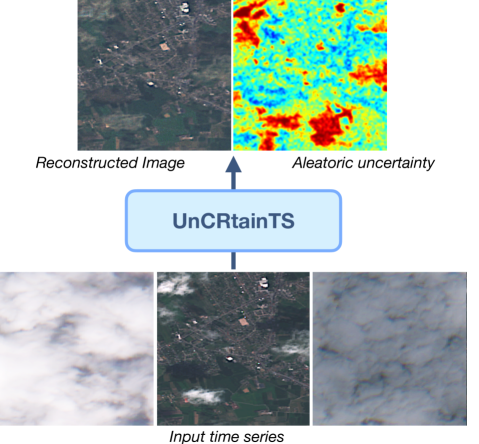
UnCRtainTS introduces a novel attention-based deep learning architecture for multi-temporal optical satellite cloud removal with integrated multivariate uncertainty quantification. By predicting pixel-wise aleatoric uncertainty alongside image reconstructions, it achieves state-of-the-art performance on SEN12MS-CR-TS and enables trustworthy quality control through well-calibrated uncertainty estimates.
Clouds and haze often occlude optical satellite images, hindering continuous, dense monitoring of the Earth's surface. Although modern deep learning methods can implicitly learn to ignore such occlusions, explicit cloud removal as pre-processing enables manual interpretation and allows training models when only few annotations are available. Cloud removal is challenging due to the wide range of occlusion scenarios -- from scenes partially visible through haze, to completely opaque cloud coverage. Furthermore, integrating reconstructed images in downstream applications would greatly benefit from trustworthy quality assessment. In this paper, we introduce UnCRtainTS, a method for multi-temporal cloud removal combining a novel attention-based architecture, and a formulation for multivariate uncertainty prediction. These two components combined set a new state-of-the-art performance in terms of image reconstruction on two public cloud removal datasets. Additionally, we show how the well-calibrated predicted uncertainties enable a precise control of the reconstruction quality.
Motivation & Objective
- To address the challenge of reconstructing cloud-free optical satellite images from temporally corrupted sequences with reliable quality assessment.
- To integrate multivariate uncertainty quantification into satellite image reconstruction, enabling confidence-aware downstream applications.
- To improve reconstruction fidelity and uncertainty calibration by leveraging full-resolution feature maps and attention-based temporal encoding.
- To evaluate the impact of input sequence length and auxiliary SAR data on reconstruction quality and uncertainty reliability.
- To demonstrate that uncertainty predictions can flag low-quality reconstructions and reflect real-world image dynamics such as transient phenomena.
Proposed method
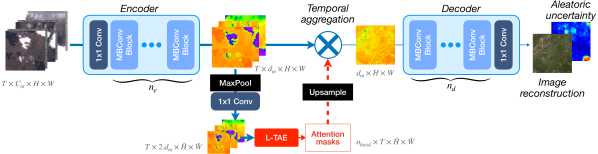
- Proposes a novel attention-based neural network architecture that operates on full-resolution feature maps, avoiding downsampling to preserve spatial details.
- Employs a diagonal covariance matrix to model multivariate aleatoric uncertainty, enabling pixel-wise variance prediction during training via negative log-likelihood loss.
- Combines the uncertainty prediction with a deep ensemble approach to estimate epistemic uncertainty, improving overall uncertainty calibration.
- Uses a multi-modal input consisting of optical and SAR data to enhance reconstruction robustness and reduce uncertainty.
- Trains the model using a hybrid loss combining pixel-wise NLL for uncertainty and perceptual losses for high-frequency detail recovery.
- Applies temporal self-attention to encode long-range dependencies across time series, enabling better modeling of transient features like waves or changing crops.
Experimental results
Research questions
- RQ1Can multivariate uncertainty quantification improve the reliability of cloud-removed satellite images in a multi-temporal setting?
- RQ2How does the inclusion of uncertainty estimates affect the interpretability and trustworthiness of reconstructed satellite images?
- RQ3Does longer input sequence length improve both image reconstruction quality and uncertainty calibration?
- RQ4To what extent does auxiliary SAR data reduce uncertainty and improve reconstruction performance?
- RQ5Can uncertainty maps effectively flag regions with persistent occlusion, cloud shadows, or dynamic features such as breaking waves or maturing crops?
Key findings
- UnCRtainTS achieves state-of-the-art performance on the SEN12MS-CR-TS benchmark, with a PSNR of 28.41 and SSIM of 0.875 on the test set using T=4 input time points.
- The method reduces pixel-level uncertainty calibration error (UCE) to 0.001 and image-level UCE to 0.002, indicating well-calibrated uncertainty estimates.
- Longer input sequences (T=4) yield better reconstruction quality and improved uncertainty calibration compared to T=2 or T=3.
- Excluding SAR data increases both image-level and pixel-level UCE, demonstrating that SAR improves reconstruction trustworthiness.
- Uncertainty maps effectively highlight regions with cloud shadows, persistent occlusions, and dynamic features such as ocean waves and changing crop colors.
- The model's uncertainty predictions correlate strongly with actual reconstruction errors, enabling reliable quality control in downstream applications.
Read this paper
Open the full text in the Nubint reader and ask about any passage as you read.
Read this paper on NubintThis review was generated by AI from the original paper. Please check the paper before citing it.