
[Paper Review] Understanding RowHammer Under Reduced Wordline Voltage: An Experimental Study Using Real DRAM Devices
This paper experimentally demonstrates that reducing the wordline voltage ($V_{PP}$) in real DDR4 DRAM chips significantly reduces RowHammer vulnerability, increasing the number of activate-precharge cycles needed to induce a bit flip by an average of 7.4% (up to 85.8%) and decreasing the bit error rate by 15.2% on average (up to 66.9%), with minimal impact on latency and retention in most chips. The findings reveal $V_{PP}$ as a tunable parameter for mitigating RowHammer without hardware changes.
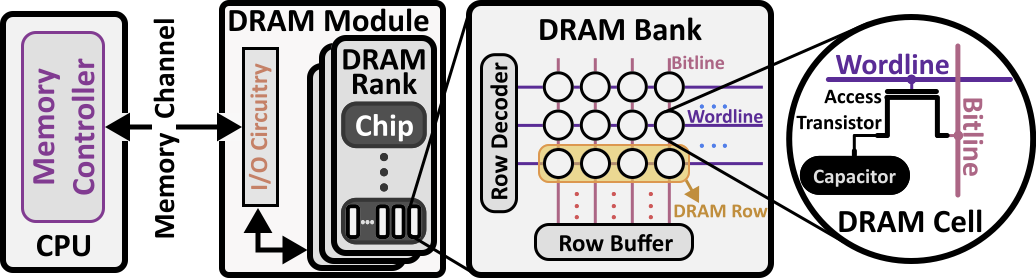
RowHammer is a circuit-level DRAM vulnerability, where repeatedly activating and precharging a DRAM row, and thus alternating the voltage of a row's wordline between low and high voltage levels, can cause bit flips in physically nearby rows. Recent DRAM chips are more vulnerable to RowHammer: with technology node scaling, the minimum number of activate-precharge cycles to induce a RowHammer bit flip reduces and the RowHammer bit error rate increases. Therefore, it is critical to develop effective and scalable approaches to protect modern DRAM systems against RowHammer. To enable such solutions, it is essential to develop a deeper understanding of the RowHammer vulnerability of modern DRAM chips. However, even though the voltage toggling on a wordline is a key determinant of RowHammer vulnerability, no prior work experimentally demonstrates the effect of wordline voltage (VPP) on the RowHammer vulnerability. Our work closes this gap in understanding. This is the first work to experimentally demonstrate on 272 real DRAM chips that lowering VPP reduces a DRAM chip's RowHammer vulnerability. We show that lowering VPP 1) increases the number of activate-precharge cycles needed to induce a RowHammer bit flip by up to 85.8% with an average of 7.4% across all tested chips and 2) decreases the RowHammer bit error rate by up to 66.9% with an average of 15.2% across all tested chips. At the same time, reducing VPP marginally worsens a DRAM cell's access latency, charge restoration, and data retention time within the guardbands of system-level nominal timing parameters for 208 out of 272 tested chips. We conclude that reducing VPP is a promising strategy for reducing a DRAM chip's RowHammer vulnerability without requiring modifications to DRAM chips.
Motivation & Objective
- To investigate the effect of reduced wordline voltage ($V_{PP}$) on RowHammer vulnerability in modern DRAM chips, as prior work has not experimentally isolated $V_{PP}$'s impact.
- To determine whether lowering $V_{PP}$ can reduce RowHammer bit flips without significantly degrading DRAM reliability metrics such as access latency, charge restoration, and data retention.
- To provide empirical data on $V_{PP}$'s influence on RowHammer behavior across diverse DDR4 DRAM chips from multiple vendors, enabling better-informed system-level defenses.
- To evaluate the feasibility of using $V_{PP}$ scaling as a non-invasive, chip-agnostic mitigation strategy that avoids hardware modifications.
Proposed method
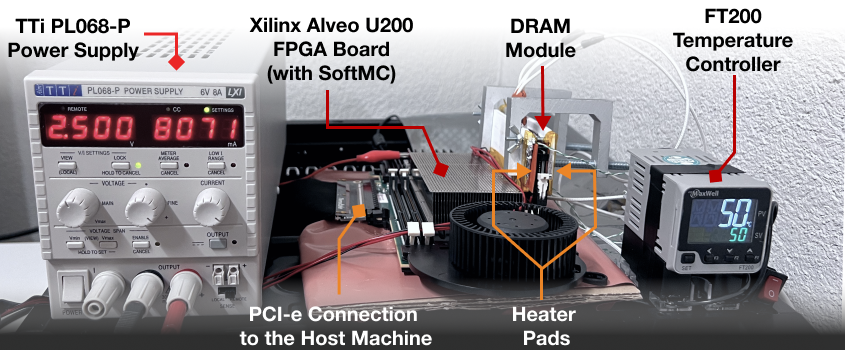
- Conducted controlled experiments on 272 real DDR4 DRAM chips from three major vendors, systematically varying $V_{PP}$ while keeping $V_{DD}$ at nominal levels to isolate its effect.
- Measured the minimum number of activate-precharge cycles ($HC_{first}$) required to induce a RowHammer bit flip at different $V_{PP}$ levels across all tested chips.
- Quantified the RowHammer bit error rate (BER) after repeated hammering of aggressor rows at reduced $V_{PP}$, comparing results to baseline $V_{PP}$.
- Evaluated the impact of $V_{PP}$ reduction on key DRAM reliability metrics: row activation latency, charge restoration time, and data retention, using both real chips and SPICE simulations.
- Analyzed the results across chip generations and vendors to assess consistency and identify guardband margins for reliable operation under reduced $V_{PP}$.
- Used statistical analysis to report average and maximum improvements in $HC_{first}$ and BER across all tested chips, with confidence in the findings due to large-scale empirical validation.
Experimental results
Research questions
- RQ1How does reducing $V_{PP}$ affect the number of activate-precharge cycles required to trigger a RowHammer bit flip in real DDR4 DRAM chips?
- RQ2To what extent does lowering $V_{PP}$ reduce the RowHammer bit error rate across diverse DRAM chips?
- RQ3How does $V_{PP}$ reduction impact DRAM reliability metrics such as access latency, charge restoration, and data retention time?
- RQ4Can $V_{PP}$ scaling be used as a viable, non-invasive mitigation strategy for RowHammer without requiring DRAM hardware modifications?
- RQ5What is the trade-off between reduced RowHammer vulnerability and marginal performance or reliability degradation under $V_{PP}$ scaling?
Key findings
- Lowering $V_{PP}$ increases the number of activate-precharge cycles needed to induce a RowHammer bit flip by an average of 7.4% across all tested DDR4 DRAM chips, with a maximum improvement of 85.8%.
- The RowHammer bit error rate (BER) decreases by an average of 15.2% across all tested chips when $V_{PP}$ is reduced, with a maximum reduction of 66.9%.
- For 208 out of 272 tested chips, the marginal degradation in access latency, charge restoration, and data retention time remains within the system-level guardbands of nominal timing parameters.
- SPICE simulations confirm that reduced $V_{PP}$ causes only minor delays in row activation and charge restoration, and only slightly reduces data retention time, which remains acceptable in most cases.
- The results demonstrate that $V_{PP}$ scaling is a viable, non-invasive method to reduce RowHammer vulnerability without requiring changes to DRAM chip design or system architecture.
- The study provides empirical evidence that $V_{PP}$ is a critical tunable parameter for mitigating RowHammer, offering a new dimension for system-level defense design.
Read this paper
Open the full text in the Nubint reader and ask about any passage as you read.
Read this paper on NubintThis review was generated by AI from the original paper. Please check the paper before citing it.