
[Paper Review] Understanding the polaritonic ground state in cavity quantum electrodynamics
The paper develops a perturbative Rayleigh-Schrödinger approach within the Pauli-Fierz framework to compute ground-state energies of molecules in optical cavities, showing good agreement with ab initio cQED methods and linking cavity effects to van der Waals forces.
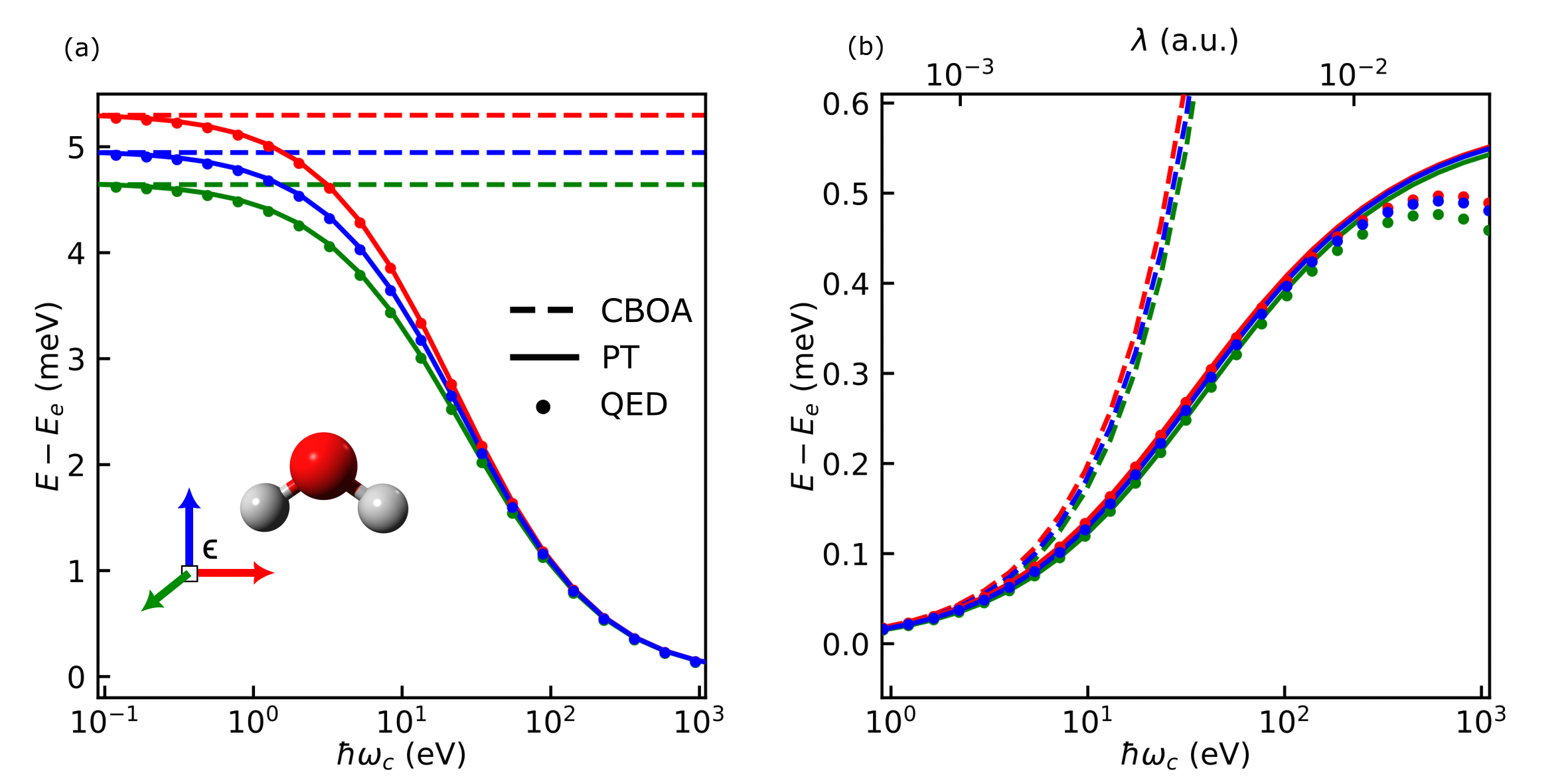
Molecular polaritons arise when molecules interact so strongly with light that they become entangled with each other. This light-matter hybridization alters the chemical and physical properties of the molecular system and allows chemical reactions to be controlled without the use of external fields. We investigate the impact of strong light-matter coupling on the electronic structure using perturbative approaches and demonstrate that Rayleigh-Schrödinger perturbation theory can reproduce the ground state energies in optical cavities to comparable accuracy as ab initio cavity quantum electrodynamics methodologies for currently relevant coupling strengths. The method is effective in both low and high cavity frequency regimes and straightforward to implement via response functions. Furthermore, we establish simple relations between cavity-induced intermolecular forces and van der Waals forces. These findings provide valuable insight into the manipulation of ground-state polaritonic energy landscapes, shedding light on the systems and conditions in which modifications can be achieved.
Motivation & Objective
- Motivate how strong light-matter coupling in cavities modifies electronic ground states and intermolecular interactions.
- Provide a perturbative framework that works with any electronic structure method to compute ground-state energies under cQED.
- Derive and implement expressions for cavity-modified one- and two-body energies using response functions.
- Relate cavity-induced forces to standard van der Waals interactions through dipole polarizability integrals.
Proposed method
- Adopt Pauli-Fierz Hamiltonian in length gauge with a single cavity mode and dipole coupling (Eq. 1).
- Use Rayleigh-Schrödinger perturbation theory with the light-matter coupling λ treated as perturbation (Eq. 3).
- Express second-order ground-state energy in terms of dipole fluctuations and a response-function term (Eq. 4).
- Rewrite sum-over-states expressions as response functions to avoid many excited states (Eq. 5–7).
- Incorporate electron-photon response within coupled-cluster theory to obtain a practical ground-state energy (Eq. 8, Eq. 30).
- Derive cavity-induced intermolecular energies: dipole-dipole interaction, van der Waals, and cavity-modified long-range terms (Eqs. 9–18, 22, 24).
- Connect two-body and higher-body terms to frequency-dependent polarizabilities via α( iω ) and related integrals (Eq. 14).
- Discuss Cavity Born-Oppenheimer approximation (CBOA) and its regime of validity (Section III.1).
Experimental results
Research questions
- RQ1How does strong light-matter coupling in a cavity modify the electronic ground state of a single molecule?
- RQ2How are cavity-induced intermolecular forces (including van der Waals and long-range terms) altered by the cavity, and how do they scale with geometry and concentration?
- RQ3Can a perturbative response-theory framework reproduce ab initio cQED results across different cavity frequencies and coupling strengths?
- RQ4What is the relation between cavity-induced forces and conventional van der Waals interactions, and how do higher-body terms contribute?
- RQ5Under what conditions do orientational and collective effects emerge or diminish in large ensembles inside a cavity?
Key findings
- Rayleigh-Schrödinger perturbation theory reproduces ground-state energies comparable to ab initio cQED methods for currently relevant coupling strengths (λ ≤ 0.01 a.u.).
- Ground-state energy changes are dominated by dipole self-energy screening; high cavity frequencies amplify screening while the bilinear coupling term cancels with the dipole self-energy in that limit (Eq. 4 and discussion).
- Cavity-induced intermolecular forces include modified van der Waals terms with R dependence transitioning toward R^(-3) rather than R^(-6) due to the cavity field (Eq. 12 and 22).
- The 1-body dipole self-energy and 2-body long-range interactions can be expressed via frequency-dependent polarizabilities and their integrals; higher-body terms become significant with more molecules in the cavity (Eq. 14–18).
- For isotropic molecules, the cavity-induced forces reduce to a form involving the C6 coefficient, linking cavity effects to standard London dispersion physics (Eq. 20–22).
- Orientational effects arise from anisotropic polarizabilities and persist at low concentrations, but diminish with increasing number of molecules and volume (Section III.2).
- The perturbative framework is demonstrated within a CC (and QED-CC) context and is proposed as a viable alternative to self-consistent QED when investigating the polaritonic ground state (Conclusions).

Read this paper
Open the full text in the Nubint reader and ask about any passage as you read.
Read this paper on NubintThis review was generated by AI from the original paper. Please check the paper before citing it.