
[Paper Review] Understanding the Role of Human Intuition on Reliance in Human-AI Decision-Making with Explanations
This study investigates how human intuition influences reliance on AI predictions with explanations, identifying three intuition-driven pathways—intuition about outcomes, features, and AI limitations—that guide decision-makers in overriding AI errors. It finds that example-based explanations outperform feature-based ones by preserving natural intuition and enabling better detection of AI unreliability, leading to improved human-AI collaboration and reduced overreliance.
AI explanations are often mentioned as a way to improve human-AI decision-making, but empirical studies have not found consistent evidence of explanations' effectiveness and, on the contrary, suggest that they can increase overreliance when the AI system is wrong. While many factors may affect reliance on AI support, one important factor is how decision-makers reconcile their own intuition -- beliefs or heuristics, based on prior knowledge, experience, or pattern recognition, used to make judgments -- with the information provided by the AI system to determine when to override AI predictions. We conduct a think-aloud, mixed-methods study with two explanation types (feature- and example-based) for two prediction tasks to explore how decision-makers' intuition affects their use of AI predictions and explanations, and ultimately their choice of when to rely on AI. Our results identify three types of intuition involved in reasoning about AI predictions and explanations: intuition about the task outcome, features, and AI limitations. Building on these, we summarize three observed pathways for decision-makers to apply their own intuition and override AI predictions. We use these pathways to explain why (1) the feature-based explanations we used did not improve participants' decision outcomes and increased their overreliance on AI, and (2) the example-based explanations we used improved decision-makers' performance over feature-based explanations and helped achieve complementary human-AI performance. Overall, our work identifies directions for further development of AI decision-support systems and explanation methods that help decision-makers effectively apply their intuition to achieve appropriate reliance on AI.
Motivation & Objective
- To understand how human intuition interacts with AI explanations in human-AI decision-making.
- To investigate why feature-based explanations often increase overreliance on incorrect AI predictions.
- To explore how different explanation types (feature- and example-based) affect decision-makers’ ability to override AI when it is wrong.
- To identify intuitive reasoning pathways that support appropriate reliance on AI.
- To inform the design of AI decision-support systems that better accommodate human intuition and reduce overreliance.
Proposed method
- Conducted a think-aloud, mixed-methods study with 26 participants across two low-stakes decision tasks (tabular and text-based).
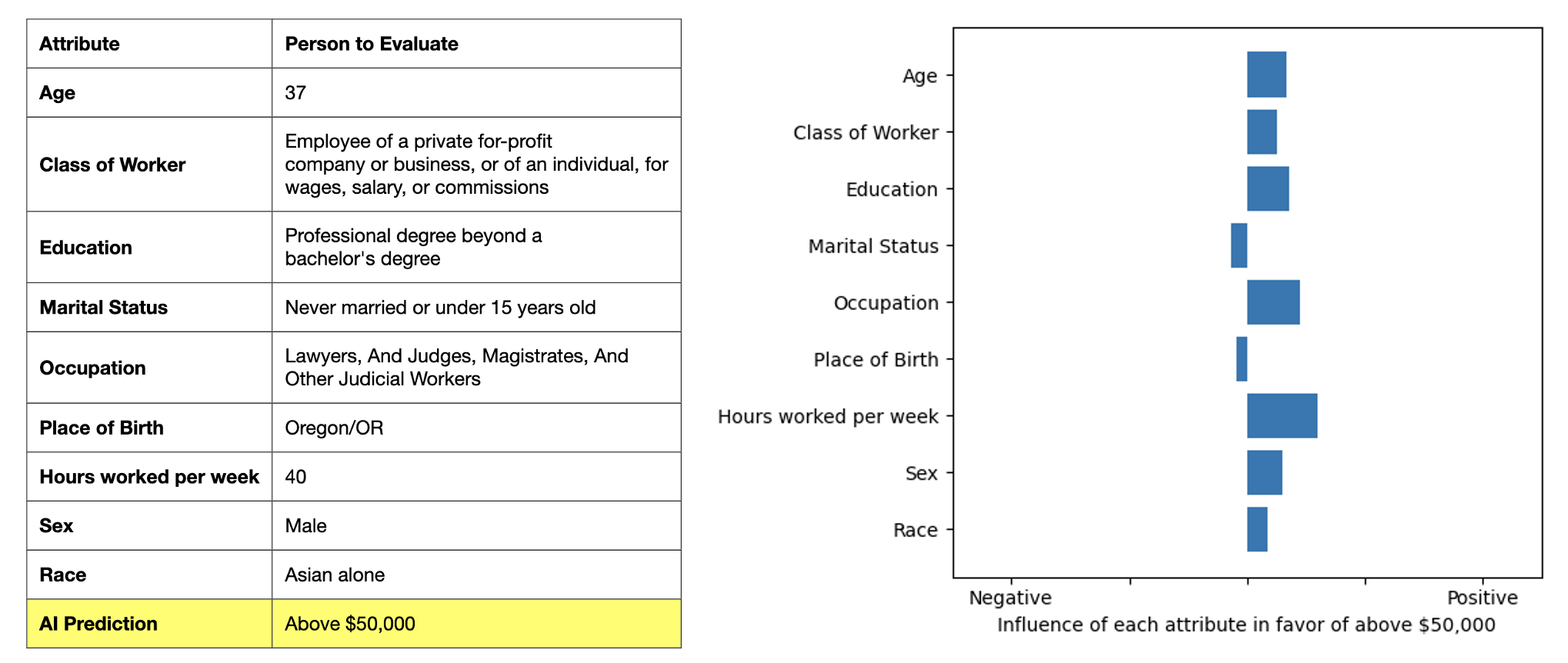
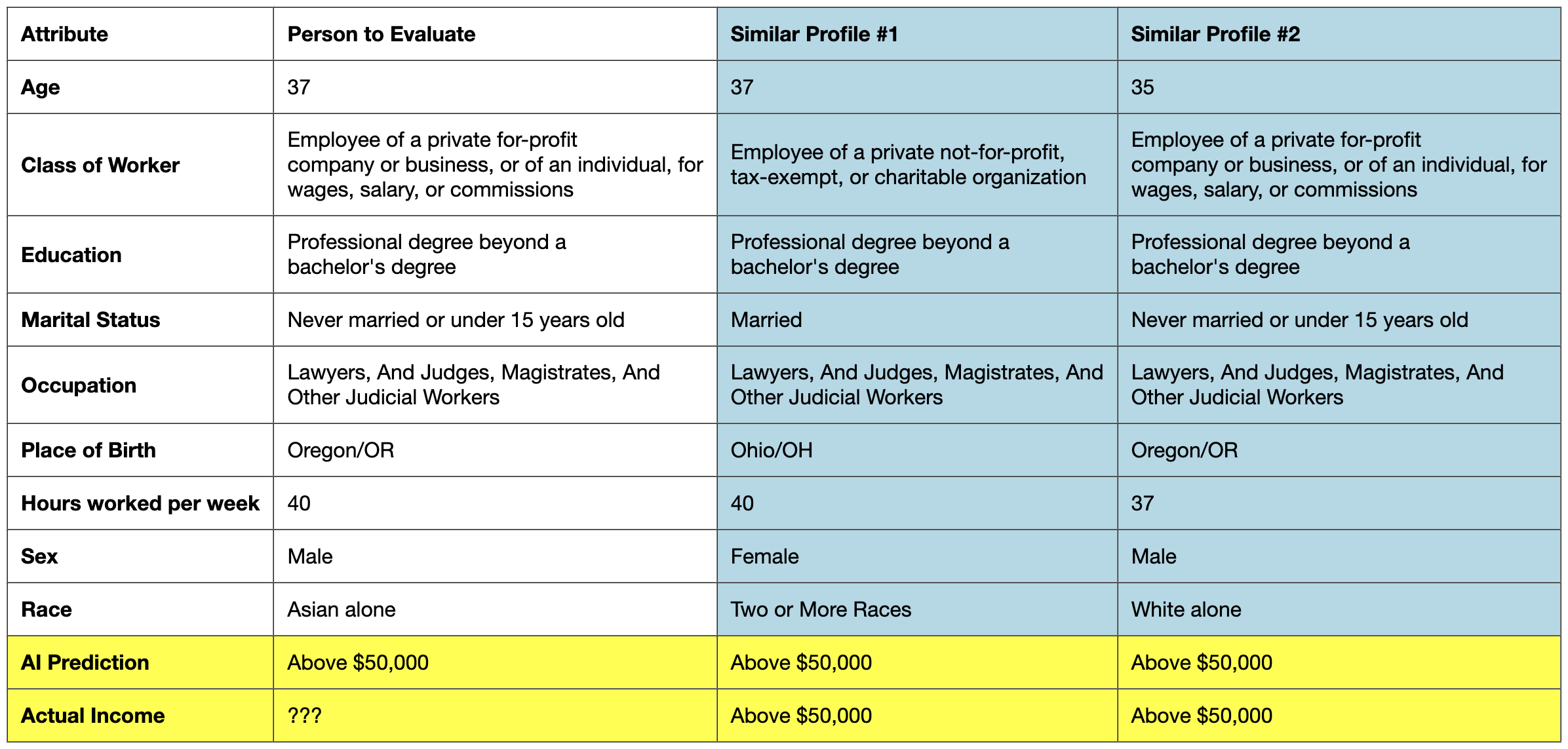
- Used two explanation types: feature-based (feature weights) and example-based (similar past cases with labels).
- Collected verbalized thought processes to analyze how participants reconciled intuition with AI predictions and explanations.
- Performed thematic analysis on think-aloud transcripts to identify recurring intuition-driven reasoning pathways.
- Compared decision outcomes and reliance behaviors between feature- and example-based explanation conditions.
- Used quantitative analysis to assess performance and overreliance, while qualitative analysis revealed cognitive pathways.
Experimental results
Research questions
- RQ1How do decision-makers reconcile their own intuition with AI predictions and explanations during human-AI decision-making?
- RQ2What types of intuition—about outcomes, features, or AI limitations—guide decision-makers in overriding incorrect AI predictions?
- RQ3Why do feature-based explanations often lead to increased overreliance on incorrect AI predictions?
- RQ4How do example-based explanations support more appropriate reliance on AI compared to feature-based explanations?
- RQ5What cognitive pathways enable effective human-AI collaboration in decision-making?
Key findings
- Three distinct intuition-driven pathways emerged: strong outcome intuition, feature-based intuition, and recognition of AI limitations through prediction unreliability signals.
- Feature-based explanations disrupted participants’ outcome intuition and conflicted with their feature-based intuition, increasing overreliance on incorrect AI predictions.
- Example-based explanations preserved natural outcome intuition, supported inductive reasoning about features, and provided clearer signals of prediction unreliability, reducing overreliance.
- Participants using example-based explanations achieved better decision outcomes and demonstrated more complementary human-AI performance than those using feature-based explanations.
- The study found that explanation effectiveness is not inherent to the explanation type alone, but depends on alignment with human intuition and cognitive processes.
- Think-aloud data revealed that participants often relied on holistic, experience-based reasoning rather than analytical interpretation of feature weights, undermining the utility of feature-based explanations.
Read this paper
Open the full text in the Nubint reader and ask about any passage as you read.
Read this paper on NubintThis review was generated by AI from the original paper. Please check the paper before citing it.