
[Paper Review] Unifying Pairwise Interactions in Complex Dynamics
This paper introduces a unified library of 237 statistics of pairwise interactions (SPIs) to integrate diverse methods for measuring dependencies in multivariate time series across disciplines. By evaluating these SPIs on 1053 real and synthetic datasets and applying them in three case studies, the authors demonstrate that combining multiple SPIs significantly improves classification performance over single-method approaches, revealing synergistic information and common theoretical structures across fields.
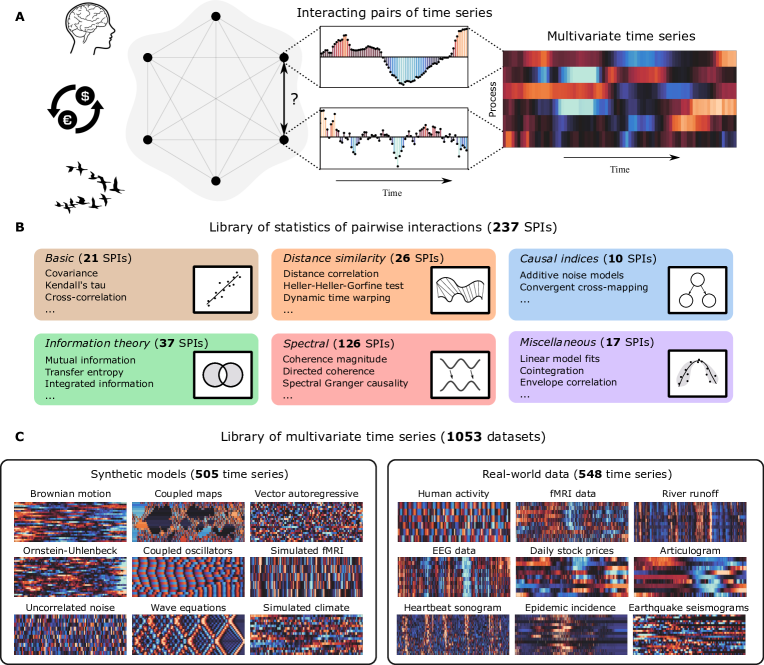
Scientists have developed hundreds of techniques to measure the interactions between pairs of processes in complex systems. But these computational methods, from correlation coefficients to causal inference, rely on distinct quantitative theories that remain largely disconnected. Here we introduce a library of 237 statistics of pairwise interactions and assess their behavior on 1053 multivariate time series from a wide range of real-world and model-generated systems. Our analysis highlights new commonalities between different mathematical formulations, providing a unified picture of a rich interdisciplinary literature. Using three real-world case studies, we then show that simultaneously leveraging diverse methods from across science can uncover those most suitable for addressing a given problem, yielding interpretable understanding of the conceptual formulations of pairwise dependence that drive successful performance. Our framework is provided in extendable open software, enabling comprehensive data-driven analysis by integrating decades of methodological advances.
Motivation & Objective
- To unify disparate statistical and computational methods for measuring pairwise interactions in complex dynamical systems.
- To assess the empirical behavior of 237 pairwise interaction statistics (SPIs) across a diverse library of 1053 multivariate time series.
- To demonstrate that combining multiple SPIs yields superior performance in real-world classification tasks compared to single-method approaches.
- To provide an open-source, extensible software toolkit enabling comprehensive, data-driven analysis of pairwise dependencies.
Proposed method
- The authors compiled 237 statistics of pairwise interactions (SPIs) from six disciplinary categories: basic, distance similarity, causal indices, information theory, spectral, and miscellaneous.
- They evaluated SPIs on a curated library of 1053 multivariate time series (MTS), including synthetic models and real-world data from neuroscience, Earth systems, and economics.
- For classification, they computed pairwise interaction matrices (MPIs) for each SPI and used upper triangular (undirected) or all non-diagonal (directed) entries as features for linear SVMs.
- SPIs with invalid or constant outputs across MTS were excluded, resulting in 219–228 usable SPIs per case study.
- They applied 30 stratified train-test splits (smartwatch and EEG) and leave-one-individual-out cross-validation (fMRI) to assess performance.
- Statistical significance was determined via permutation testing with Bonferroni correction, comparing observed accuracy to null distributions.
Experimental results
Research questions
- RQ1Do different pairwise interaction statistics capture unique or redundant information in multivariate time series?
- RQ2Can combining multiple SPIs from diverse methodological traditions improve classification performance beyond single-method approaches?
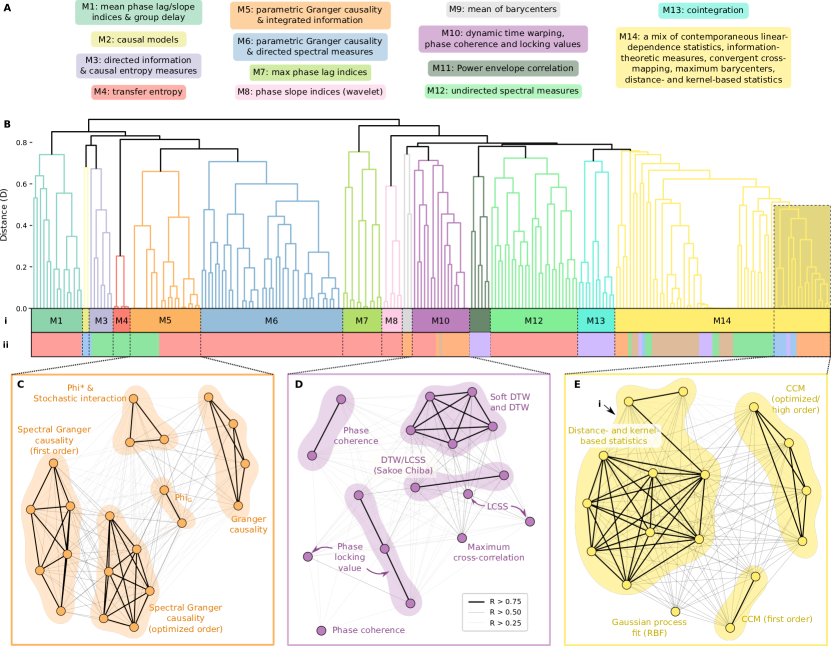
- RQ3What commonalities exist across seemingly disconnected theoretical formulations of pairwise dependence in complex systems?
- RQ4How do SPIs behave across diverse real-world and model-generated time series, and what patterns emerge in their empirical behavior?
Key findings
- The library of 237 SPIs revealed significant synergy when combined, with a union of all SPIs achieving statistically significant classification performance in all three case studies (p < 0.05 after correction).
- The combined SPI approach yielded higher classification accuracy than any individual SPI, demonstrating that diverse methods collectively capture more interpretable and robust information about underlying system dynamics.
- A total of 228, 219, and 227 usable SPIs were retained for the smartwatch activity, EEG state, and fMRI film datasets, respectively, after filtering out numerically unstable or constant results.
- The framework successfully identified that different SPIs are sensitive to distinct types of dependencies—such as lagged, nonlinear, or causal relationships—highlighting their complementary nature.
- The study demonstrated that no single method, including the widely used Pearson correlation, consistently outperformed the ensemble of SPIs across all datasets.
- The open-source toolkit (pyspi v0.4.0) enabled reproducible analysis and integration of decades of methodological advances into a single, extensible platform.
Read this paper
Open the full text in the Nubint reader and ask about any passage as you read.
Read this paper on NubintThis review was generated by AI from the original paper. Please check the paper before citing it.