
[Paper Review] Unleashing the Power of Data Tsunami: A Comprehensive Survey on Data Assessment and Selection for Instruction Tuning of Language Models
This survey proposes a unified, fine-grained taxonomy for data assessment and selection in instruction tuning of large language models (LLMs), categorizing methods into quality-based, diversity-based, and importance-based approaches. It reviews representative techniques, compares their performance on standard benchmarks, and identifies key challenges and future directions for efficient, scalable data curation in LLM training.
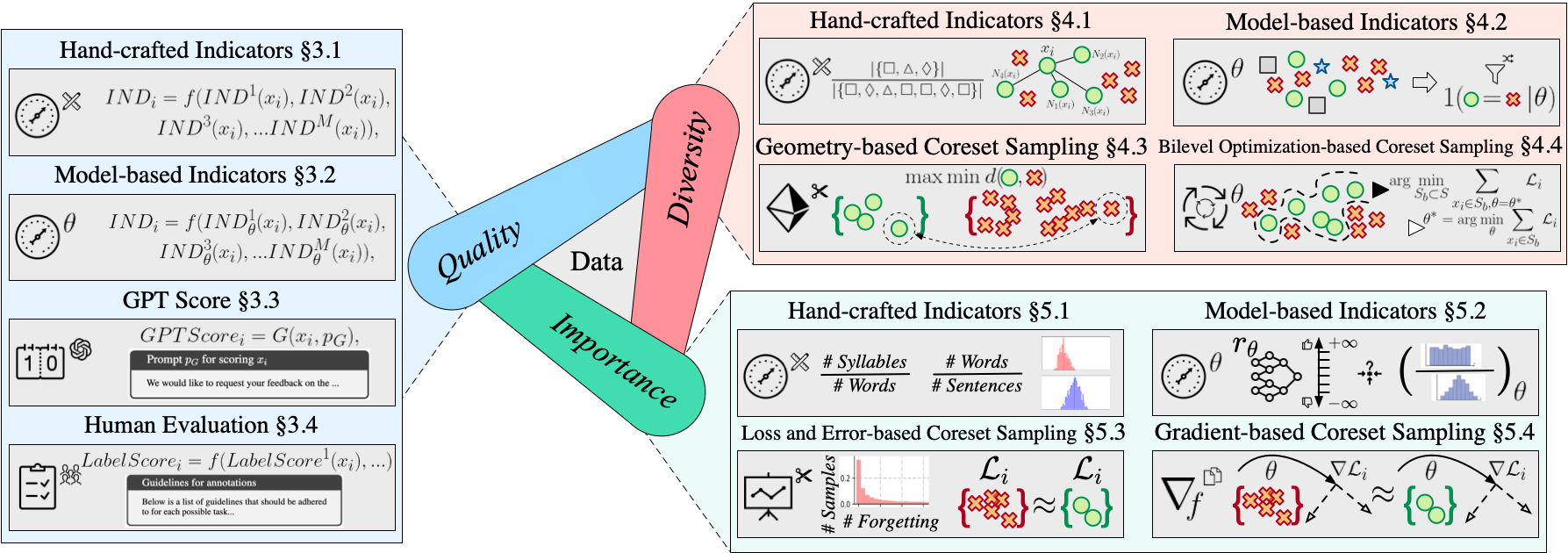
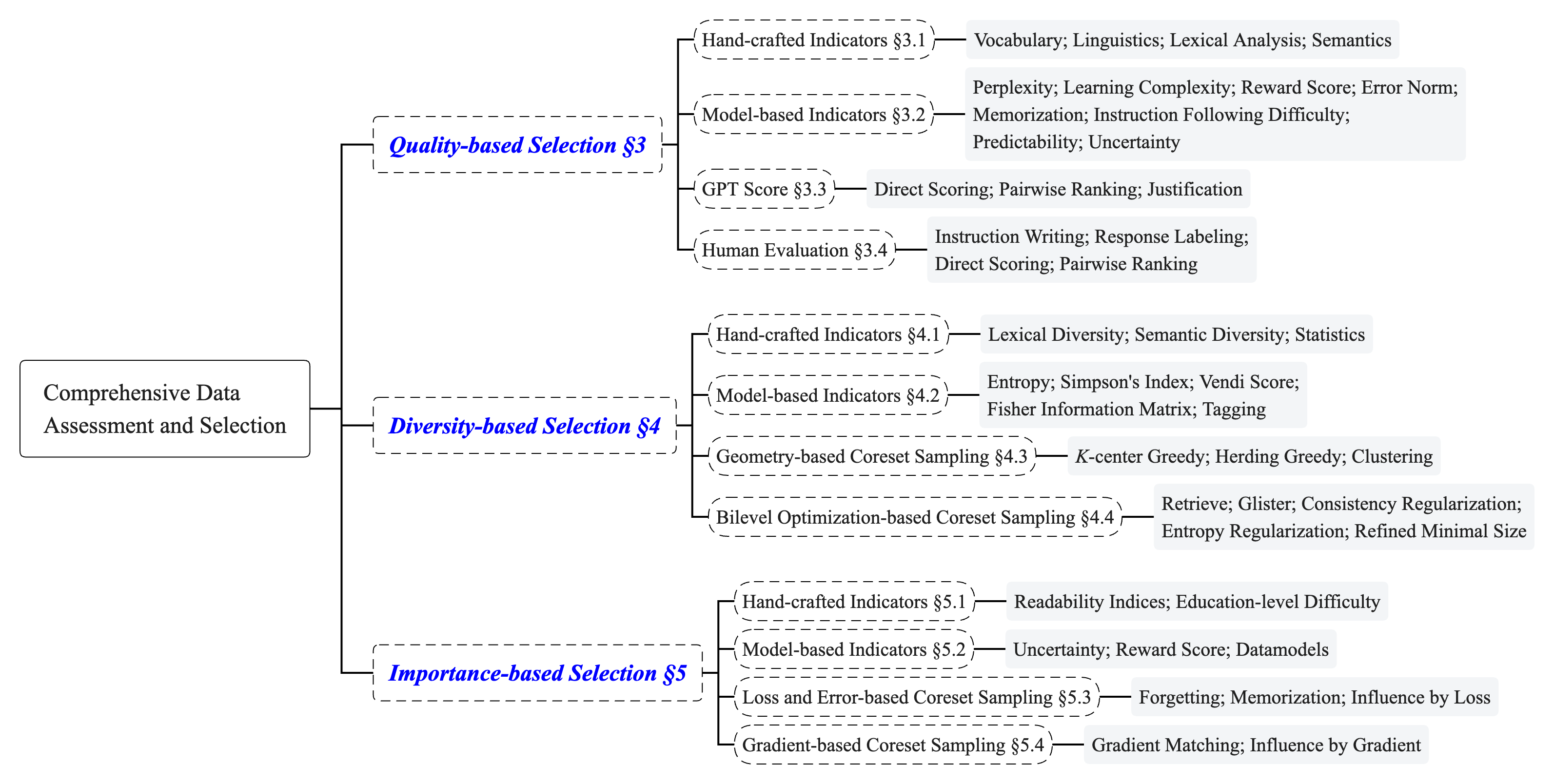
Instruction tuning plays a critical role in aligning large language models (LLMs) with human preference. Despite the vast amount of open instruction datasets, naively training a LLM on all existing instructions may not be optimal and practical. To pinpoint the most beneficial datapoints, data assessment and selection methods have been proposed in the fields of natural language processing (NLP) and deep learning. However, under the context of instruction tuning, there still exists a gap in knowledge on what kind of data evaluation metrics can be employed and how they can be integrated into the selection mechanism. To bridge this gap, we present a comprehensive review on existing literature of data assessment and selection especially for instruction tuning of LLMs. We systematically categorize all applicable methods into quality-based, diversity-based, and importance-based ones where a unified, fine-grained taxonomy is structured. For each category, representative methods are elaborated to describe the landscape of relevant research. In addition, comparison between the latest methods is conducted on their officially reported results to provide in-depth discussions on their limitations. Finally, we summarize the open challenges and propose the promosing avenues for future studies. All related contents are available at https://github.com/yuleiqin/fantastic-data-engineering.
Motivation & Objective
- To address the gap in understanding which data evaluation metrics and selection mechanisms are most effective for instruction tuning of LLMs.
- To systematically organize existing data assessment and selection methods into a unified, fine-grained taxonomy centered on quality, diversity, and importance.
- To compare state-of-the-art data selection methods using officially reported results to identify strengths, limitations, and performance trade-offs.
- To highlight open challenges in applying these methods to large-scale and mixture-of-experts (MoE) LLMs, especially regarding generalizability and scalability.
- To guide future research by proposing promising avenues, including evaluation on 70B and 405B parameter models and MoE architectures.
Proposed method
- Categorizes data assessment and selection methods into three core dimensions: quality (e.g., instruction clarity, task completeness), diversity (e.g., task, domain, and instruction type coverage), and importance (e.g., model performance gain from inclusion).
- Reviews representative methods within each category, such as loss-based influence estimation, gradient matching, submodular optimization, and proxy model-based selection.
- Integrates insights from statistical learning theory and deep learning coreset selection, adapting techniques like greedy batch sampling and low-rank approximations (e.g., PCA, random projection) for efficient metric computation.
- Employs proxy models—smaller LLMs with similar architecture but fewer parameters—to predict data utility and guide selection without full fine-tuning.
- Applies dimensionality reduction and optimization tricks (e.g., iterative sampling, approximation of influence scores) to reduce computational cost in large-scale data assessment.
- Proposes a framework for evaluating data selection pipelines across model scales, emphasizing the need for validation on large LLMs (e.g., 70B, 405B) and MoE models.
Experimental results
Research questions
- RQ1Which data assessment metrics are most effective for identifying high-quality instruction data in LLM instruction tuning?
- RQ2How do diversity-based and importance-based selection strategies compare in terms of downstream performance and generalization across different model scales?
- RQ3To what extent do data selection methods designed for small LLMs (e.g., <7B parameters) generalize to large-scale models (e.g., 70B, 405B) or MoE architectures?
- RQ4What are the limitations of current proxy models and approximation techniques in accurately predicting data utility for instruction tuning?
- RQ5How do scaling laws and model architecture influence the relative importance of quality, diversity, and importance in data selection?
Key findings
- Quality-based methods such as loss-based influence estimation and gradient matching show strong performance in identifying high-impact training examples, especially in low-resource settings.
- Diversity-based selection strategies, including submodular optimization and domain-aware sampling, improve model generalization and reduce overfitting on specialized tasks.
- Importance-based methods using proxy models achieve competitive performance with significantly reduced computational cost, making them suitable for large-scale data curation.
- Performance gains from data selection diminish in larger LLMs (e.g., 70B and 405B), suggesting that selection criteria may need to be re-evaluated for high-parameter models.
- Small LLMs are more sensitive to data quality and selection, showing immediate performance improvements, while large models exhibit weaker responses to the same selection pipelines.
- Current benchmarks and evaluations are largely limited to small and moderate-sized models, highlighting a critical gap in validating selection methods on state-of-the-art LLMs.
Read this paper
Open the full text in the Nubint reader and ask about any passage as you read.
Read this paper on NubintThis review was generated by AI from the original paper. Please check the paper before citing it.