
[Paper Review] Unsupervised Deep Anomaly Detection for Multi-Sensor Time-Series Signals
This paper proposes CAE-M, a novel unsupervised deep learning model for anomaly detection in multi-sensor time-series data by jointly modeling spatial and temporal dependencies. It combines a deep convolutional autoencoder with MMD regularization and a hybrid memory network using autoregressive and attention-based bidirectional LSTM components, achieving state-of-the-art performance on HAR and HC datasets with robustness to noisy data.
Nowadays, multi-sensor technologies are applied in many fields, e.g., Health Care (HC), Human Activity Recognition (HAR), and Industrial Control System (ICS). These sensors can generate a substantial amount of multivariate time-series data. Unsupervised anomaly detection on multi-sensor time-series data has been proven critical in machine learning researches. The key challenge is to discover generalized normal patterns by capturing spatial-temporal correlation in multi-sensor data. Beyond this challenge, the noisy data is often intertwined with the training data, which is likely to mislead the model by making it hard to distinguish between the normal, abnormal, and noisy data. Few of previous researches can jointly address these two challenges. In this paper, we propose a novel deep learning-based anomaly detection algorithm called Deep Convolutional Autoencoding Memory network (CAE-M). We first build a Deep Convolutional Autoencoder to characterize spatial dependence of multi-sensor data with a Maximum Mean Discrepancy (MMD) to better distinguish between the noisy, normal, and abnormal data. Then, we construct a Memory Network consisting of linear (Autoregressive Model) and non-linear predictions (Bidirectional LSTM with Attention) to capture temporal dependence from time-series data. Finally, CAE-M jointly optimizes these two subnetworks. We empirically compare the proposed approach with several state-of-the-art anomaly detection methods on HAR and HC datasets. Experimental results demonstrate that our proposed model outperforms these existing methods.
Motivation & Objective
- To address the challenge of unsupervised anomaly detection in multi-sensor time-series data where anomalies are rare and unlabeled.
- To jointly model spatial and temporal dependencies in multivariate time-series signals to capture generalized normal patterns.
- To improve robustness against noisy data during training, which can otherwise mislead models into treating noise as normal.
- To overcome limitations of two-step or separately trained models by jointly optimizing feature extraction and forecasting components.
- To develop a composite anomaly detection framework that integrates reconstruction and prediction errors into a unified score for fine-grained detection.
Proposed method
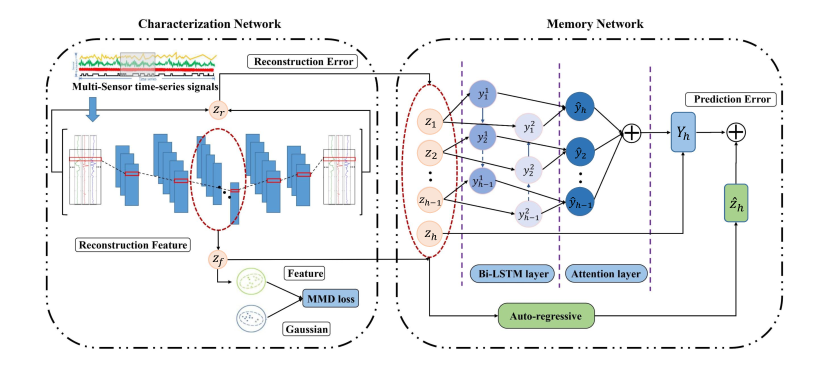
- The model uses a deep convolutional autoencoder (CAE) with Maximum Mean Discrepancy (MMD) regularization to learn robust representations and reduce overfitting to noise and anomalies in training data.
- A memory network is constructed with two parallel branches: a linear autoregressive model and a non-linear bidirectional LSTM with self-attention for temporal forecasting.
- The CAE-M model jointly optimizes reconstruction loss from the CAE, prediction loss from the autoregressive model, and prediction loss from the attention-based BiLSTM.
- Anomaly scores are computed as a compound objective function combining reconstruction and prediction errors, enabling fine-grained anomaly detection.
- The model is trained end-to-end to minimize the composite loss, enhancing generalization and robustness to data noise.
- Hyperparameter sensitivity and convergence are evaluated using control variate reduction and iterative training analysis on multiple datasets.
Experimental results
Research questions
- RQ1Can a unified deep learning framework effectively model both spatial and temporal dependencies in multi-sensor time-series data for unsupervised anomaly detection?
- RQ2How does incorporating MMD regularization improve model robustness to noisy training data in anomaly detection?
- RQ3What is the relative contribution of autoregressive modeling versus attention-based BiLSTM in capturing temporal dynamics for anomaly detection?
- RQ4Does joint optimization of feature extraction and forecasting components lead to better performance than separate training of subnetworks?
- RQ5How sensitive is the model’s performance to hyperparameter choices, particularly the weighting of reconstruction and prediction losses?
Key findings
- CAE-M outperforms state-of-the-art methods on HAR and healthcare (HC) datasets, demonstrating superior detection performance in terms of F1, precision, and recall.
- The ablation study shows that removing the autoregressive component (CAE-M w/o AR) causes a significant performance drop, confirming its critical role in modeling temporal dynamics.
- The attention mechanism and MMD regularization each contribute substantially to performance gains across all datasets, with MMD being especially effective in reducing overfitting to noise.
- CAE-M maintains stable performance under increasing noise levels (up to 30% Gaussian noise), showing strong robustness compared to UODA and ConvLSTM-COMPOSITE.
- The model converges within fewer than 40 training iterations across all datasets, indicating fast and stable training.
- Parameter sensitivity analysis reveals that the model remains robust across a wide range of hyperparameter values, with optimal weights found at λ₁ = 1e-4, λ₂ = 0.5, λ₃ = 0.5.

Read this paper
Open the full text in the Nubint reader and ask about any passage as you read.
Read this paper on NubintThis review was generated by AI from the original paper. Please check the paper before citing it.