
[Paper Review] Unsupervised Discovery of Semantic Latent Directions in Diffusion Models
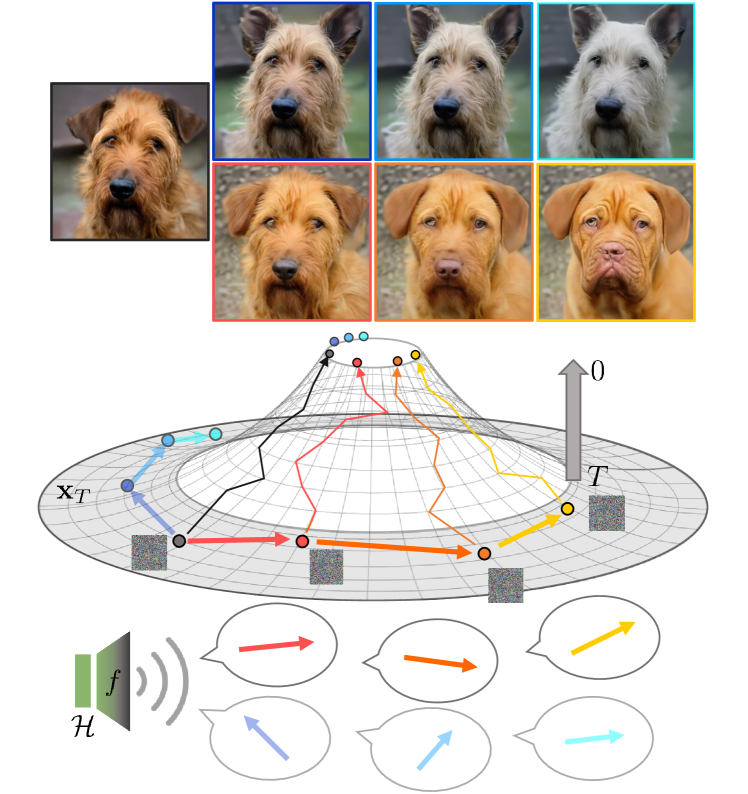
This paper proposes an unsupervised method to discover interpretable, globally consistent semantic latent directions in the latent space of diffusion models using Riemannian geometry between the latent variables $\mathbf{x}_t$ and intermediate U-Net features $\mathcal{H}$. By decomposing the Jacobian of the encoder mapping from $\mathbf{x}_t$ to $\mathcal{H}$, the method identifies disentangled editing directions that manipulate attributes coherently across samples, even in models like Stable Diffusion, revealing that early timesteps control coarse features and later timesteps refine high-frequency details.
Despite the success of diffusion models (DMs), we still lack a thorough understanding of their latent space. While image editing with GANs builds upon latent space, DMs rely on editing the conditions such as text prompts. We present an unsupervised method to discover interpretable editing directions for the latent variables $\mathbf{x}_t \in \mathcal{X}$ of DMs. Our method adopts Riemannian geometry between $\mathcal{X}$ and the intermediate feature maps $\mathcal{H}$ of the U-Nets to provide a deep understanding over the geometrical structure of $\mathcal{X}$. The discovered semantic latent directions mostly yield disentangled attribute changes, and they are globally consistent across different samples. Furthermore, editing in earlier timesteps edits coarse attributes, while ones in later timesteps focus on high-frequency details. We define the curvedness of a line segment between samples to show that $\mathcal{X}$ is a curved manifold. Experiments on different baselines and datasets demonstrate the effectiveness of our method even on Stable Diffusion. Our source code will be publicly available for the future researchers.
Motivation & Objective
- To address the lack of interpretability and control in the latent space of diffusion models, which currently rely on conditional prompting rather than latent space editing.
- To discover globally consistent, interpretable editing directions in the latent space $\mathbf{x}_t$ of diffusion models without requiring attribute annotations or external supervision.
- To understand the geometric structure of the latent space $\mathcal{X}$, particularly its curvature and how it relates to hierarchical feature generation across timesteps.
- To enable semantic image editing in pretrained, frozen diffusion models by identifying meaningful directions in $\mathbf{x}_t$ that yield coherent attribute changes.
- To demonstrate that the method generalizes to state-of-the-art models like Stable Diffusion, despite their complex architecture and conditional guidance.
Proposed method
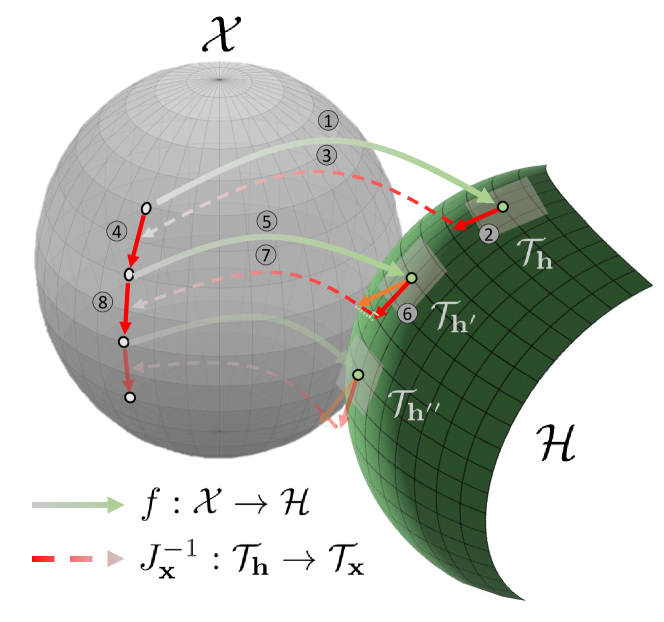
- The method uses Riemannian geometry to relate the latent variables $\mathbf{x}_t$ to the intermediate feature maps $\mathcal{H}$ of the U-Net, treating $\mathcal{H}$ as a Riemannian manifold.
- It computes the Jacobian of the encoder mapping from $\mathbf{x}_t$ to $\mathcal{H}$ and applies singular value decomposition (SVD) to extract principal directions that maximize changes in $\mathcal{H}$.
- Global semantic directions are derived by averaging local tangent-space directions across multiple samples, ensuring consistency and generalizability.
- The method normalizes the direction vectors using a geometric mean to prevent saturation and ensure stable editing across extreme perturbations.
- It leverages spherical linear interpolation (slerp) in $\mathbf{x}_t$ space, which approximates geodesics in $\mathcal{H}$, indicating that $\mathcal{X}$ is a curved manifold.
- The approach is applied end-to-end to various diffusion model architectures, including Stable Diffusion, without finetuning or access to training data.
Experimental results
Research questions
- RQ1Can we discover globally consistent, interpretable editing directions in the latent space $\mathbf{x}_t$ of diffusion models without any supervision or attribute annotations?
- RQ2How does the geometric structure of the latent space $\mathcal{X}$, particularly its curvature, affect the generation process and editing behavior?
- RQ3Do early and late timesteps in the diffusion process correspond to coarse and fine-grained attribute manipulation, respectively?
- RQ4How do the discovered directions compare to existing methods like GANSpace in terms of disentanglement and visual quality?
- RQ5To what extent does the method generalize to complex, conditional diffusion models like Stable Diffusion?
Key findings
- The method discovers semantic latent directions in $\mathbf{x}_t$ that lead to coherent, disentangled attribute changes—such as age, expression, and hair length—without any attribute supervision.
- The discovered directions are globally consistent: the same direction applied to different samples produces similar semantic edits, enabling general-purpose image editing.
- Editing in earlier timesteps primarily affects low-frequency components (e.g., overall shape, pose), while later timesteps refine high-frequency details (e.g., texture, facial features).
- The latent space $\mathbf{x}_t$ is geometrically curved, as evidenced by the non-zero curvedness of line segments between samples, and spherical interpolation in $\mathbf{x}_t$ approximates geodesics in $\mathcal{H}$.
- The method outperforms GANSpace when applied to the feature space $\mathcal{H}$, producing less distortion and better disentanglement, even though GANSpace is designed for GANs.
- The method works effectively on Stable Diffusion, though it discovers fewer semantic directions and occasionally exhibits abrupt changes, suggesting a more complex latent manifold in this model.
Read this paper
Open the full text in the Nubint reader and ask about any passage as you read.
Read this paper on NubintThis review was generated by AI from the original paper. Please check the paper before citing it.