
[Paper Review] URET: Universal Robustness Evaluation Toolkit (for Evasion)
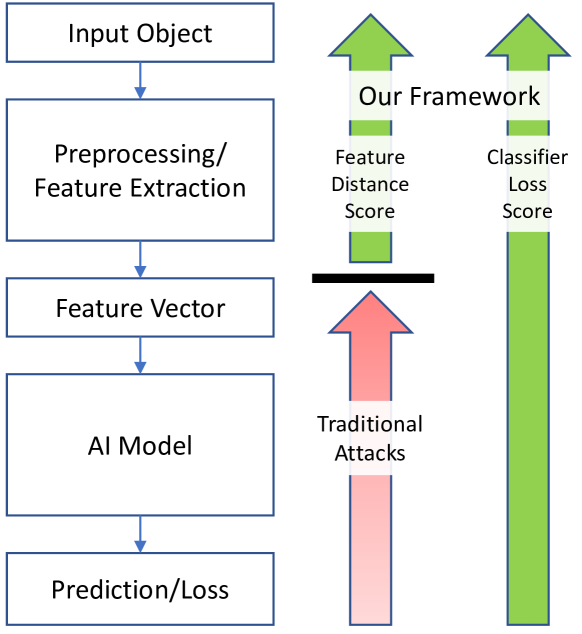
URET is a universal framework for generating semantically correct and functional adversarial inputs across diverse AI system modalities by modeling adversarial example generation as a graph exploration problem over domain-specific, functionality-preserving transformations. It enables effective evasion attacks on non-image inputs—such as malware binaries—achieving a 58% average detection rate on VirusTotal, demonstrating transferability and practical impact beyond image-based attacks.
Machine learning models are known to be vulnerable to adversarial evasion attacks as illustrated by image classification models. Thoroughly understanding such attacks is critical in order to ensure the safety and robustness of critical AI tasks. However, most evasion attacks are difficult to deploy against a majority of AI systems because they have focused on image domain with only few constraints. An image is composed of homogeneous, numerical, continuous, and independent features, unlike many other input types to AI systems used in practice. Furthermore, some input types include additional semantic and functional constraints that must be observed to generate realistic adversarial inputs. In this work, we propose a new framework to enable the generation of adversarial inputs irrespective of the input type and task domain. Given an input and a set of pre-defined input transformations, our framework discovers a sequence of transformations that result in a semantically correct and functional adversarial input. We demonstrate the generality of our approach on several diverse machine learning tasks with various input representations. We also show the importance of generating adversarial examples as they enable the deployment of mitigation techniques.
Motivation & Objective
- Address the lack of generalizable adversarial attack frameworks for non-image AI systems with complex input structures.
- Overcome limitations of gradient-based attacks that rely on differentiable, continuous, and independent features—common in images but not in real-world data like binaries or tabular features.
- Enable practical adversarial testing for safety-critical AI systems by generating semantically correct and functionally valid adversarial inputs across diverse domains.
- Provide a reusable, extensible toolkit that supports custom transformations and integrates into evaluation and mitigation pipelines for robust AI development.
- Demonstrate the effectiveness of adversarial transferability in real-world detection systems, such as VirusTotal, to highlight practical risks and the need for robust defenses.
Proposed method
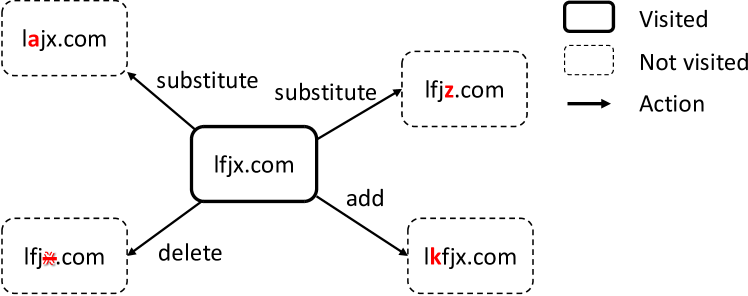
- Model adversarial input generation as a graph exploration problem, where nodes represent inputs and edges represent domain-specific transformations.
- Define a set of pre-configured, functionality- and semantic-preserving transformations for common data types (e.g., images, text, binaries, tabular data).
- Expose a pluggable transformation interface allowing users to define custom transformations for unsupported data types using domain-specific knowledge.
- Use beam search with configurable depth and width to explore sequences of transformations that maximize adversarial success while maintaining input validity.
- Leverage adversarial transferability by evaluating generated examples on multiple models and detection systems to assess generalization and real-world impact.
- Abstract low-level implementation details via configuration files, enabling easy customization across different machine learning tasks and input representations.
Experimental results
Research questions
- RQ1Can a universal framework generate adversarial inputs that are both semantically correct and functionally valid across diverse AI input modalities beyond images?
- RQ2How effective is the graph-based exploration of transformation sequences in generating adversarial examples that evade detection in real-world systems?
- RQ3To what extent do adversarial examples generated by URET transfer across different detection models, such as those in VirusTotal?
- RQ4How does adversarial training on image-based adversarial features compare to training on functionally valid adversarial inputs generated by URET in terms of robustness?
- RQ5Can the framework be extended to new data types through user-defined transformations without requiring changes to the core toolkit?
Key findings
- URET successfully generated 38 adversarial malware binaries using a beam width of 5 and depth of 3, demonstrating feasibility in complex binary input spaces.
- The average detection rate of adversarial malware binaries on VirusTotal dropped from 82% (original) to 58%, with one detector flagging only 6% as malicious.
- Precision and recall metrics across six anonymized VirusTotal scanners showed significant degradation, with recall dropping from 100% to as low as 28% on some detectors.
- Adversarial training on image-based adversarial features was ineffective against functionally valid adversarial inputs generated by URET, highlighting the limitations of current defense strategies.
- The framework achieved high effectiveness across diverse tasks—including malware detection, HMDA credit risk prediction, and image classification—using minimal configuration changes.
- Adversarial examples generated by URET exhibited strong transferability, successfully evading multiple detection systems, which underscores the real-world threat of such attacks.
Read this paper
Open the full text in the Nubint reader and ask about any passage as you read.
Read this paper on NubintThis review was generated by AI from the original paper. Please check the paper before citing it.