
[Paper Review] Using Large Language Models for Zero-Shot Natural Language Generation from Knowledge Graphs
This paper evaluates zero-shot knowledge graph-to-text generation using large language models (LLMs), specifically OpenAI's ChatGPT, without fine-tuning. It finds that while ChatGPT achieves near state-of-the-art performance on some WebNLG 2020 metrics, its performance varies significantly based on the factualness of triples—performing best on factual, worse on counter-factual, and worst on fictional statements—highlighting a strong link between model knowledge and generation quality.
In any system that uses structured knowledge graph (KG) data as its underlying knowledge representation, KG-to-text generation is a useful tool for turning parts of the graph data into text that can be understood by humans. Recent work has shown that models that make use of pretraining on large amounts of text data can perform well on the KG-to-text task even with relatively small sets of training data on the specific graph-to-text task. In this paper, we build on this concept by using large language models to perform zero-shot generation based on nothing but the model's understanding of the triple structure from what it can read. We show that ChatGPT achieves near state-of-the-art performance on some measures of the WebNLG 2020 challenge, but falls behind on others. Additionally, we compare factual, counter-factual and fictional statements, and show that there is a significant connection between what the LLM already knows about the data it is parsing and the quality of the output text.
Motivation & Objective
- To investigate the feasibility of zero-shot knowledge graph-to-text generation using large language models without task-specific fine-tuning.
- To assess how the factualness of knowledge graph triples—factual, counter-factual, or fictional—affects LLM generation quality.
- To evaluate grammatical coherence, triple coverage, and hallucination rates in LLM-generated text from KGs.
- To determine whether LLMs' pretraining knowledge enhances or hinders accurate expression of arbitrary KG information.
- To provide insights into the limitations and potential of LLMs for open-domain, zero-shot NLG from structured data.
Proposed method
- Utilizes OpenAI's GPT-3.5-turbo (ChatGPT) for zero-shot generation from knowledge graph triples without any fine-tuning.
- Presents triples in a natural language prompt format, relying solely on the LLM’s understanding of triple structure and pretraining.
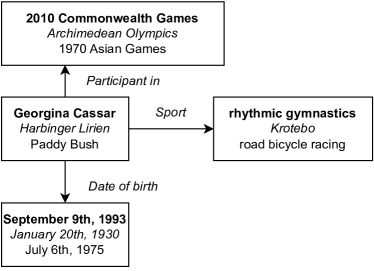
- Evaluates performance on the WebNLG 2020 benchmark and a newly collected WikiData-based dataset with factual, counter-factual, and fictional triples.
- Employs human annotation via Mechanical Turk to assess grammatical coherence, triple coverage, and hallucination rates.
- Compares model outputs against reference texts using automatic metrics and manual judgments for factual consistency.
- Conducts ablation studies on prompt design and evaluates model behavior across different types of knowledge graph statements.
Experimental results
Research questions
- RQ1How does the performance of LLMs on zero-shot KG-to-text generation compare to state-of-the-art fine-tuned models on the WebNLG 2020 benchmark?
- RQ2How does the factualness of KG triples (factual, counter-factual, fictional) influence the grammatical quality and coherence of LLM-generated text?
- RQ3To what extent do LLMs cover all input triples in their generated text, and how does this vary by triple type?
- RQ4How frequently do LLMs generate hallucinated content (i.e., facts not present in the input triples), and does this vary by factualness?
- RQ5What is the relationship between the LLM’s pretraining knowledge and its ability to accurately express KG data?
Key findings
- ChatGPT achieves near state-of-the-art performance on certain automatic metrics in the WebNLG 2020 challenge, indicating strong zero-shot generalization.
- Performance varies significantly by triple type: factual triples are generated with highest accuracy, counter-factual next, and fictional triples with the lowest coverage and highest hallucination rates.
- There is a strong correlation between the LLM’s pretraining knowledge and the quality of generated text, particularly for factual statements.
- Hallucination rates are higher for counter-factual and fictional triples, suggesting LLMs struggle to generate text when the input contradicts their world knowledge.
- Triple coverage is lowest for fictional statements, indicating that LLMs may fail to generate text even when instructed to do so.
- The study identifies that prompt design significantly affects performance, though no optimal prompt was identified, and that model behavior is sensitive to input type and factual consistency.
Read this paper
Open the full text in the Nubint reader and ask about any passage as you read.
Read this paper on NubintThis review was generated by AI from the original paper. Please check the paper before citing it.