
[Paper Review] Using VAEs to Learn Latent Variables: Observations on Applications in cryo-EM
This paper investigates the amortized inference properties of variational autoencoders (VAEs) in cryo-EM applications, particularly for modeling continuous conformational heterogeneity. It finds that the VAE encoder in CryoDRGN does not generalize well to rotated or translated particle images—suggesting overfitting to noise features—while explicit latent variable estimation performs comparably or better, challenging assumptions about VAE generalization in scientific imaging.
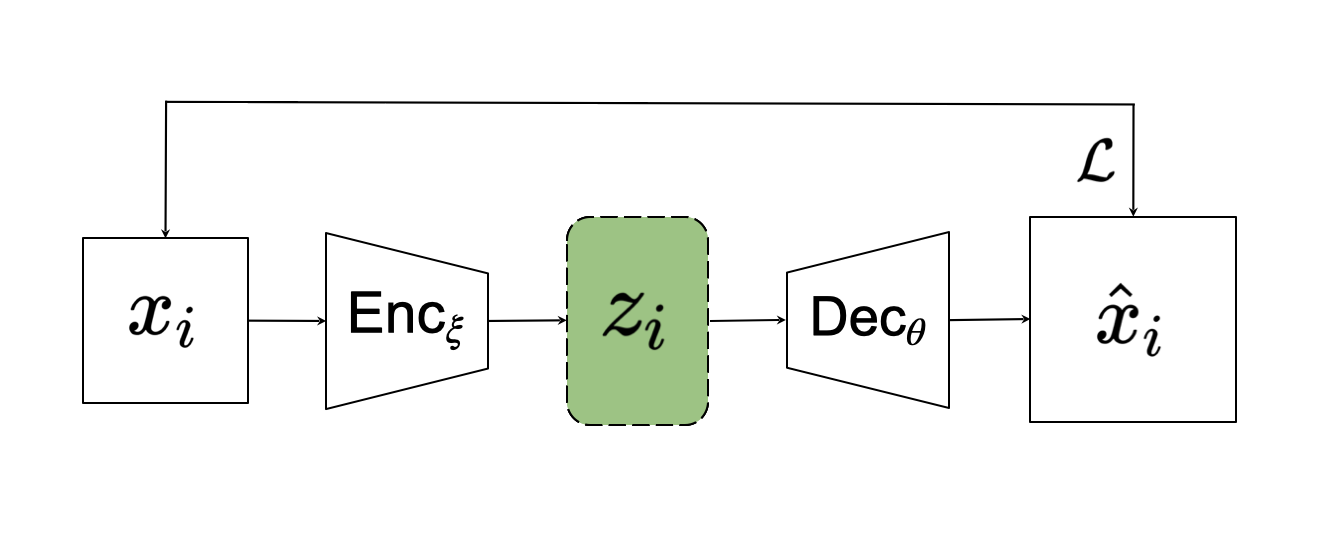
Variational autoencoders (VAEs) are a popular generative model used to approximate distributions. The encoder part of the VAE is used in amortized learning of latent variables, producing a latent representation for data samples. Recently, VAEs have been used to characterize physical and biological systems. In this case study, we qualitatively examine the amortization properties of a VAE used in biological applications. We find that in this application the encoder bears a qualitative resemblance to more traditional explicit representation of latent variables.
Motivation & Objective
- To evaluate whether the amortized encoder in a VAE generalizes well to unseen or augmented cryo-EM particle images.
- To compare the performance of VAE-based amortized inference with explicit variational estimation of latent variables in cryo-EM data.
- To investigate whether the encoder in CryoDRGN overfits to noise or structural artifacts rather than capturing true conformational variability.
- To assess the impact of data invariances (e.g., rotation, translation) on VAE generalization in high-noise biological imaging.
- To explore whether VAEs in scientific applications like cryo-EM may behave more like explicit latent variable models than commonly assumed.
Proposed method
- Trained a VAE on cryo-EM particle images using the CryoDRGN framework, with a shared encoder network producing Gaussian latent distributions for each input.
- Applied data augmentation via in-plane rotations and translations to test generalization, leveraging known invariances in cryo-EM data as a proxy for unseen data.
- Compared the VAE encoder’s latent representations of augmented images to those of original images to assess consistency and generalization.
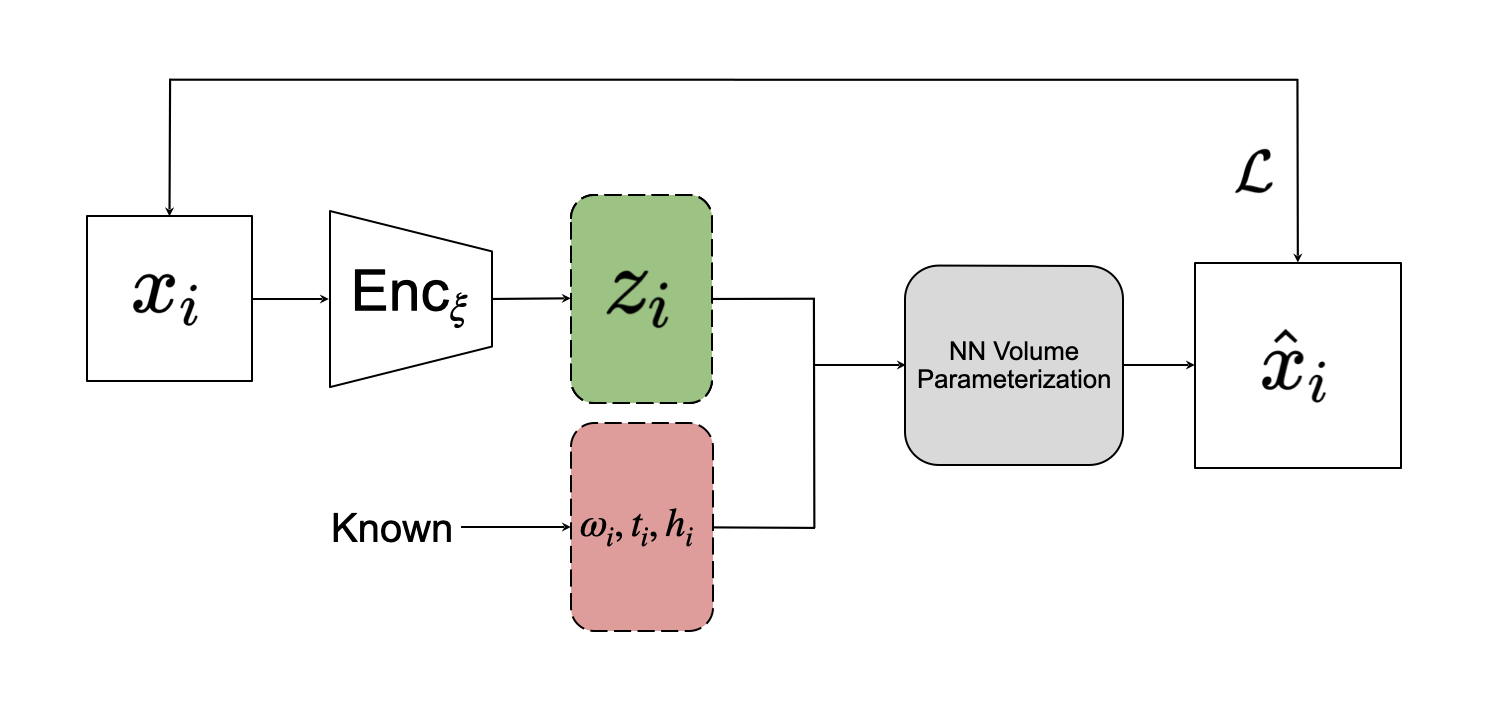
- Used explicit variational inference by fitting separate latent distributions per particle image, avoiding shared encoder parameters.
- Evaluated performance using qualitative comparisons of latent space structure and consistency across augmented views.
- Conducted ablation experiments using MNIST VAEs in Appendix B to provide a baseline for comparison in a standard deep learning setting.
Experimental results
Research questions
- RQ1Does the VAE encoder in cryo-EM generalize well to rotated or translated particle images not seen during training?
- RQ2How does the performance of amortized inference via a shared encoder compare to explicit estimation of latent variables in cryo-EM?
- RQ3To what extent does the VAE encoder overfit to noise or structural artifacts in cryo-EM data rather than capturing true conformational states?
- RQ4Are the generalization failures in cryo-EM VAEs due to high noise levels and image variability, or architectural limitations?
- RQ5Can explicit latent variable estimation yield qualitatively better or more robust representations than amortized VAEs in this context?
Key findings
- The VAE encoder in CryoDRGN does not generalize well to rotated or translated particle images, indicating poor generalization to natural data augmentations.
- The encoder’s latent representations for augmented images differ significantly from those of the original images, suggesting overfitting to noise or image-specific features.
- Explicit latent variable estimation (without shared encoder parameters) yields qualitatively similar or better performance than the amortized VAE in the same task.
- The lack of architectural invariance in CryoDRGN (e.g., no rotation invariance) may contribute to poor generalization, though such invariance is not guaranteed to fully resolve the issue.
- The VAE encoder’s behavior in cryo-EM resembles that of explicit latent variable models more than expected, challenging assumptions about the advantages of amortized inference.
- In contrast to MNIST VAEs, where generalization is more robust, the cryo-EM case shows that high noise and image variability can undermine VAE generalization despite successful model training.
Read this paper
Open the full text in the Nubint reader and ask about any passage as you read.
Read this paper on NubintThis review was generated by AI from the original paper. Please check the paper before citing it.