
[Paper Review] VampNet: Music Generation via Masked Acoustic Token Modeling
VampNet is a non-autoregressive, bidirectional transformer model that generates high-fidelity music by predicting masked acoustic tokens using parallel iterative decoding. It enables flexible music generation, compression, inpainting, and variation through diverse prompting strategies, achieving state-of-the-art FAD scores with just 36 sampling steps on an NVIDIA RTX3090.
We introduce VampNet, a masked acoustic token modeling approach to music synthesis, compression, inpainting, and variation. We use a variable masking schedule during training which allows us to sample coherent music from the model by applying a variety of masking approaches (called prompts) during inference. VampNet is non-autoregressive, leveraging a bidirectional transformer architecture that attends to all tokens in a forward pass. With just 36 sampling passes, VampNet can generate coherent high-fidelity musical waveforms. We show that by prompting VampNet in various ways, we can apply it to tasks like music compression, inpainting, outpainting, continuation, and looping with variation (vamping). Appropriately prompted, VampNet is capable of maintaining style, genre, instrumentation, and other high-level aspects of the music. This flexible prompting capability makes VampNet a powerful music co-creation tool. Code and audio samples are available online.
Motivation & Objective
- To develop a non-autoregressive music generation model that supports diverse audio manipulation tasks like compression, inpainting, and variation.
- To enable efficient, high-quality audio synthesis using parallel iterative decoding on discrete acoustic tokens.
- To explore the effectiveness of various prompting strategies—periodic, beat-driven, and inpainting—for controlling generation behavior.
- To demonstrate that masked token modeling with bidirectional attention can produce coherent, stylistically consistent music without autoregressive generation.
- To provide a flexible, open-source tool for music co-creation and audio manipulation via prompt-based control.
Proposed method
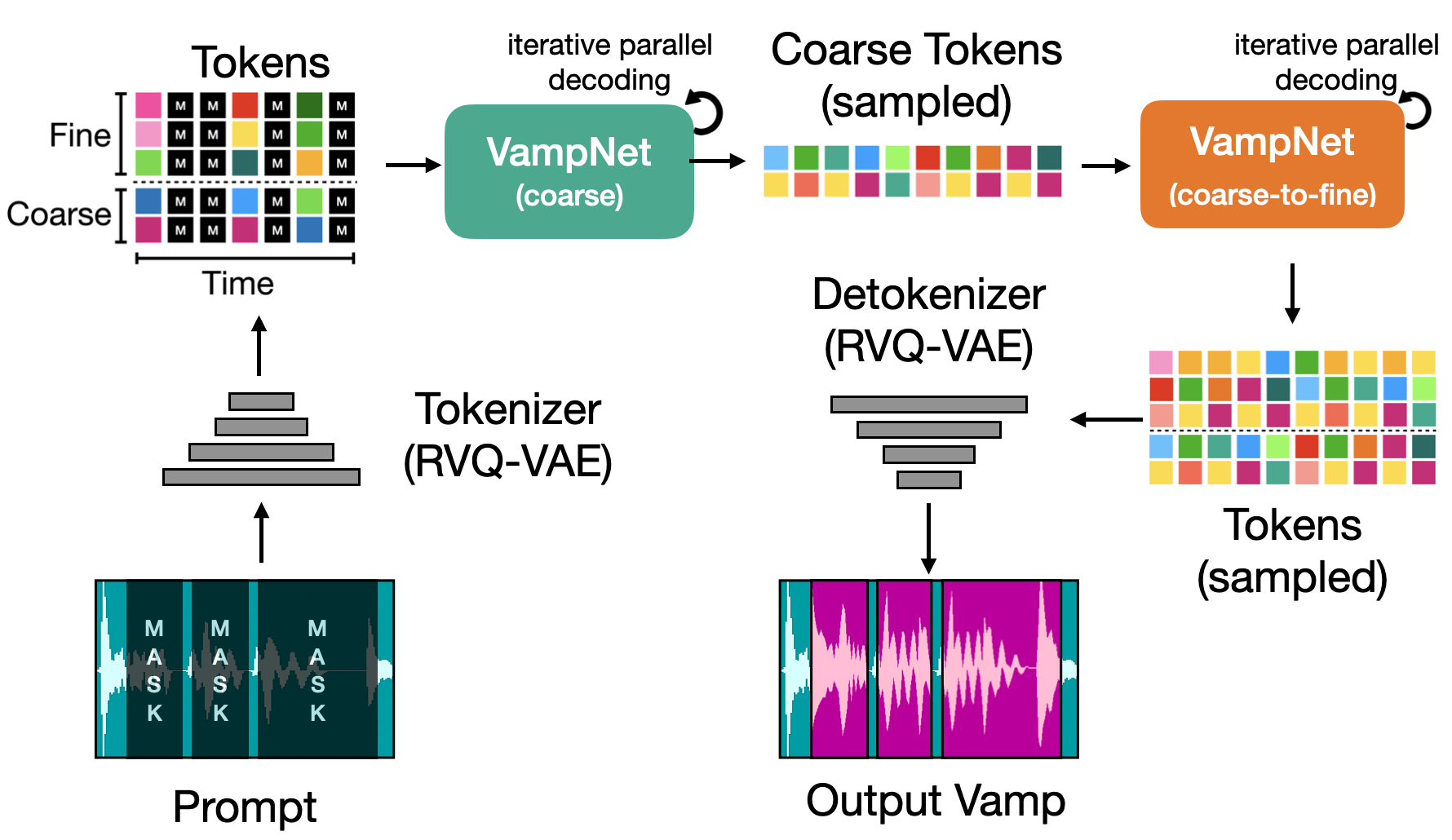
- VampNet uses a bidirectional transformer architecture that attends to all tokens in a single forward pass, enabling non-autoregressive generation.
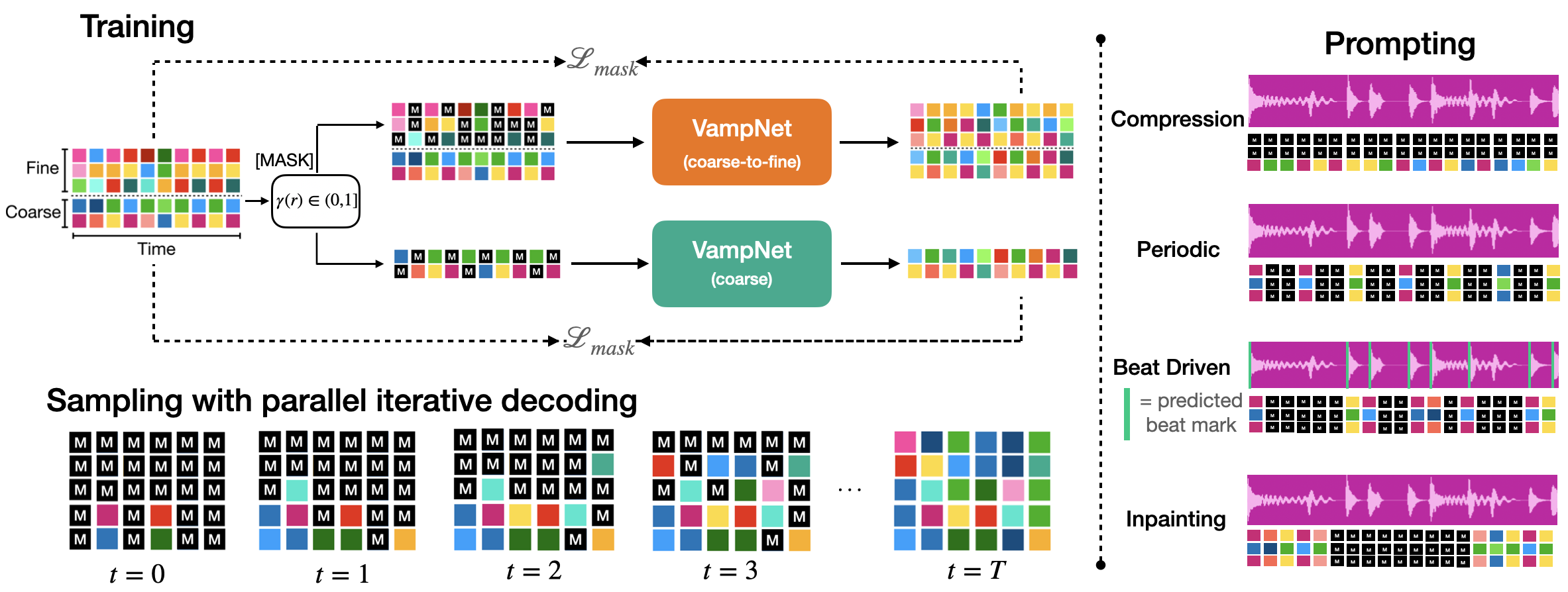
- It employs a variable masking schedule during training, where input tokens are masked and the model learns to predict the masked values.
- During inference, parallel iterative decoding is used: in each step, the model samples the most confident predicted tokens, iteratively refining the sequence.
- The model is conditioned via prompting—input sequences are masked in specific patterns (e.g., periodic, beat-aligned, or random) to guide generation.
- Audio is first tokenized using a pretrained audio tokenizer (e.g., DAC), and the resulting discrete tokens are processed by VampNet before decoding back to audio.
- Different prompting strategies (e.g., compression, periodic, beat-driven) allow the model to operate across a spectrum from reconstruction to creative variation.
Experimental results
Research questions
- RQ1Can a non-autoregressive, bidirectional transformer model generate high-fidelity music from masked acoustic tokens with minimal sampling steps?
- RQ2How effective are different prompting strategies (e.g., periodic, beat-driven, inpainting) in guiding music generation and variation?
- RQ3To what extent can VampNet perform music compression while preserving perceptual quality and musical structure?
- RQ4How does the model’s performance vary with the number of sampling steps and masking density?
- RQ5Can masked acoustic token modeling with prompting produce coherent, stylistically consistent variations of input music?
Key findings
- VampNet achieves the lowest Fréchet Audio Distance (FAD) with 36 sampling steps, outperforming autoregressive baselines in both quality and speed.
- With 24 sampling steps, VampNet generates 10-second audio in ~6 seconds on an NVIDIA RTX3090, compared to ~1 minute for an autoregressive model with similar parameters.
- Beat-driven prompting achieves the lowest FAD, indicating superior perceptual quality and better tempo consistency than other prompting methods.
- Periodic prompting with P=16 (35 conditioning timesteps) performs comparably to inpainting with 1 second of context (57 timesteps), showing that distributed conditioning improves efficiency.
- At bitrates below 200 bps, VampNet maintains lower FAD than a random token baseline, indicating it still generates musically plausible audio despite poor reconstruction.
- Combining periodic and compression prompting allows the model to smoothly transition from reconstruction to creative generation as masking increases.
Read this paper
Open the full text in the Nubint reader and ask about any passage as you read.
Read this paper on NubintThis review was generated by AI from the original paper. Please check the paper before citing it.