
[Paper Review] Vision Transformer for Contrastive Clustering
This paper proposes Vision Transformer for Contrastive Clustering (VTCC), a novel self-supervised deep clustering method that unifies Vision Transformers (ViT) with contrastive learning for image clustering. By using a ViT encoder with a convolutional stem for stable patch embedding and two contrastive projectors—instance-level and cluster-level—VTCC achieves state-of-the-art performance across eight datasets, demonstrating improved stability and clustering accuracy from training-from-scratch.
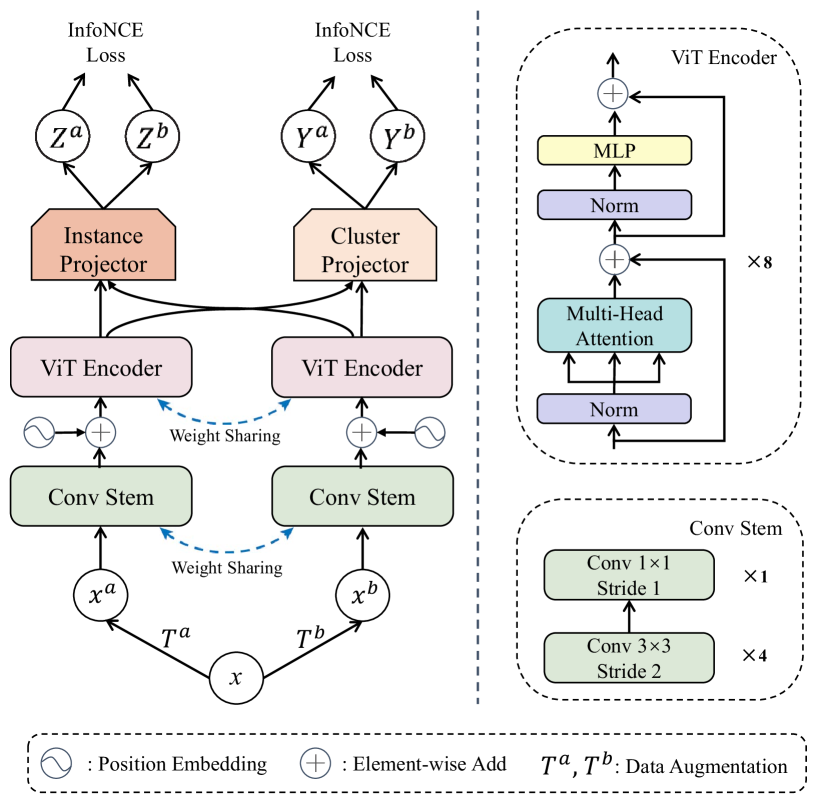
Vision Transformer (ViT) has shown its advantages over the convolutional neural network (CNN) with its ability to capture global long-range dependencies for visual representation learning. Besides ViT, contrastive learning is another popular research topic recently. While previous contrastive learning works are mostly based on CNNs, some recent studies have attempted to combine ViT and contrastive learning for enhanced self-supervised learning. Despite the considerable progress, these combinations of ViT and contrastive learning mostly focus on the instance-level contrastiveness, which often overlook the global contrastiveness and also lack the ability to directly learn the clustering result (e.g., for images). In view of this, this paper presents a novel deep clustering approach termed Vision Transformer for Contrastive Clustering (VTCC), which for the first time, to our knowledge, unifies the Transformer and the contrastive learning for the image clustering task. Specifically, with two random augmentations performed on each image, we utilize a ViT encoder with two weight-sharing views as the backbone. To remedy the potential instability of the ViT, we incorporate a convolutional stem to split each augmented sample into a sequence of patches, which uses multiple stacked small convolutions instead of a big convolution in the patch projection layer. By learning the feature representations for the sequences of patches via the backbone, an instance projector and a cluster projector are further utilized to perform the instance-level contrastive learning and the global clustering structure learning, respectively. Experiments on eight image datasets demonstrate the stability (during the training-from-scratch) and the superiority (in clustering performance) of our VTCC approach over the state-of-the-art.
Motivation & Objective
- To address the gap in combining Vision Transformers (ViT) with contrastive learning for image clustering, especially in modeling global structure.
- To improve training stability of ViT in self-supervised contrastive learning by introducing a convolutional stem for patch extraction.
- To jointly learn instance-level and cluster-level representations via dual contrastive projectors for better clustering structure learning.
- To demonstrate that ViT-based contrastive clustering outperforms CNN-based methods in unsupervised image clustering.
- To provide a new benchmark for self-supervised image clustering using the ViT architecture with contrastive objectives.
Proposed method
- A Vision Transformer (ViT) encoder with weight-shared views is used as the backbone, processing two augmented views of each image.
- A convolutional stem replaces the standard patchify operation, using stacked small convolutions to improve training stability and representation quality.
- An instance projector performs contrastive learning between augmented views to learn instance-level representations.
- A cluster projector performs contrastive learning based on cluster-level assignments to learn global clustering structure.
- The model is trained end-to-end using a combined contrastive loss combining instance-level and cluster-level InfoNCE losses.
- After training, K-means clustering is applied to the final features for evaluation.
Experimental results
Research questions
- RQ1Can Vision Transformers be effectively combined with contrastive learning to improve unsupervised image clustering?
- RQ2Does the use of a convolutional stem improve the training stability and performance of ViT in self-supervised contrastive clustering?
- RQ3How do instance-level and cluster-level contrastive learning components contribute to the final clustering performance?
- RQ4Is the proposed VTCC method superior to state-of-the-art deep clustering approaches across diverse image datasets?
- RQ5Does the joint modeling of global dependencies (via ViT) and contrastive learning lead to better clustering than using either component alone?
Key findings
- VTCC achieves state-of-the-art performance on eight real-world image datasets, with the highest NMI of 0.611 on the RSOD dataset.
- The convolutional stem improves clustering performance, increasing NMI from 0.570 to 0.611 on the RSOD dataset and from 0.365 to 0.373 on the Chaoyang dataset.
- Using both instance and cluster projectors yields the best clustering performance, with NMI 0.611 on RSOD and 0.373 on Chaoyang, outperforming single-projector baselines.
- The ViT-Small architecture achieves the best balance of performance and efficiency, outperforming ViT-Base on small datasets due to reduced overfitting.
- t-SNE visualization shows progressive improvement in feature separation over training epochs, with NMI rising from 0.231 (0 epochs) to 0.611 (500 epochs) on RSOD.
- The method demonstrates strong training stability from scratch, confirming its practicality for self-supervised image clustering.
Read this paper
Open the full text in the Nubint reader and ask about any passage as you read.
Read this paper on NubintThis review was generated by AI from the original paper. Please check the paper before citing it.