
[Paper Review] Visual Question Answering: A Survey on Techniques and Common Trends in Recent Literature
This survey provides a comprehensive, up-to-date analysis of Visual Question Answering (VQA) research from 2020–2022, evaluating 29 recent papers, 6 datasets, and state-of-the-art models. It highlights key trends such as bias mitigation, external knowledge integration via knowledge graphs, and transformer-based multimodal modeling, offering a novel, open-access, and reproducible overview of VQA advancements and future research directions.
Visual Question Answering (VQA) is an emerging area of interest for researches, being a recent problem in natural language processing and image prediction. In this area, an algorithm needs to answer questions about certain images. As of the writing of this survey, 25 recent studies were analyzed. Besides, 6 datasets were analyzed and provided their link to download. In this work, several recent pieces of research in this area were investigated and a deeper analysis and comparison among them were provided, including results, the state-of-the-art, common errors, and possible points of improvement for future researchers.
Motivation & Objective
- To provide a comprehensive, up-to-date review of recent VQA research (2020–2022) with a focus on novel techniques and trends.
- To analyze and compare 29 recent papers, 6 datasets, and state-of-the-art models in VQA, emphasizing methodological diversity and performance.
- To identify and discuss common problems such as dataset bias, lack of standardization, and high computational costs in VQA model training.
- To highlight emerging trends like external knowledge injection, knowledge graph integration, and attention mechanism modeling to improve model robustness and generalization.
- To support reproducibility and future research by including open-access papers and open-source datasets with downloadable links.
Proposed method
- Systematic analysis of 29 recent VQA papers published between 2020 and 2022, selected based on content quality, open access, and open-source availability.
- Evaluation of six major VQA datasets, including their structure, annotation style, and suitability for benchmarking generalization and bias mitigation.
- Categorization of VQA models by architecture (CNN, RNN, Transformers), with focus on attention mechanisms and multimodal fusion strategies.
- Investigation of bias mitigation techniques, including data redistribution, architectural branches (e.g., content vs. context), and training protocols to reduce spurious correlations.
- Examination of knowledge injection methods, particularly the use of external knowledge graphs to enhance reasoning and contextual understanding in VQA models.
- Application of a novel digital framework for model and dataset evaluation, enabling systematic comparison of performance and robustness across studies.
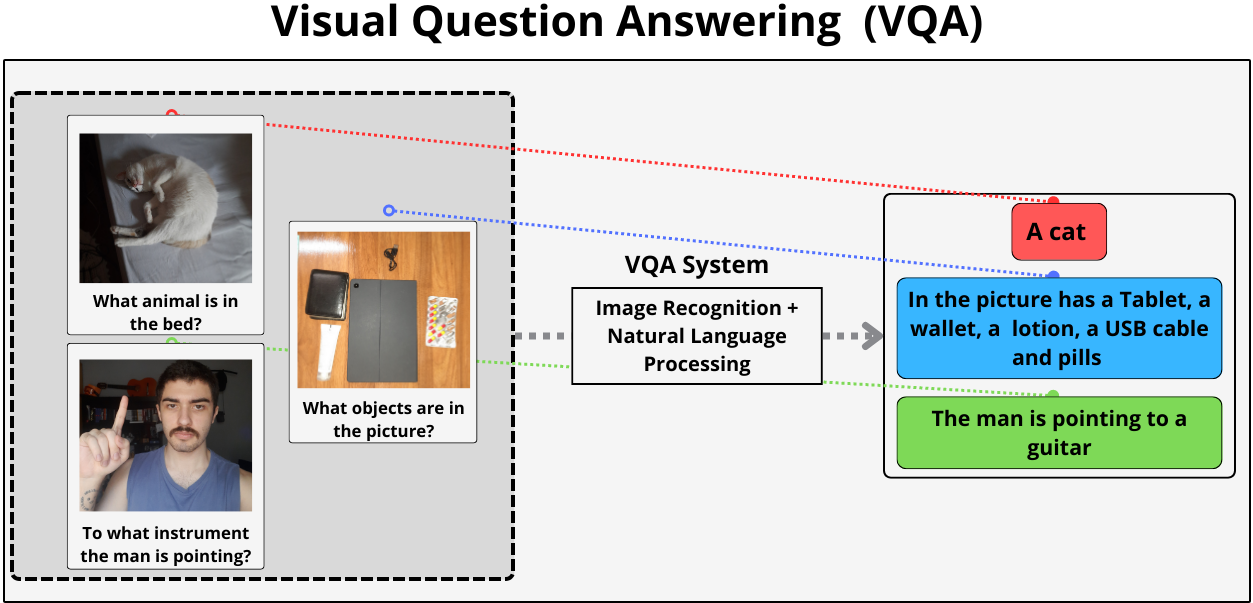
Experimental results
Research questions
- RQ1What are the most prominent trends and methodological innovations in VQA research from 2020 to 2022?
- RQ2How do recent VQA models address the challenge of bias from spurious correlations in training data?
- RQ3To what extent do external knowledge sources, such as knowledge graphs, improve the reasoning and generalization capabilities of VQA models?
- RQ4What are the key limitations and recurring weaknesses in current VQA research, particularly regarding dataset standardization and computational cost?
- RQ5How do attention mechanisms in VQA models compare to human visual attention, and what improvements have been made to align them?
Key findings
- The LXMERT and UpDn backbones achieved the best performance on the VQA v2.0 dataset when using Accuracy as the evaluation metric.
- Seven recent works specifically targeted bias mitigation through data redistribution, architectural branching (e.g., content vs. context), and training protocol redesign to reduce reliance on spurious correlations.
- External knowledge injection via knowledge graphs significantly improved model robustness and contextual reasoning, particularly in out-of-distribution generalization tasks.
- Transformers and multimodal attention mechanisms were widely adopted, with several studies modeling attention as feature functions to better mimic human visual attention.
- Despite progress, the majority of models still rely heavily on Accuracy as the primary evaluation metric, with limited use of more nuanced or human-aligned metrics.
- A major challenge remains the lack of standardization in dataset creation, with many authors developing custom datasets, which hinders reproducibility and cross-study comparison.
Read this paper
Open the full text in the Nubint reader and ask about any passage as you read.
Read this paper on NubintThis review was generated by AI from the original paper. Please check the paper before citing it.