
[Paper Review] Vocal markers from sustained phonation in Huntington's Disease
This study investigates vocal markers from sustained phonation in Huntington’s Disease (HD) using phonatory and modulation power spectrum (MPS) features to distinguish premanifest gene carriers (preHD), symptomatic HD patients, and healthy controls. Phonatory features best predict clinical scores, while MPS features significantly improve identification of preHD, reducing misclassification by threefold and offering potential for remote, repeatable monitoring in clinical trials.
Disease-modifying treatments are currently assessed in neurodegenerative diseases. Huntington's Disease represents a unique opportunity to design automatic sub-clinical markers, even in premanifest gene carriers. We investigated phonatory impairments as potential clinical markers and propose them for both diagnosis and gene carriers follow-up. We used two sets of features: Phonatory features and Modulation Power Spectrum Features. We found that phonation is not sufficient for the identification of sub-clinical disorders of premanifest gene carriers. According to our regression results, Phonatory features are suitable for the predictions of clinical performance in Huntington's Disease.
Motivation & Objective
- To identify sub-clinical vocal markers in premanifest Huntington’s Disease (preHD) gene carriers using sustained phonation.
- To evaluate whether phonatory and modulation power spectrum (MPS) features can distinguish preHD, HD, and healthy controls.
- To assess the predictive capability of speech features for clinical scores (cUHDRS, TFC, TMS) in HD.
- To explore the feasibility of using brief, automated speech tasks as ecological, repeatable biomarkers in neurodegenerative disease monitoring.
- To determine whether MPS features offer advantages over traditional phonatory features in detecting early, pre-symptomatic HD.
Proposed method
- Acquired sustained /a/ vowel recordings from 85 participants: 24 controls (C), 16 preHD, 45 HD.
- Extracted phonatory features (e.g., jitter, shimmer, fundamental frequency) known to reflect dysarthria in HD.
- Computed Modulation Power Spectrum (MPS) features to capture temporal and spectral modulations linked to speech intelligibility and roughness.
- Applied regularized linear models (logistic regression) to classify group membership and predict clinical scores.
- Used statistical tests (H-statistic, p-values, FDR correction) to assess group differences in feature distributions.
- Combined phonatory and MPS features to improve classification and prediction performance.
Experimental results
Research questions
- RQ1Can sustained phonation features distinguish between healthy controls, premanifest gene carriers (preHD), and symptomatic HD patients?
- RQ2Do modulation power spectrum (MPS) features enhance the detection of preHD compared to traditional phonatory features?
- RQ3To what extent can phonatory features predict clinical scores (cUHDRS, TFC, TMS) in HD patients?
- RQ4What types of errors do classification models make when distinguishing preHD from controls and HD, and how do feature sets affect error patterns?
- RQ5Can speech-based markers from a 1-minute sustained vowel task replace or supplement lengthy clinical assessments like UHDRS?
Key findings
- Phonatory features showed the strongest predictive capability for clinical scores, with the highest coefficient of determination (R²) for the composite cUHDRS score.
- The combination of phonatory and MPS features improved classification accuracy to 0.56 and F1-macro to 0.46, outperforming either feature set alone.
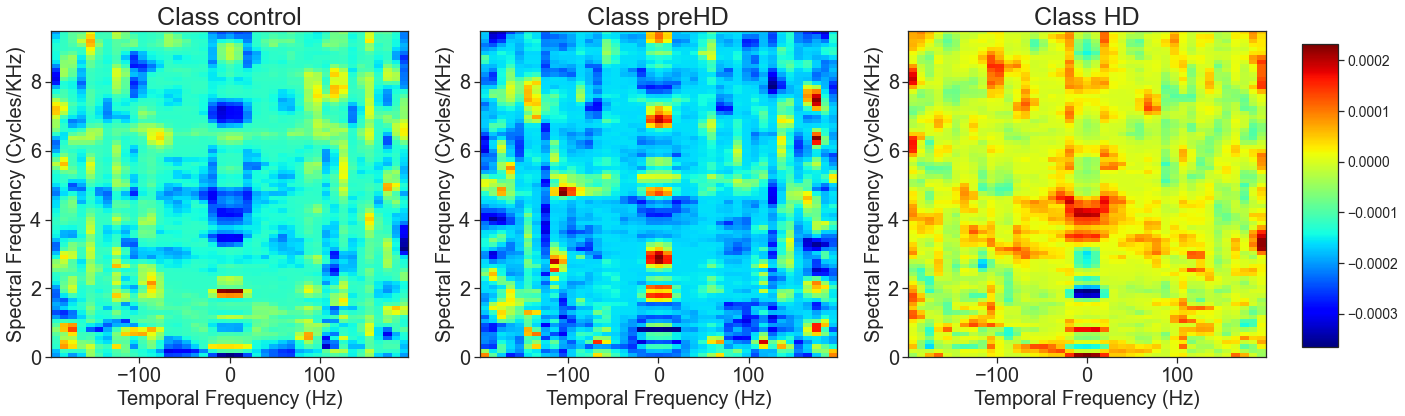
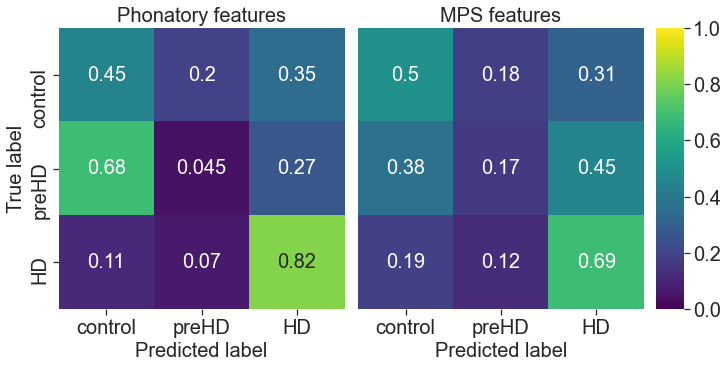
- MPS features reduced misclassification of preHD by threefold compared to phonatory features alone, significantly improving preHD detection.
- HD patients were most reliably classified, while preHD showed high confusion with both controls and HD, indicating blurred boundaries in early stages.
- The logistic regression model trained on MPS features revealed interpretable activation patterns, including strong responses at 0.0 Hz temporal frequency (voice breaks) and specific spectral modulations at 2.5 and 7 cycles/kHz in preHD.
- Despite lower overall classification performance, MPS features demonstrated superior sensitivity in identifying preHD, suggesting their potential for early detection.
Read this paper
Open the full text in the Nubint reader and ask about any passage as you read.
Read this paper on NubintThis review was generated by AI from the original paper. Please check the paper before citing it.