
[Paper Review] VQVC+: One-Shot Voice Conversion by Vector Quantization and U-Net architecture
This paper proposes VQVC+, a one-shot voice conversion method that combines U-Net architecture with vector quantization (VQ) to achieve high-quality, disentangled speaker and content representation. By leveraging U-Net’s skip connections and VQ’s strong information bottleneck, the model outperforms AutoVC and Chou et al. in both objective and subjective evaluations, especially for unseen speakers, achieving state-of-the-art results in audio naturalness and speaker similarity.
Voice conversion (VC) is a task that transforms the source speaker's timbre, accent, and tones in audio into another one's while preserving the linguistic content. It is still a challenging work, especially in a one-shot setting. Auto-encoder-based VC methods disentangle the speaker and the content in input speech without given the speaker's identity, so these methods can further generalize to unseen speakers. The disentangle capability is achieved by vector quantization (VQ), adversarial training, or instance normalization (IN). However, the imperfect disentanglement may harm the quality of output speech. In this work, to further improve audio quality, we use the U-Net architecture within an auto-encoder-based VC system. We find that to leverage the U-Net architecture, a strong information bottleneck is necessary. The VQ-based method, which quantizes the latent vectors, can serve the purpose. The objective and the subjective evaluations show that the proposed method performs well in both audio naturalness and speaker similarity.
Motivation & Objective
- To address the challenge of high-fidelity one-shot voice conversion without requiring parallel training data.
- To improve disentanglement of speaker and content representations in autoencoder-based voice conversion systems.
- To enhance audio naturalness and speaker similarity, especially for unseen speakers, by integrating U-Net with vector quantization.
- To demonstrate that VQ provides a strong information bottleneck enabling U-Net to generalize well without overfitting to reconstruction.
- To show that speaker embeddings learned via self-reconstruction are effective for zero-shot voice conversion without explicit speaker supervision.
Proposed method
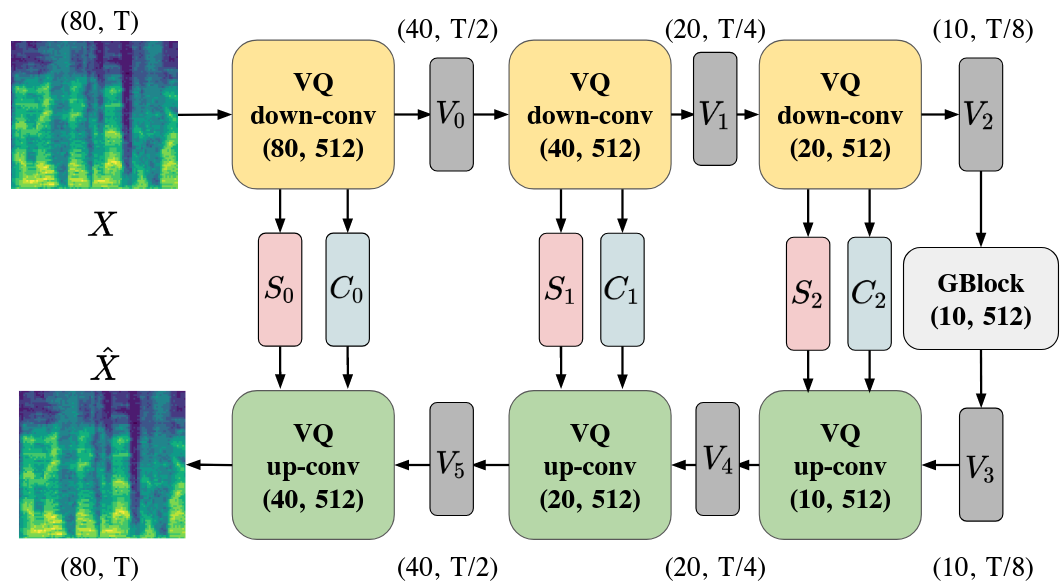
- The model uses a U-Net-based autoencoder with skip connections between encoder and decoder layers to preserve fine-grained spectrogram details.
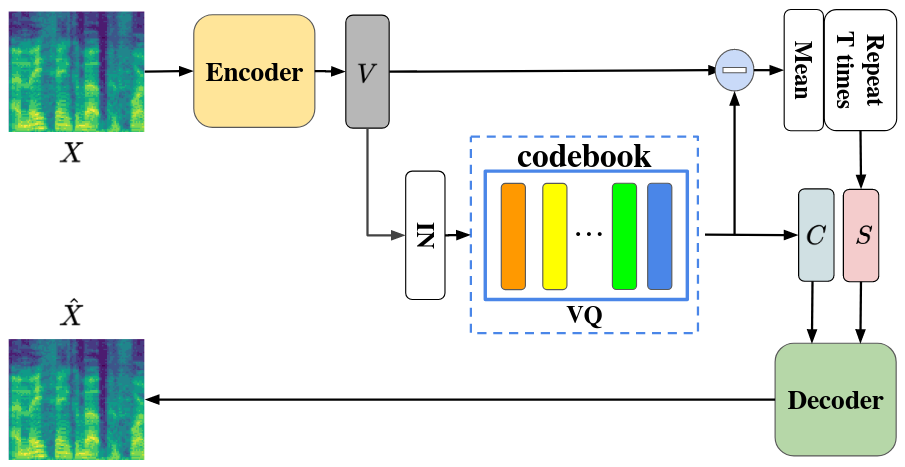
- Vector quantization (VQ) is applied to the latent representation to create a discrete codebook, enforcing a strong information bottleneck that promotes disentanglement.
- Speaker embedding is derived as the global average of the difference between continuous latent vectors and their quantized counterparts: $\vec{s} = \mathbb{E}_t[\vec{V} - \vec{C}]$, then repeated across time to match dimensionality.
- Content and speaker embeddings are combined as $\vec{C} + \vec{S}$ and passed through the decoder to reconstruct the input audio.
- The model is trained with only a self-reconstruction loss: $L_{rec} = \mathbb{E}[||\hat{\vec{X}} - \vec{X}||_1]$, without adversarial or explicit speaker loss.
- Instance normalization is applied before quantization to stabilize training and improve disentanglement.
Experimental results
Research questions
- RQ1Can the U-Net architecture be effectively used in one-shot voice conversion without compromising disentanglement?
- RQ2Does vector quantization serve as a sufficient information bottleneck to prevent U-Net from overfitting to reconstruction?
- RQ3Can speaker embeddings be effectively disentangled from content representations using only self-reconstruction loss and VQ?
- RQ4How does the proposed method perform in terms of audio quality and speaker similarity, especially for unseen speakers?
- RQ5Is the combination of U-Net and VQ superior to existing autoencoder-based methods like AutoVC and Chou et al. in subjective and objective evaluations?
Key findings
- VQVC+ achieves a mean opinion score (MOS) of 4.48 for unseen speakers (”-U”), outperforming AutoVC (4.21) and Chou et al. (4.32) in audio naturalness.
- For speaker similarity, VQVC+ achieves a MOS of 4.51 for unseen speakers, surpassing AutoVC (4.24) and Chou et al. (4.35).
- In pairwise comparison, VQVC+ is preferred in 72.5% of cases for naturalness and 74.1% for speaker similarity when comparing with baselines on unseen speakers.
- The speaker classifier accuracy on embeddings from $\vec{S}_0$ reaches 98.3%, indicating strong speaker correlation in the learned embeddings.
- The model with VQ and U-Net (Q64) achieves 98.3% accuracy in speaker identification from $\vec{S}_0$, while the IN-only variant (no quantization) achieves only 97.4%, showing VQ enhances disentanglement.
- Subjective evaluations confirm that VQVC+ generalizes better to unseen speakers than baselines, demonstrating robustness in one-shot voice conversion.
Read this paper
Open the full text in the Nubint reader and ask about any passage as you read.
Read this paper on NubintThis review was generated by AI from the original paper. Please check the paper before citing it.