
[Paper Review] Wav2Seq: Pre-training Speech-to-Text Encoder-Decoder Models Using Pseudo Languages
Wav2Seq introduces a self-supervised method to jointly pre-train both encoder and decoder in speech-to-text models by formulating a pseudo ASR task that transcribes raw audio into discrete pseudo subword tokens. This approach achieves state-of-the-art results in end-to-end spoken named entity recognition and consistently improves performance across 20 language pairs in speech-to-text translation, even without additional text data, while closing the performance gap between encoder-decoder and CTC models in low-resource ASR settings.
We introduce Wav2Seq, the first self-supervised approach to pre-train both parts of encoder-decoder models for speech data. We induce a pseudo language as a compact discrete representation, and formulate a self-supervised pseudo speech recognition task -- transcribing audio inputs into pseudo subword sequences. This process stands on its own, or can be applied as low-cost second-stage pre-training. We experiment with automatic speech recognition (ASR), spoken named entity recognition, and speech-to-text translation. We set new state-of-the-art results for end-to-end spoken named entity recognition, and show consistent improvements on 20 language pairs for speech-to-text translation, even when competing methods use additional text data for training. Finally, on ASR, our approach enables encoder-decoder methods to benefit from pre-training for all parts of the network, and shows comparable performance to highly optimized recent methods.
Motivation & Objective
- To address the imbalance in self-supervised pre-training, where only encoders are typically pre-trained, while decoders are randomly initialized or borrowed from NLP models.
- To enable end-to-end pre-training of both encoder and decoder components in speech-to-text models using only raw audio, without requiring aligned text.
- To improve performance in low-resource settings, especially for sequence-to-sequence models that traditionally underperform compared to CTC-based models.
- To demonstrate that a compact discrete pseudo language representation can serve as an effective self-supervised target for joint pre-training.
- To enable flexible, low-cost second-stage pre-training that enhances existing pre-trained encoders like HuBERT and XLS-R.
Proposed method
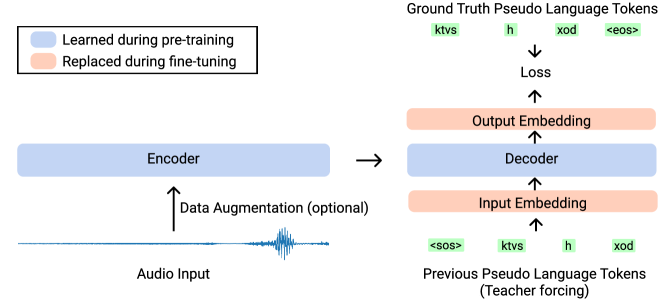
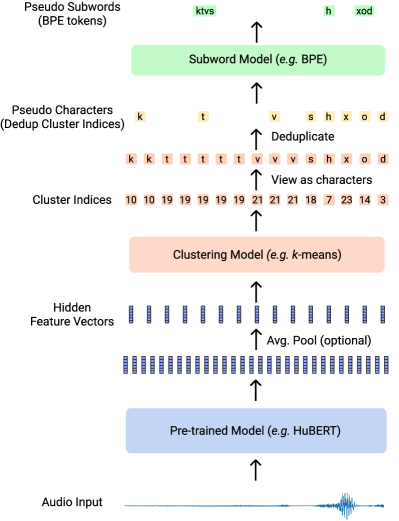
- Induce a pseudo language by clustering raw speech representations into discrete subword units using vector quantization and clustering algorithms.
- Formulate a self-supervised pseudo ASR task where the model learns to transcribe raw audio into sequences of pseudo subword tokens.
- Pre-train the full encoder-decoder architecture end-to-end using this pseudo ASR objective, with cross-entropy loss on the pseudo tokens.
- Fine-tune the model on downstream tasks by replacing the input and output embedding layers with real language embeddings (e.g., English subwords or characters).
- Apply the method as a second-stage pre-training step on top of existing pre-trained encoders like HuBERT or XLS-R, improving performance with minimal additional cost.
- Use length compression and deduplication techniques to create compact, meaningful pseudo subword sequences that balance semantic relevance and sequence efficiency.
Experimental results
Research questions
- RQ1Can joint pre-training of both encoder and decoder in speech-to-text models lead to improved performance compared to pre-training only the encoder?
- RQ2Does using a self-supervised pseudo ASR task with discrete pseudo subwords as targets enable effective pre-training without any text supervision?
- RQ3How does Wav2Seq perform in low-resource settings, particularly when compared to CTC-based models and models with external language models?
- RQ4Can Wav2Seq serve as a low-cost second-stage pre-training method that boosts performance of existing pre-trained encoders like HuBERT or XLS-R?
- RQ5To what extent does the choice of pseudo subword representation (e.g., deduplication, BPE) affect downstream performance?
Key findings
- On the SLUE-VoxPopuli SNER benchmark, Wav2Seq initialized with HuBERT-large achieved the best end-to-end performance among all evaluated models.
- For speech-to-text translation, Wav2Seq outperformed models initialized with HuBERT or XLS-R on 20 language pairs and matched the performance of models trained with additional machine translation data.
- In low-resource ASR (10h of labeled data), Wav2Seq closed the performance gap between encoder-decoder and CTC models, significantly improving the latter’s performance.
- When applied as second-stage pre-training, Wav2Seq improved performance of HuBERT-large-based models on both low- and high-resource ST tasks, even outperforming models with 2–3× larger encoders.
- The pseudo ASR task achieved a WER of 38.1% on LibriSpeech dev-other using pseudo subwords, with a 17.4% length compression rate, outperforming BPE and character-level targets.
- Ablation studies showed that deduplication and BPE-based subword tokenization were critical for performance, reducing WER by 6.0 percentage points compared to raw characters.
Read this paper
Open the full text in the Nubint reader and ask about any passage as you read.
Read this paper on NubintThis review was generated by AI from the original paper. Please check the paper before citing it.