
[Paper Review] Weakly-Supervised Semantic Segmentation with Image-Level Labels: from Traditional Models to Foundation Models
This paper surveys traditional weakly-supervised semantic segmentation (WSSS) methods using image-level labels and investigates the application of the Segment Anything Model (SAM) for WSSS in two settings: text prompting and zero-shot learning. It demonstrates that SAM significantly outperforms traditional methods, generating high-quality pseudo masks that often exceed human-annotated quality, especially for outdoor scenes and common object categories.
The rapid development of deep learning has driven significant progress in image semantic segmentation - a fundamental task in computer vision. Semantic segmentation algorithms often depend on the availability of pixel-level labels (i.e., masks of objects), which are expensive, time-consuming, and labor-intensive. Weakly-supervised semantic segmentation (WSSS) is an effective solution to avoid such labeling. It utilizes only partial or incomplete annotations and provides a cost-effective alternative to fully-supervised semantic segmentation. In this journal, our focus is on the WSSS with image-level labels, which is the most challenging form of WSSS. Our work has two parts. First, we conduct a comprehensive survey on traditional methods, primarily focusing on those presented at premier research conferences. We categorize them into four groups based on where their methods operate: pixel-wise, image-wise, cross-image, and external data. Second, we investigate the applicability of visual foundation models, such as the Segment Anything Model (SAM), in the context of WSSS. We scrutinize SAM in two intriguing scenarios: text prompting and zero-shot learning. We provide insights into the potential and challenges of deploying visual foundational models for WSSS, facilitating future developments in this exciting research area.
Motivation & Objective
- To provide a comprehensive survey of traditional WSSS methods that use only image-level labels, categorizing them by operational level: pixel-wise, image-wise, cross-image, and external data.
- To investigate the feasibility and performance of visual foundation models—specifically SAM—in weakly-supervised semantic segmentation under limited supervision.
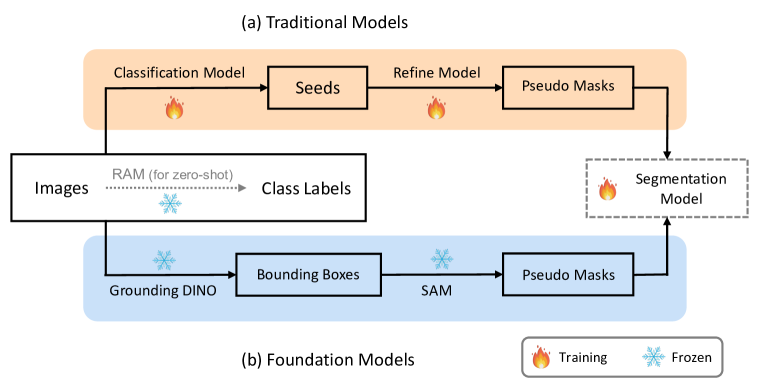
- To evaluate SAM in two practical scenarios: text input (using Grounded DINO for bounding boxes) and zero-shot learning (using RAM for class tagging) for pseudo mask generation.
- To analyze the limitations and failure cases of foundation models in WSSS, particularly concerning annotation strategy discrepancies and complex indoor scenes.
- To identify key challenges and future research directions for deploying foundation models in weakly-supervised segmentation, including model robustness and annotation standardization.
Proposed method
- Categorizes traditional WSSS methods into four groups based on operational level: pixel-wise (e.g., loss functions, local patches), image-wise (e.g., adversarial learning, consistency regularization), cross-image (e.g., multi-image comparisons), and external data (e.g., saliency maps, OOD data).
- Employs the Grounded DINO model to generate object bounding boxes from class labels in the text input setting, which are then used as prompts for SAM to generate segmentation masks.
- In the zero-shot setting, uses the Recognise Anything Model (RAM) to predict class labels from image features, which are then used as text prompts for SAM to generate masks without any class-specific fine-tuning.
- Applies SAM’s prompt-based segmentation framework to generate pseudo masks using both textual and zero-shot class embeddings, leveraging its large-scale pretraining on SA-1B.
- Conducts per-class and failure case analysis on the VOC dataset to evaluate mask quality, focusing on mIoU and visual discrepancies between model outputs and dataset annotations.
- Compares pseudo mask quality across methods using mIoU metrics, with qualitative analysis highlighting failures due to grounding/tagging model errors or annotation strategy mismatches.
Experimental results
Research questions
- RQ1How do traditional WSSS methods that use only image-level labels compare in performance and design across different operational levels (pixel-wise, image-wise, cross-image, external data)?
- RQ2Can the Segment Anything Model (SAM) effectively generate high-quality pseudo masks for weakly-supervised semantic segmentation when prompted with text or in a zero-shot manner?
- RQ3What are the key failure modes of SAM in WSSS, and how do they relate to the performance of the grounding and tagging models used in the pipeline?
- RQ4How does the annotation strategy of benchmark datasets like VOC influence the evaluation of pseudo mask quality, particularly for complex or ambiguous categories?
- RQ5To what extent can foundation models like SAM surpass traditional WSSS methods, and what are the remaining challenges in deploying them for real-world weakly-supervised segmentation?
Key findings
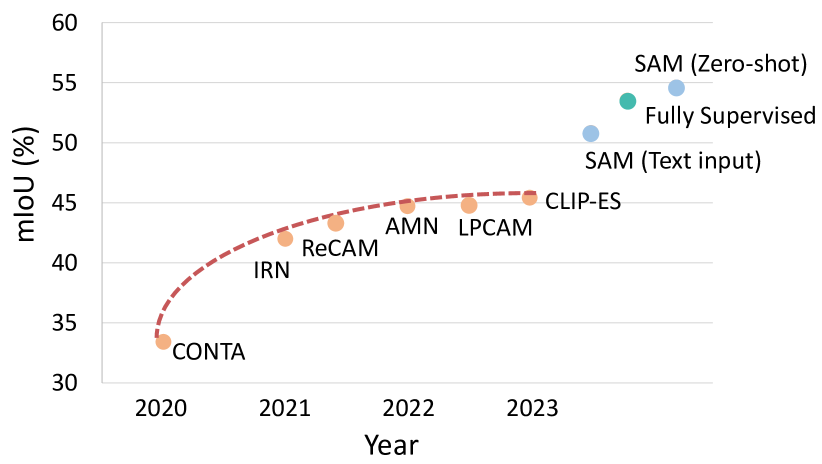
- SAM (text input) and SAM (zero-shot) significantly outperform traditional WSSS methods in pseudo mask quality, with mIoU scores that often approach or exceed those of fully supervised models.
- SAM (text input) achieves high mIoU for classes related to animals and transportation, particularly in outdoor scenes with simpler backgrounds, due to better generalization and prompt alignment.
- Performance degrades for indoor scenes and object categories (e.g., dining tables, bicycles), primarily due to complex backgrounds and annotation strategy mismatches—such as excluding hollow wheel sections or including table-top items.
- Failure cases are often attributable to errors in the grounding (Grounded DINO) or tagging (RAM) models rather than SAM itself, indicating that pipeline robustness depends on upstream components.
- Per-class analysis reveals that SAM (text input) and SAM (zero-shot) produce pseudo masks that frequently exceed the quality of human-annotated masks, especially in terms of boundary accuracy and completeness.
- The study identifies a critical gap between model-based segmentation and dataset annotation protocols, highlighting the need for standardized and more consistent annotation practices in evaluation.
Read this paper
Open the full text in the Nubint reader and ask about any passage as you read.
Read this paper on NubintThis review was generated by AI from the original paper. Please check the paper before citing it.