
[Paper Review] What can a GNOME do? Search targets for the Global Network of Optical Magnetometers for Exotic physics searches
This paper proposes expanding the Global Network of Optical Magnetometers (GNOME) beyond its original focus on axion-like particles to probe a broad range of exotic physics scenarios, including scalar and pseudoscalar fields, domain walls, and mixed-parity dark matter. By leveraging cross-correlation of signals from geographically separated sensors, GNOME enables background-suppressed searches for weakly coupled new physics, with potential for discovery through synchronized observations with gravitational-wave detectors and future integration with machine learning for anomaly detection.
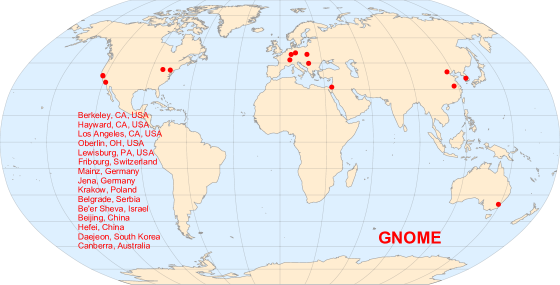
Numerous observations suggest that there exist undiscovered beyond-the-Standard-Model particles and fields. Because of their unknown nature, these exotic particles and fields could interact with Standard Model particles in many different ways and assume a variety of possible configurations. Here we present an overview of the Global Network of Optical Magnetometers for Exotic physics searches (GNOME), our ongoing experimental program designed to test a wide range of exotic physics scenarios. The GNOME experiment utilizes a worldwide network of shielded atomic magnetometers (and, more recently, comagnetometers) to search for spatially and temporally correlated signals due to torques on atomic spins from exotic fields of astrophysical origin. We survey the temporal characteristics of a variety of possible signals currently under investigation such as those from topological defect dark matter (axion-like particle domain walls), axion-like particle stars, solitons of complex-valued scalar fields (Q-balls), stochastic fluctuations of bosonic dark matter fields, a solar axion-like particle halo, and bursts of ultralight bosonic fields produced by cataclysmic astrophysical events such as binary black hole mergers.
Motivation & Objective
- To extend the science case of the Global Network of Optical Magnetometers (GNOME) beyond axion-like particle searches to a broader spectrum of exotic physics scenarios.
- To identify and evaluate diverse astrophysical and cosmological targets—such as domain walls, oscillating fields, and mixed-parity dark matter—suitable for detection with GNOME.
- To enable background suppression and enhanced sensitivity through cross-correlation of signals from multiple, spatially separated optical magnetometers.
- To explore synergies with other networks, such as atomic clocks and gravitational-wave detectors, for multimessenger exotic physics searches.
- To assess the feasibility of using machine learning to detect unknown or unexpected signals in GNOME data by learning the network's normal dynamic state.
Proposed method
- Utilize a global network of optical magnetometers to detect transient or persistent oscillating magnetic fields from exotic particle fields passing through Earth.
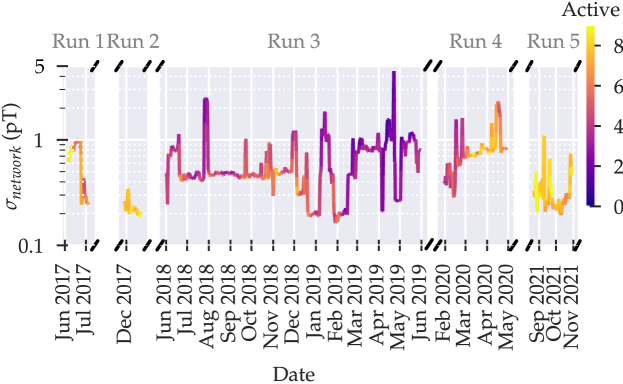
- Cross-correlate signals from multiple, geographically distributed sensors to distinguish coherent, astrophysically sourced signals from local noise and instrumental drift.
- Model the expected signal response for various exotic physics scenarios, including axion-like particles, scalar and pseudoscalar fields, and domain walls.
- Synchronize GNOME observations with gravitational-wave detector networks (e.g., LIGO/VIRGO) to enable multimessenger searches for correlated exotic signals.
- Train machine learning systems on GNOME data to learn the baseline dynamic state and detect anomalous patterns indicative of new physics.
- Integrate with atomic clock networks to cross-correlate signals from scalar and pseudoscalar fields, enhancing sensitivity and background suppression.
Experimental results
Research questions
- RQ1What are the most promising astrophysical and cosmological targets for exotic physics searches using the GNOME network of optical magnetometers?
- RQ2How can cross-correlation of signals from multiple spatially separated magnetometers improve background suppression and signal detection sensitivity?
- RQ3In what ways can GNOME be synchronized with gravitational-wave detector networks to enable multimessenger exotic physics astronomy?
- RQ4Can machine learning techniques detect previously unknown or unmodeled signals in GNOME data by learning the network’s normal behavior?
- RQ5How do mixed-parity dark matter candidates, such as the relaxion, affect the signal response in optical magnetometer networks?
Key findings
- GNOME is capable of probing a wide range of exotic physics scenarios beyond axion-like particles, including domain walls, oscillating fields, and mixed-parity dark matter candidates.
- Cross-correlation of signals from multiple sensors enables effective suppression of local noise and instrumental drift, significantly enhancing sensitivity to weak, coherent signals.
- Synchronization of GNOME with gravitational-wave detector networks offers a new pathway for multimessenger exotic physics searches, particularly for transient or burst-like signals.
- Machine learning approaches show promise for detecting anomalous or previously unmodeled signals by learning the normal dynamic state of the network.
- The integration of GNOME with atomic clock networks can enhance detection capabilities for scalar and pseudoscalar fields, particularly those with mixed intrinsic parity.
- The science case for GNOME is not limited by current theoretical models, suggesting potential for discovery of unexpected new physics with continued data collection and advanced analysis.
Read this paper
Open the full text in the Nubint reader and ask about any passage as you read.
Read this paper on NubintThis review was generated by AI from the original paper. Please check the paper before citing it.