
[Paper Review] What does it take to catch a Chinchilla? Verifying Rules on Large-Scale Neural Network Training via Compute Monitoring
This paper proposes a hardware-software monitoring framework to verify large-scale ML training rules by logging weight snapshots on ML chips, transcript provenance, and supply-chain monitoring, enabling high-probability detection of rule-violating training runs without exposing proprietary data.
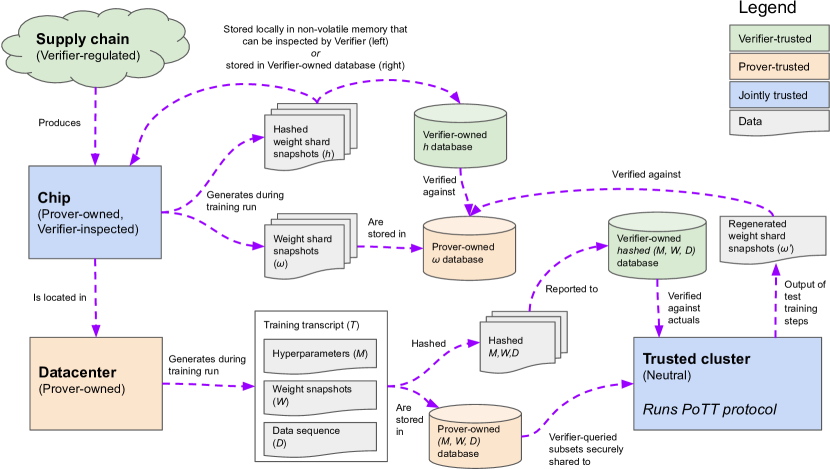
As advanced machine learning systems' capabilities begin to play a significant role in geopolitics and societal order, it may become imperative that (1) governments be able to enforce rules on the development of advanced ML systems within their borders, and (2) countries be able to verify each other's compliance with potential future international agreements on advanced ML development. This work analyzes one mechanism to achieve this, by monitoring the computing hardware used for large-scale NN training. The framework's primary goal is to provide governments high confidence that no actor uses large quantities of specialized ML chips to execute a training run in violation of agreed rules. At the same time, the system does not curtail the use of consumer computing devices, and maintains the privacy and confidentiality of ML practitioners' models, data, and hyperparameters. The system consists of interventions at three stages: (1) using on-chip firmware to occasionally save snapshots of the the neural network weights stored in device memory, in a form that an inspector could later retrieve; (2) saving sufficient information about each training run to prove to inspectors the details of the training run that had resulted in the snapshotted weights; and (3) monitoring the chip supply chain to ensure that no actor can avoid discovery by amassing a large quantity of un-tracked chips. The proposed design decomposes the ML training rule verification problem into a series of narrow technical challenges, including a new variant of the Proof-of-Learning problem [Jia et al. '21].
Motivation & Objective
- Motivate governance of advanced ML by enabling government verification of training rules.
- Propose a three-tier monitoring framework spanning chips, data centers, and supply chains.
- Ensure confidentiality of training data and models while enabling high-probability rule detection.
- Assess practicality, limitations, and challenges of deploying such a verification system.
Proposed method
- Introduce on-chip weight-shard snapshot logging anchored by hardware-backed firmware attestation.
- Require transmission of weight-snapshot hashes and corresponding training transcripts to prove provenance (via a Proof-of-Learning-inspired protocol).
- Implement supply-chain ownership verification to prevent untracked chip concealment.
- Derive probabilistic guarantees for catching rule-violating training runs based on sample sizes and compute parameters.
- Provide a quantitative table estimating required inspections for past and future models under various scales.
Experimental results
Research questions
- RQ1What minimal verifiable actions can a Verifier require to detect violation of ML training rules with high probability?
- RQ2How can chip-level logging, training transcripts, and supply-chain monitoring be integrated to provide robust compliance proofs?
- RQ3What are the practical sample sizes and inspection frequencies needed to catch large-scale rule-violating runs?
- RQ4What rules (compute, data properties, hyperparameters, performance thresholds) can be enforced by this monitoring approach?
- RQ5What are the scalability and security limitations of the proposed framework?
Key findings
- A sampling-based framework can detect rule-violating training runs with high probability by inspecting a subset of chips and verifying weight-snapshot hashes against training transcripts.
- The paper provides a quantitative estimate showing required samples per year for various models and numbers of chips, illustrating scalability with model size.
- Weight shard snapshots and hashed provenance enable retroactive verification without revealing proprietary data or weights.
- Supply-chain monitoring is essential to prevent untracked chips from masking large training runs.
- The approach remains feasible mainly for large-scale training on specialized accelerators, with limitations for older chips and non-center compute.
Read this paper
Open the full text in the Nubint reader and ask about any passage as you read.
Read this paper on NubintThis review was generated by AI from the original paper. Please check the paper before citing it.