
[논문 리뷰] What to do when things get crowded? Scalable joint analysis of overlapping gravitational wave signals
이 논문은 TMNRE를 이용한 순차 시뮬레이션 기반 추론(peregrine과 swyft를 통해)이 두 개의 중첩된 회전하는 프레세싱 BBH 신호에 대해 30개 파라미터를 함께 추론할 수 있으며, 전통적인 방법보다 훨씬 적은 약 7×10^6 파형 평가만으로 높은 정밀도를 달성한다는 것을 보여준다.
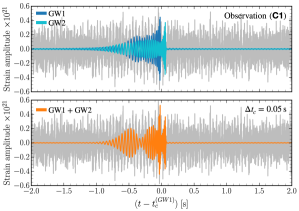
The gravitational wave sky is starting to become very crowded, with the fourth science run (O4) at LIGO expected to detect $\mathcal{O}(100)$ compact object coalescence signals. Data analysis issues start to arise as we look further forwards, however. In particular, as the event rate increases in e.g. next generation detectors, it will become increasingly likely that signals arrive in the detector coincidentally, eventually becoming the dominant source class. It is known that current analysis pipelines will struggle to deal with this scenario, predominantly due to the scaling of traditional methods such as Monte Carlo Markov Chains and nested sampling, where the time difference between analysing a single signal and multiple can be as significant as days to months. In this work, we argue that sequential simulation-based inference methods can solve this problem by breaking the scaling behaviour. Specifically, we apply an algorithm known as (truncated marginal) neural ratio estimation (TMNRE), implemented in the code peregrine and based on swyft. To demonstrate its applicability, we consider three case studies comprising two overlapping, spinning, and precessing binary black hole systems with merger times separated by 0.05 s, 0.2 s, and 0.5 s. We show for the first time that we can recover, with full precision (as quantified by a comparison to the analysis of each signal independently), the posterior distributions of all 30 model parameters in a full joint analysis. Crucially, we achieve this with only $\sim 15\%$ of the waveform evaluations that would be needed to analyse even a single signal with traditional methods.
연구 동기 및 목표
- 현재 및 미래 검출기에서 중첩 중력파 신호의 공동 분석 필요성에 대한 동기 제시.
- 여러 중첩 신호에 대한 전체 사후분포를 추출하기 위한 순차 시뮬레이션 기반 추론 접근법을 개발하고 적용.
- TMNRE가 전통적인 방법보다 훨씬 적은 파형 평가로 30-파라미터 전체 포스터리어를 회복할 수 있음을 보여줌.
- 독립적인 단일 신호 분석과의 정확도 비교 및 보정/포괄성 평가.
- 다음 세대 검출기 및 더 복잡한 중첩에 대한 확장성 및 전망 논의.
제안 방법
- 돌출된 겹치는 GW 신호에 대해 peregrine 구현체(swyft 기반)로 truncated marginal neural ratio estimation(TMNR E)을 적용한다.
- 세 탐지기 O4 네트워크(Hanford, Livingston, Virgo)에서 두 개의 겹친 회전하는 프레세싱 BBH 파형(IMRPhenomXPHM)으로 데이터를 순방향 생성한다.
- 저차원 주변 사후분포에 초점을 맞춘 prior truncation을 사용한 순차 추론 라운드를 수행하여 매개변수의 주변 분포를 효율적으로 주변화한다.
- joint 30-파라미터 포스터리어 회복(각 신호 15개)을 달성하고 검증을 위해 독립적인 단일 신호 분석과 비교한다.
- 계산 비용: 약 7×10^6 파형 평가, 18코어 노드에서 라운드당 약 2–3시간, 라운드당 약 8–12시간의 학습, 총 약 48시간.
- 3G 검출기 및 두 개를 초과하는 중첩 신호에 대한 확장성과 가능성에 대해 논의한다.
실험 결과
연구 질문
- RQ1TMNRE 기반 SBI가 두 개의 중첩 BBH 신호에 대해 고정밀도 및 적절한 보정으로 30차원 전체 포스터리어를 회복할 수 있는가?
- RQ2중첩 분석이 신호를 독립적으로 분석하는 경우와 비교하여 어떻게 수행되는가?
- RQ3TMNRE가 중첩 GW 신호의 공동 분석에 대해 가지는 계산 요구사항 및 확장성 혜택은 무엇인가?
- RQ4중첩 정도와 머지 시간 간격이 매개변수 제한과 모호성에 어떤 영향을 미치는가?
- RQ5향후 검출기 및 더 많은 중첩 신호에 대한 시사점은 무엇인가?
주요 결과
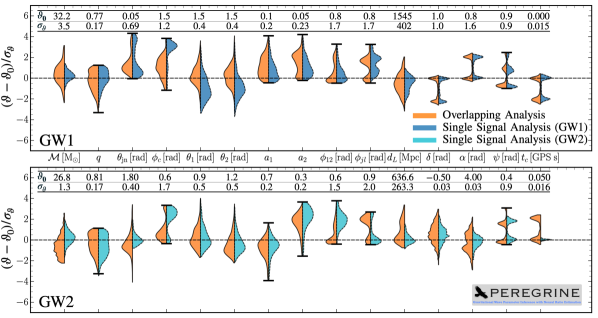
- TMNRE는 두 개의 중첩 회전하는 프레세싱 BBHs에 대해 30-파라미터 포스터리어를 높은 정확도로 회복할 수 있으며, 개별 신호 분석의 정밀도에 근접한 정확성을 보인다.
- 중첩 분석은 포스터리어의 폭이 크게 벌어지지 않으며 모든 매개변수에서 주입된 값의 커버리지가 즉시 거의 동일하게 나타난다.
- 1D 및 2D 주변 분포는 신호가 분리될수록 칼리브가 개선되지만, 대부분의 매개변수는 신호 간에 상관관계가 거의 없는 것으로 보인다.
- 방법은 모든 사례 연구에서 포커스가 거의 대각선인 커버리지 플롯으로 매우 잘 보정된 포스터리어를 제공한다.
- 계산 효율성이 크게 향상된다: 약 7×10^6 파형 평가(전통적 공동 분석에 비해 약 한 차례의 규모 감소) 및 이용 가능한 하드웨어에서의 라운드 총 소요 시간 약 2–3일.
- 중첩 신호가 일반적으로 나타날 3G 검출기에 대한 확장성과 확장 가능성의 잠재력을 보여준다.
더 나은 연구,지금 바로 시작하세요
연구 설계부터 논문 작성까지, 연구 시간을 획기적으로 줄여보세요.
카드 등록 없음 · 무료 플랜 제공
이 리뷰는 AI가 만들고, 인간 에디터가 검토했습니다.