
[Paper Review] When accurate prediction models yield harmful self-fulfilling prophecies
This paper demonstrates that accurate medical prediction models can produce harmful self-fulfilling prophecies when used to guide clinical decisions, even when they maintain strong discrimination and calibration after deployment. The authors formalize conditions under which such models cause systematic harm to patient subgroups by reinforcing existing biases, showing that predictive accuracy alone is insufficient for safe deployment in clinical decision support systems.
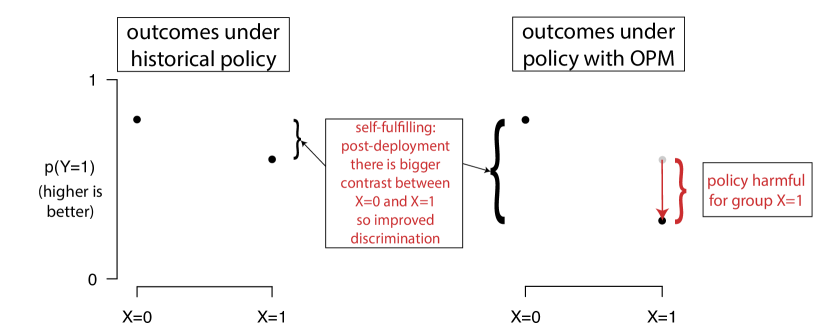
Prediction models are popular in medical research and practice. By predicting an outcome of interest for specific patients, these models may help inform difficult treatment decisions, and are often hailed as the poster children for personalized, data-driven healthcare. We show however, that using prediction models for decision making can lead to harmful decisions, even when the predictions exhibit good discrimination after deployment. These models are harmful self-fulfilling prophecies: their deployment harms a group of patients but the worse outcome of these patients does not invalidate the predictive power of the model. Our main result is a formal characterization of a set of such prediction models. Next we show that models that are well calibrated before and after deployment are useless for decision making as they made no change in the data distribution. These results point to the need to revise standard practices for validation, deployment and evaluation of prediction models that are used in medical decisions.
Motivation & Objective
- To investigate whether predictive accuracy in validation studies is sufficient for safe deployment of outcome prediction models in clinical decision support.
- To identify conditions under which accurate prediction models lead to harmful, self-fulfilling prophecies in medical decision-making.
- To formalize the mechanism by which model deployment alters patient outcomes in ways that preserve model performance but worsen care for specific subgroups.
- To challenge the standard practice of relying solely on discrimination and calibration for model validation and deployment in medicine.
Proposed method
- The authors develop a causal framework modeling the interaction between prediction models, treatment policies, and patient outcomes using potential outcomes and intervention distributions.
- They define a self-fulfilling prophecy as a scenario where a model's deployment leads to worse outcomes for a subgroup, yet the model maintains good predictive performance post-deployment.
- The method includes formal conditions for model calibration before and after deployment, showing that well-calibrated models under both distributions are ineffective for decision-making.
- Key equations characterize the difference between pre- and post-deployment outcome expectations, identifying when model-driven policies cause harm.
- The analysis uses a binary covariate setting to demonstrate that a non-trivial subset of models yield harmful outcomes despite strong discrimination after deployment.
- The framework identifies that harm occurs when treatment policies change based on predictions, and outcomes shift in alignment with predictions, reinforcing bias.
Experimental results
Research questions
- RQ1Under what conditions does deploying an accurate prediction model lead to worse outcomes for a patient subgroup, despite maintaining good predictive performance?
- RQ2Why do harmful policies based on accurate models go undetected by standard evaluation metrics like discrimination and calibration?
- RQ3When is a prediction model well-calibrated both before and after deployment, and what are the implications for clinical decision-making?
- RQ4How can a model’s predictions be accurate in validation but still perpetuate or amplify existing healthcare disparities?
- RQ5What conditions must be met for a prediction model to be both accurate and non-harmful in a real-world clinical deployment?
Key findings
- A non-trivial subset of accurate prediction models produce harmful self-fulfilling prophecies in clinical settings, where deployment leads to worse outcomes for certain patient subgroups despite strong discrimination post-deployment.
- Models that are well-calibrated both before and after deployment are ineffective for decision-making, as they imply no change in the data distribution under the new policy.
- Harm occurs when treatment policies are based on predictions and alter outcomes in ways that align with the model’s predictions, even if the model remains accurate.
- The difference between pre- and post-deployment outcome expectations is determined by the interaction between treatment policy shifts and outcome differences under treatment vs. no treatment.
- A model is calibrated on the deployment distribution if and only if either the treatment policy remains unchanged or the outcome probabilities under treatment and no treatment are equal across subgroups.
- The paper shows that predictive accuracy alone cannot ensure safe deployment, as models can be accurate yet perpetuate or worsen health disparities.
Read this paper
Open the full text in the Nubint reader and ask about any passage as you read.
Read this paper on NubintThis review was generated by AI from the original paper. Please check the paper before citing it.