
[Paper Review] When Quantum Information Technologies Meet Blockchain in Web 3.0
This paper proposes a quantum blockchain-driven Web 3.0 framework that integrates quantum cryptography and quantum deep learning to achieve information-theoretic security and optimal revenue in decentralized NFT trading. By leveraging quantum key distribution, quantum hash functions, and a quantum neural network-based optimal auction (QDLA), the framework ensures provably secure data transmission and enhanced market liquidity, with experiments showing QDLA achieves comparable revenue to classical deep learning with fewer parameters.
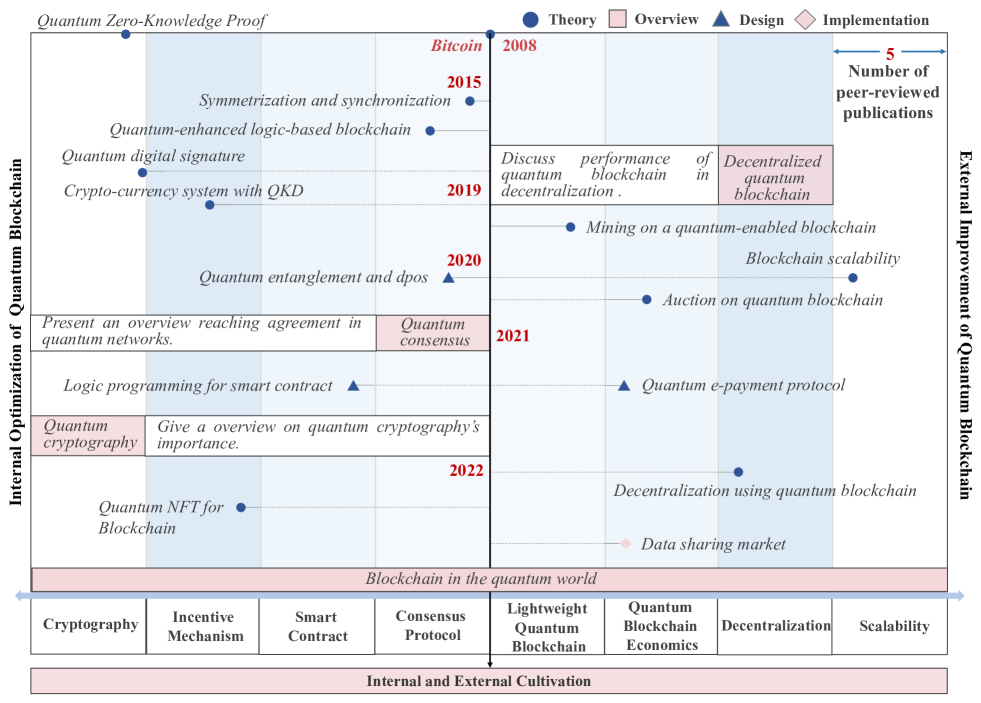
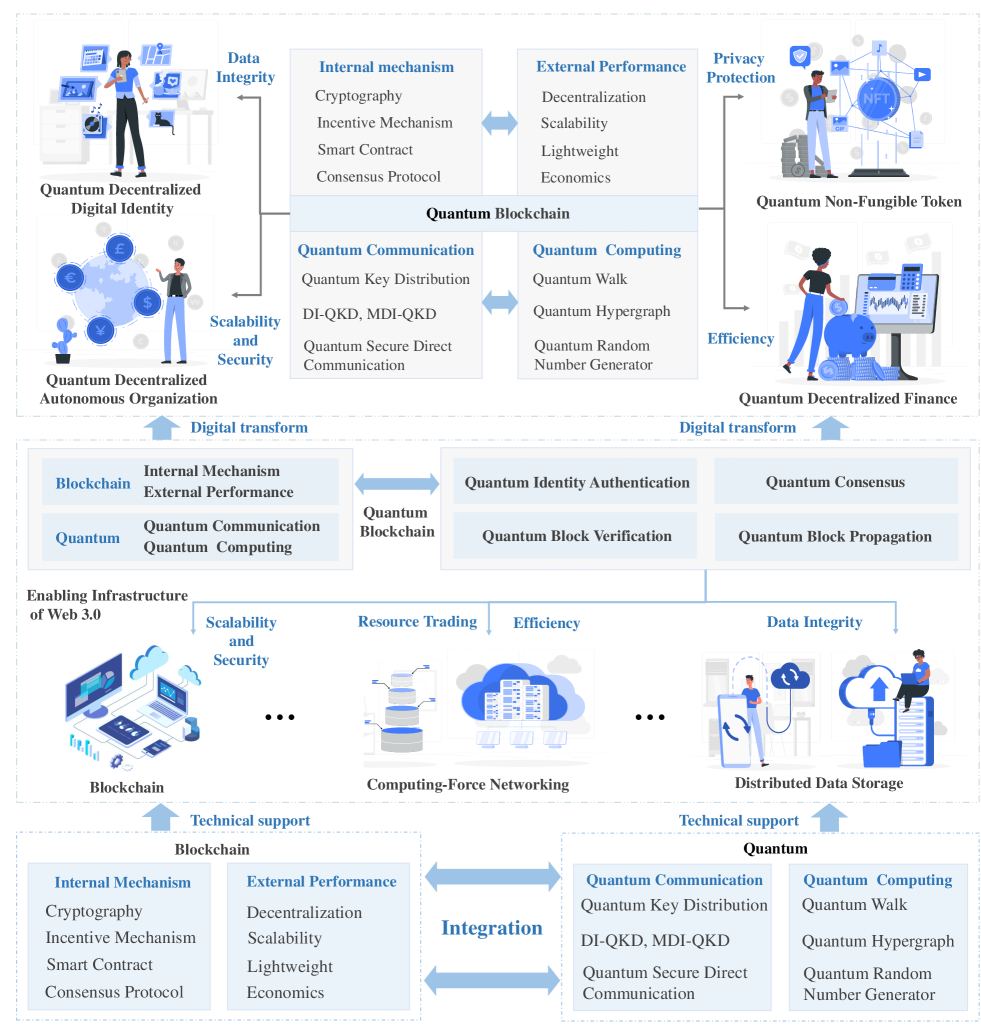
With the drive to create a decentralized digital economy, Web 3.0 has become a cornerstone of digital transformation, developed on the basis of computing-force networking, distributed data storage, and blockchain. With the rapid realization of quantum devices, Web 3.0 is being developed in parallel with the deployment of quantum cloud computing and quantum Internet. In this regard, quantum computing first disrupts the original cryptographic systems that protect data security while reshaping modern cryptography with the advantages of quantum computing and communication. Therefore, in this paper, we introduce a quantum blockchain-driven Web 3.0 framework that provides information-theoretic security for decentralized data transferring and payment transactions. First, we present the framework of quantum blockchain-driven Web 3.0 with future-proof security during the transmission of data and transaction information. Next, we discuss the potential applications and challenges of implementing quantum blockchain in Web 3.0. Finally, we describe a use case for quantum non-fungible tokens (NFTs) and propose a quantum deep learning-based optimal auction for NFT trading to maximize the achievable revenue for sufficient liquidity in Web 3.0. In this way, the proposed framework can achieve proven security and sustainability for the next-generation decentralized digital society.
Motivation & Objective
- To address the vulnerability of classical blockchain to quantum attacks, particularly from Shor’s and Grover’s algorithms.
- To design a future-proof quantum blockchain framework that integrates quantum cryptography for long-term data security in Web 3.0.
- To enable secure, decentralized digital identity and quantum non-fungible tokens (QNFTs) using quantum consensus and quantum state verification.
- To develop an incentive mechanism that maximizes revenue in NFT markets while ensuring individual rationality and dominant strategy-incentive compatibility.
- To demonstrate the effectiveness of quantum deep learning in achieving optimal auction outcomes with reduced model complexity.
Proposed method
- The framework integrates quantum key distribution (QKD) and one-time pad encryption for information-theoretic secure communication in Web 3.0.
- Quantum hash functions and quantum signature algorithms are used to secure blockchain transactions and digital identities.
- A quantum delegated proof-of-stake (QDPoS) consensus mechanism enables trustless, quantum-secure validation of QNFT creation and distribution.
- Quantum non-fungible tokens (QNFTs) are encoded as entangled quantum states, with the first qubit storing UGC metadata and the second a random phase for uniqueness.
- A quantum deep learning-based optimal auction (QDLA) replaces classical neural networks with quantum circuits (AngleEmbedding and BasicEntangler layers) to optimize NFT pricing and allocation.
- The QDLA uses long-short term memory (LSTM) nodes for bid processing and applies ReLU and softmax functions to output price rules and allocation probabilities.
Experimental results
Research questions
- RQ1How can quantum blockchain be architected to provide information-theoretic security for decentralized Web 3.0 systems?
- RQ2What are the key challenges and applications of integrating quantum cryptography into blockchain for future-proof data protection?
- RQ3Can quantum deep learning outperform classical deep learning in optimizing NFT auctions while reducing model parameters?
- RQ4How can quantum consensus mechanisms like QDPoS ensure secure and scalable QNFT issuance and verification?
- RQ5To what extent does the proposed QDLA achieve revenue maximization while preserving individual rationality and dominant strategy-incentive compatibility?
Key findings
- The QDLA achieved expected revenue comparable to classical deep learning-based auctions (DLA), demonstrating its effectiveness in revenue optimization.
- Despite having fewer parameters—4 LSTM units and 16 hidden units in classical layers, and 4 qubits with 6 layers in quantum circuits—the QDLA matched the revenue performance of the larger DLA.
- The regret metric, measuring deviation from optimal utility, converged close to zero for both DLA and QDLA, indicating successful enforcement of dominant strategy-incentive compatibility.
- The QDLA showed improved robustness compared to DLA, suggesting better generalization and stability in auction outcomes.
- The proposed quantum blockchain framework enables secure, scalable, and sustainable Web 3.0 services, including quantum-secured NFTs and decentralized identity systems.
- Experimental results confirmed that quantum blockchain can provide long-term security beyond classical cryptographic assumptions, even under threat from large-scale quantum computers.
Read this paper
Open the full text in the Nubint reader and ask about any passage as you read.
Read this paper on NubintThis review was generated by AI from the original paper. Please check the paper before citing it.