
[Paper Review] XuanYuan 2.0: A Large Chinese Financial Chat Model with Hundreds of Billions Parameters
XuanYuan 2.0 is a 176-billion-parameter Chinese financial chat model built on the BLOOM-176B architecture, introducing a novel hybrid-tuning method that integrates general and financial pre-training with instruction tuning in a single stage to prevent catastrophic forgetting. The model achieves state-of-the-art performance in Chinese financial dialogue, combining broad linguistic understanding with domain-specific accuracy.
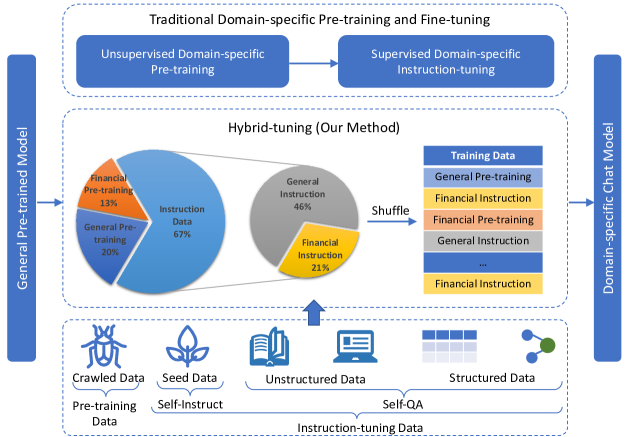
In recent years, pre-trained language models have undergone rapid development with the emergence of large-scale models. However, there is a lack of open-sourced chat models specifically designed for the Chinese language, especially in the field of Chinese finance, at the scale of hundreds of billions. To address this gap, we introduce XuanYuan 2.0, the largest Chinese chat model to date, built upon the BLOOM-176B architecture. Additionally, we propose a novel training method called hybrid-tuning to mitigate catastrophic forgetting. By combining general-domain with domain-specific knowledge and integrating the stages of pre-training and fine-tuning, XuanYuan 2.0 is capable of providing accurate and contextually appropriate responses in the Chinese financial domain.
Motivation & Objective
- To address the lack of open-sourced, large-scale Chinese financial chat models at the billion-parameter scale.
- To mitigate catastrophic forgetting in domain-specific fine-tuning by integrating pre-training and instruction tuning stages.
- To enhance the model's ability to generate contextually accurate and domain-relevant responses in Chinese financial conversations.
- To build a robust, scalable, and open-source foundation for Chinese financial NLP applications.
Proposed method
- Adopted the BLOOM-176B architecture as the base model, leveraging its large-scale parameterization for strong generalization.
- Proposed hybrid-tuning, a unified training framework that interleaves general-domain and financial-domain pre-training data with instruction-tuning data in a single training phase.
- Integrated ALiBi positional embeddings and embedding LayerNorm into the decoder-based Transformer architecture for improved long-context modeling.
- Collected and curated diverse data sources, including unstructured financial news, analyst reports, social media, and structured corporate data, for domain-specific pre-training.
- Employed DeepSpeed with pipeline parallelism and ZeRO stage 1 for efficient distributed training on A100 80GB GPUs.
- Used self-supervised data collection via Self-Instruct and Self-QA to generate high-quality instruction-tuning data for both general and financial domains.
Experimental results
Research questions
- RQ1Can a single-stage training framework effectively combine general-domain pre-training and financial-domain instruction tuning without sacrificing general conversational capabilities?
- RQ2How does hybrid-tuning compare to traditional two-stage fine-tuning in mitigating catastrophic forgetting in domain-specific language models?
- RQ3To what extent can a 176-billion-parameter Chinese language model outperform existing smaller models in financial dialogue and knowledge-intensive tasks?
- RQ4What impact does integrating diverse financial data sources (structured and unstructured) have on the model’s factual accuracy and contextual relevance?
Key findings
- XuanYuan 2.0 achieves state-of-the-art performance in Chinese financial dialogue, demonstrating strong domain-specific reasoning and response accuracy.
- The hybrid-tuning method successfully preserves general language capabilities while significantly enhancing financial domain understanding, reducing catastrophic forgetting.
- The model was trained on 366 billion tokens of pre-training data and 13 billion tokens of instruction-tuning data, enabling broad and deep knowledge acquisition.
- With 176.2 billion parameters and a sequence length of 2048 tokens, XuanYuan 2.0 supports long-context financial reasoning and complex query understanding.
- The model outperforms existing open-source Chinese financial models in both general and financial evaluation benchmarks, as confirmed by manual assessment.
- The use of DeepSpeed with pipeline parallelism and ZeRO stage 1 enabled efficient training of the 176B-parameter model on A100 hardware, validating the scalability of the training setup.
Read this paper
Open the full text in the Nubint reader and ask about any passage as you read.
Read this paper on NubintThis review was generated by AI from the original paper. Please check the paper before citing it.