
[Paper Review] Zeeman tomography of magnetic white dwarfs III. The 70-80 Megagauss magnetic field of PG 1015+014
This study uses Zeeman tomography on high-resolution spectropolarimetric data from the VLT to reconstruct the complex magnetic field geometry of the white dwarf PG 1015+014. It reveals a dominant field strength of 70 MG with a secondary peak at 80 MG over one-third of the rotation cycle, indicating a non-dipolar, multipolar field structure that cannot be described by simple oblique dipole models, with field contributions spanning 50–90 MG and significant discrepancies suggesting unmodeled small-scale field structure.
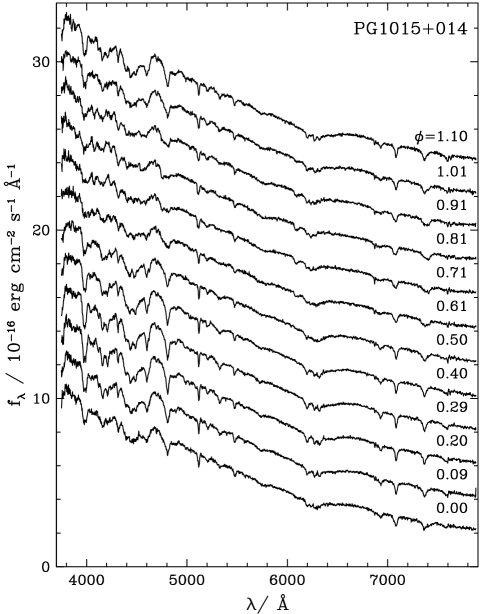
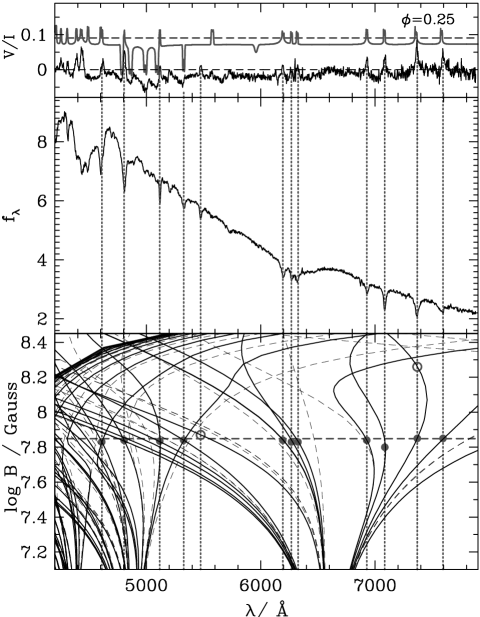
<b>Aims:</b> We analyse the magnetic field geometry of the magnetic DA white dwarf PG 1015+014 with our Zeeman tomography method.<br> <b>Methods:</b> This study is based on rotation-phase resolved optical flux and circular polarization spectra of PG 1015+014 obtained with FORS1 at the ESO VLT. Our tomographic code makes use of an extensive database of pre-computed Zeeman spectra. The general approach has been described in Papers I and II of this series.<br> <b>Results:</b> The surface field strength distributions for all rotational phases of PG 1015+014 are characterised by a strong peak at 70 MG. A separate peak at 80 MG is seen for about one third of the rotation cycle. Significant contributions to the Zeeman features arise from regions with field strengths between 50 and 90 MG. We obtain equally good simultaneous fits to the observations, collected in five phase bins, for two different field parametrizations: (i) a superposition of individually tilted and off-centred zonal multipole components; and (ii) a truncated multipole expansion up to degree l = 4 including all zonal and tesseral components. The magnetic fields generated by both parametrizations exhibit a similar global structure of the absolute surface field values, but differ considerably in the topology of the field lines. An effective photospheric temperature of T<sub>eff</sub> = 10000 ± 1000 K was found.<br> <b>Conclusions:</b> Remaining discrepancies between the observations and our best-fit models suggest that additional small-scale structure of the magnetic field exists which our field models are unable to cover due to the restricted number of free parameters.<br>
Motivation & Objective
- To determine the detailed magnetic field geometry of the magnetic white dwarf PG 1015+014 using high-resolution spectropolarimetric data.
- To test whether standard oblique dipole or quadrupole models can reproduce the observed Zeeman features.
- To assess the limitations of current field modeling techniques in capturing the true complexity of magnetic field distributions on white dwarf surfaces.
- To investigate the implications of residual discrepancies between observed and synthetic spectra for model accuracy and field structure.
- To explore the potential for future improvements in field geometry reconstruction using higher-resolution models and more free parameters.
Proposed method
- Zeeman tomography is applied to rotation-phase-resolved flux and circular polarization spectra obtained with FORS1 at the ESO VLT.
- The method uses a pre-computed database of synthetic Zeeman spectra to match observed spectral features across multiple rotational phases.
- Two field parametrizations are tested: (i) a superposition of tilted, off-centered zonal multipole components and (ii) a truncated multipole expansion up to degree l=4 with zonal and tesseral components.
- Simultaneous fitting is performed across five phase bins to constrain the spatial distribution of field strengths and directions.
- Model spectra are synthesized using atomic parameters and Zeeman splitting theory, with effective temperature and field strength distributions iteratively adjusted.
- Residuals between observed and synthetic spectra are analyzed to assess model quality and identify systematic discrepancies.
Experimental results
Research questions
- RQ1Can a simple oblique dipole model adequately describe the Zeeman features observed in PG 1015+014?
- RQ2What is the spatial distribution of magnetic field strengths across the surface of PG 1015+014, and how does it vary with rotational phase?
- RQ3How do different field geometry parametrizations—multipole components versus truncated spherical harmonic expansions—compare in fitting the observed spectra?
- RQ4What do the residual discrepancies between observations and best-fit models suggest about the limitations of current modeling techniques?
- RQ5To what extent do systematic errors in synthetic spectra or insufficient spatial resolution of field models contribute to the observed mismatches?
Key findings
- The surface magnetic field strength distribution of PG 1015+014 is dominated by a strong peak at 70 MG, with a secondary peak at 80 MG present for approximately one-third of the rotation cycle.
- Significant contributions to the Zeeman features arise from regions with field strengths between 50 and 90 MG, indicating a broad distribution of field strengths across the stellar surface.
- Two distinct field parametrizations—off-centered zonal multipoles and a degree-l=4 truncated multipole expansion—yield equally good simultaneous fits to the five-phase data set.
- Despite good overall fits, residual discrepancies persist, suggesting the presence of unmodeled small-scale magnetic field structure beyond the current model complexity.
- The effective photospheric temperature is measured as 10,000 ± 1000 K, consistent with the object's spectral classification and evolutionary state.
- The failure of a simple oblique dipole model to reproduce the data confirms that PG 1015+014 hosts a complex, non-dipolar magnetic field geometry.
Read this paper
Open the full text in the Nubint reader and ask about any passage as you read.
Read this paper on NubintThis review was generated by AI from the original paper. Please check the paper before citing it.