
[Paper Review] Zero-shot Temporal Relation Extraction with ChatGPT
This paper evaluates ChatGPT's zero-shot capability for temporal relation extraction using three prompt strategies: zero-shot, event ranking, and chain-of-thought (CoT) prompting. Despite significant performance gaps compared to supervised models, CoT prompting improves results substantially, though ChatGPT exhibits critical flaws in consistency and long-dependency inference.
The goal of temporal relation extraction is to infer the temporal relation between two events in the document. Supervised models are dominant in this task. In this work, we investigate ChatGPT's ability on zero-shot temporal relation extraction. We designed three different prompt techniques to break down the task and evaluate ChatGPT. Our experiments show that ChatGPT's performance has a large gap with that of supervised methods and can heavily rely on the design of prompts. We further demonstrate that ChatGPT can infer more small relation classes correctly than supervised methods. The current shortcomings of ChatGPT on temporal relation extraction are also discussed in this paper. We found that ChatGPT cannot keep consistency during temporal inference and it fails in actively long-dependency temporal inference.
Motivation & Objective
- To investigate whether large language models like ChatGPT can perform zero-shot temporal relation extraction without fine-tuning.
- To evaluate the effectiveness of different prompt engineering techniques—zero-shot, event ranking, and chain-of-thought (CoT)—on ChatGPT’s performance.
- To identify the limitations of ChatGPT in temporal reasoning, particularly regarding consistency and long-distance dependency inference.
- To compare ChatGPT’s performance on low-resource (small) temporal relation classes against supervised models.
- To assess whether LLMs can serve as a viable alternative to supervised methods in zero-shot temporal relation extraction.
Proposed method
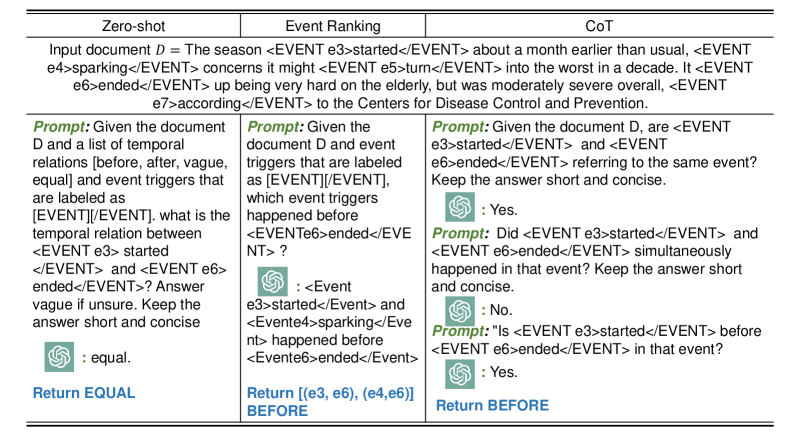
- Designed a zero-shot prompt that directly asks ChatGPT to classify the temporal relation between two events from a predefined list.
- Implemented an event ranking prompt where ChatGPT is asked to list events that happened before or after a given event trigger.
- Proposed a chain-of-thought (CoT) prompting strategy that decomposes the task into binary classification steps: first checking if a specific relation (e.g., BEFORE) holds, then refining the choice.
- Used the CoT approach to guide step-by-step reasoning, improving confidence and accuracy by leveraging intermediate reasoning states.
- Evaluated all prompts on standard temporal relation extraction datasets using standard metrics like F1 and precision/recall.
- Conducted ablation studies to compare performance across prompt types and analyzed failure cases for consistency and long-dependency issues.
Experimental results
Research questions
- RQ1Can ChatGPT perform zero-shot temporal relation extraction effectively without any fine-tuning?
- RQ2How does prompt engineering—specifically zero-shot, event ranking, and chain-of-thought (CoT) prompts—affect ChatGPT’s performance on temporal relation extraction?
- RQ3Does ChatGPT outperform supervised models on low-resource (rare) temporal relation classes despite overall lower performance?
- RQ4To what extent does ChatGPT maintain consistency in temporal reasoning when given the same input multiple times with different question phrasings?
- RQ5What are the key limitations of ChatGPT in handling long-dependency temporal relations and ambiguous temporal cues?
Key findings
- ChatGPT significantly underperforms supervised models, with performance gaps comparable to or worse than traditional neural networks like Bi-LSTM.
- The chain-of-thought (CoT) prompting strategy consistently outperforms zero-shot and event ranking prompts across all datasets, demonstrating the importance of structured reasoning in prompting.
- ChatGPT shows better performance on low-frequency temporal relation classes (e.g., 'VAGUE', 'EQUAL') than supervised models, suggesting potential advantages in zero-shot generalization for rare relations.
- ChatGPT exhibits severe inconsistency in temporal reasoning: given the same document, it may produce conflicting temporal relations when asked different but logically equivalent questions, with 84% of cases showing contradictory answers after claiming uncertainty.
- ChatGPT fails to handle long-dependency temporal relations effectively, indicating limitations in maintaining temporal context over longer spans.
- In CoT prompting, ChatGPT frequently fails to return 'vague' when uncertain, instead outputting phrases like 'Cannot determine' or 'Unknown', which are treated as 'vague' during evaluation, but still leads to inconsistent final classifications in multi-step reasoning.
Read this paper
Open the full text in the Nubint reader and ask about any passage as you read.
Read this paper on NubintThis review was generated by AI from the original paper. Please check the paper before citing it.