
[论文解读] A photonic source of heralded GHZ states
该论文利用固态量子点光源和稳定的偏振干涉仪,实现了高重率、后选的三光子极化编码Greenberger-Horne-Zeilinger(GHZ)态。通过探测三个辅助光子,系统以0.914 ± 0.006 Hz的速率后选成功生成的GHZ态,保真度高达0.7278 ± 0.0106,从而通过融合基协议实现可扩展的光量子计算。
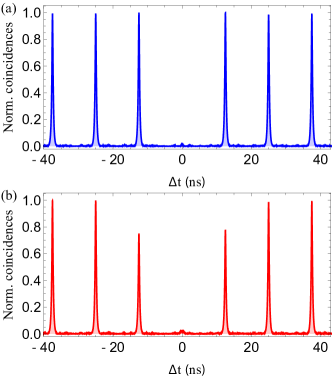
Generating large multiphoton entangled states is of main interest due to enabling universal photonic quantum computing and all-optical quantum repeater nodes. These applications exploit measurement-based quantum computation using cluster states. Remarkably, it was shown that photonic cluster states of arbitrary size can be generated by using feasible heralded linear optics fusion gates that act on heralded three-photon Greenberger-Horne-Zeilinger (GHZ) states as the initial resource state. Thus, the capability of generating heralded GHZ states is of great importance for scaling up photonic quantum computing. Here, we experimentally demonstrate this required building block by reporting a polarisation-encoded heralded GHZ state of three photons, for which we build a high-rate six-photon source ($547{\pm}2$ Hz) from a solid-state quantum emitter and a stable polarisation-based interferometer. The detection of three ancillary photons heralds the generation of three-photon GHZ states among the remaining particles with fidelities up to $\mathcal{F}=0.7278{\pm}0.0106$. Our results initiate a path for scalable entangling operations using heralded linear-optics implementations.
研究动机与目标
- 开发一种可扩展的、高重率的后选多光子纠缠态光源,用于光量子计算。
- 展示一种实用的、对损耗具有容忍性的通用量子计算路径,仅依赖线性光学和后选操作。
- 通过确定性多光子干涉和伪数分辨探测,实现高保真度的三光子GHZ态。
- 通过提供可靠、高质量的资源态,使未来基于融合的量子计算协议成为可能。
- 推动使用固态发射器和集成光子电路实现多光子纠缠生成的极限。
提出的方法
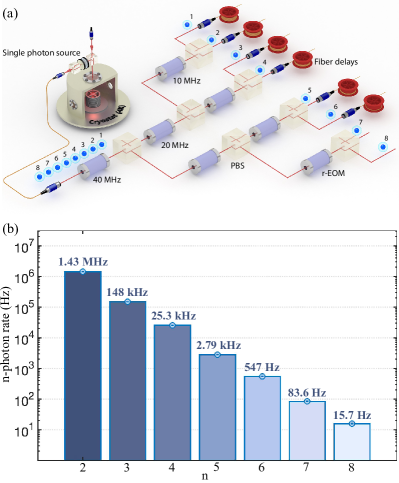
- 使用了效率为28.7%的光纤高效量子点单光子源,以547 ± 2 Hz的速率生成六个体素不可区分的光子。
- 通过在多个频率(10、20、40 MHz)下同步的七组电光调制器(r-EOMs)实现主动去复用,实现了对八个连续时间窗口的确定性时移复用。
- 采用稳定、基于光纤的偏振干涉仪,相干叠加六个光子,实现高可见度的量子干涉。
- 采用伪数分辨探测技术探测三个后选光子,以实现对剩余三个光子处于GHZ态的后选,探测使用了18个超导纳米线单光子探测器(SNSPDs)。
- 通过测量三个信号量子比特上所有27种Pauli算符(X、Y、Z)的组合,对|GHZ⁺⟩和|GHZ⁻⟩态进行了过完备量子态层析。
- 保真度相对于理想GHZ态进行计算,并对重建密度矩阵中的微小虚部分量进行相位校正。
实验结果
研究问题
- RQ1能否利用固态量子点光源和线性光学生成高重率、后选的三光子GHZ态?
- RQ2该光源和干涉仪设置下,后选GHZ态的可实现保真度和生成速率是多少?
- RQ3能否使用单一多光子光源同时对|GHZ⁺⟩和|GHZ⁻⟩态进行过完备量子态层析?
- RQ4该系统的性能在多大程度上支持可扩展的融合基量子计算协议?
- RQ5光路中的损耗和效率低下如何影响整体后选态生成速率和保真度?
主要发现
- 六光子源的探测速率达到547 ± 2 Hz,支持高计数率实验。
- 后选的三光子GHZ态以0.914 ± 0.006 Hz的速率生成,与考虑光学损耗和探测效率低下的理论预期一致。
- 经相位校正后,对理想|GHZ⁺⟩态的保真度测量为0.7278 ± 0.0106,证实了高质量纠缠。
- 对|GHZ⁻⟩态的保真度为0.7083 ± 0.0120,密度矩阵中的微小虚部表明存在微小相位偏移。
- 系统展示了真正的三体纠缠,保真度见证值为⟨W_GHZ⟩ = -0.2613 ± 0.0335,超过七个标准差。
- 八光子速率达15.7 ± 0.4 Hz,表明系统具备向十光子级协议扩展的潜力。
更好的研究,从现在开始
从阅读论文到最终审阅,大幅缩短您的研究时间。
无需绑定信用卡
本解读由 AI 生成,并经人工编辑审核。