
[论文解读] Accurate and efficient structure elucidation from routine one-dimensional NMR spectra using multitask machine learning
本文提出了一种多任务机器学习框架,可在无需分子式或片段信息的前提下,直接从原始的一维¹H和¹³C NMR谱图中实现有机分子的精确端到端结构解析。该模型采用基于变换器的架构,在子结构到结构映射任务上进行预训练,并结合卷积神经网络(CNN)进行谱图编码,实现了在最多含19个重原子的分子中,正确结构预测的top-15准确率达到69.6%,并将搜索空间缩小了高达11个数量级。
Rapid determination of molecular structures can greatly accelerate workflows across many chemical disciplines. However, elucidating structure using only one-dimensional (1D) NMR spectra, the most readily accessible data, remains an extremely challenging problem because of the combinatorial explosion of the number of possible molecules as the number of constituent atoms is increased. Here, we introduce a multitask machine learning framework that predicts the molecular structure (formula and connectivity) of an unknown compound solely based on its 1D 1H and/or 13C NMR spectra. First, we show how a transformer architecture can be constructed to efficiently solve the task, traditionally performed by chemists, of assembling large numbers of molecular fragments into molecular structures. Integrating this capability with a convolutional neural network (CNN), we build an end-to-end model for predicting structure from spectra that is fast and accurate. We demonstrate the effectiveness of this framework on molecules with up to 19 heavy (non-hydrogen) atoms, a size for which there are trillions of possible structures. Without relying on any prior chemical knowledge such as the molecular formula, we show that our approach predicts the exact molecule 69.6% of the time within the first 15 predictions, reducing the search space by up to 11 orders of magnitude.
研究动机与目标
- 解决在不依赖分子式或片段信息的前提下,从常规一维NMR谱图中实现无监督、高精度结构解析的挑战。
- 克服当分子大小超过10–19个重原子时,可能的分子结构组合爆炸性增长的问题。
- 开发一种端到端的深度学习框架,直接将原始NMR谱图映射为分子连接性和分子式。
- 实现快速、可扩展且易于访问的结构解析,适用于化学研究、教育及工业流程。
- 为未来扩展至立体化学、更大分子及更广泛的元素多样性奠定基础。
提出的方法
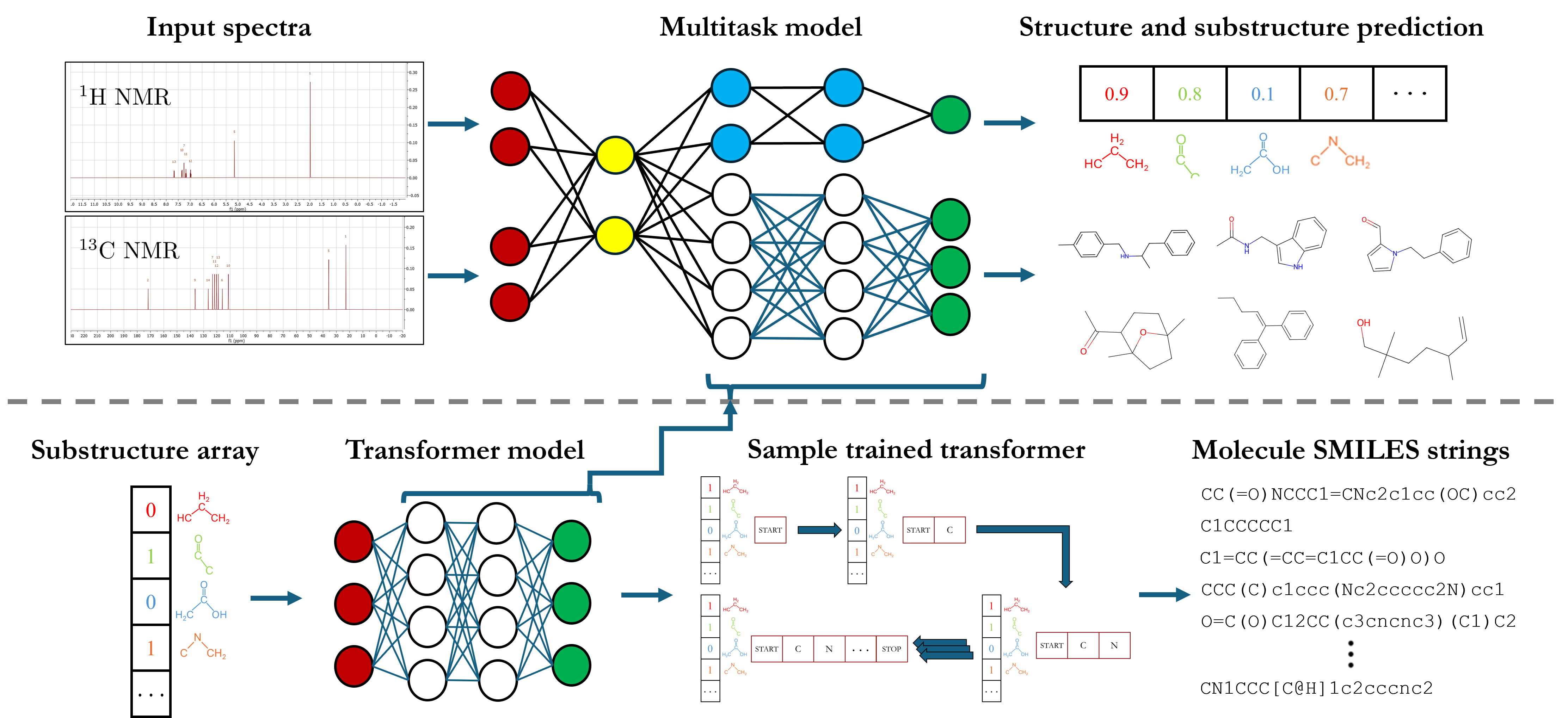
- 使用变换器模型在957种简单子结构(≤7个原子)的存在或缺失基础上进行预训练,以实现高效的结构组装。
- 采用卷积神经网络(CNN)将原始的一维¹H和¹³C NMR谱图编码为潜在表征,无需大量预处理。
- 将预训练的变换器与CNN整合到多任务学习框架中,联合预测分子子结构和完整分子结构。
- 在含最多19个重原子的分子的模拟NMR谱图上进行端到端训练,仅以谱图数据作为输入。
- 框架采用束搜索策略生成并排序候选结构,对最高预测结果进行准确率评估。
- 在含10–19个重原子的分子基准数据集上评估模型,测量top-1和top-15准确率。
实验结果
研究问题
- RQ1多任务深度学习模型能否在不依赖分子式或片段信息的前提下,仅凭原始一维NMR谱图准确预测分子结构?
- RQ2随着分子尺寸增大,特别是可能结构数量呈组合爆炸式增长时,模型性能如何变化?
- RQ3基于变换器的架构能否有效利用子结构存在/缺失信号重建分子连接性?
- RQ4与以往方法相比,通过CNN实现谱图编码与通过变换器实现结构生成的联合集成,在多大程度上提升了预测准确率?
- RQ5该模型能否在多种多样的分子骨架上实现泛化,并在谱图解析复杂性较高的情况下仍保持高准确率?
主要发现
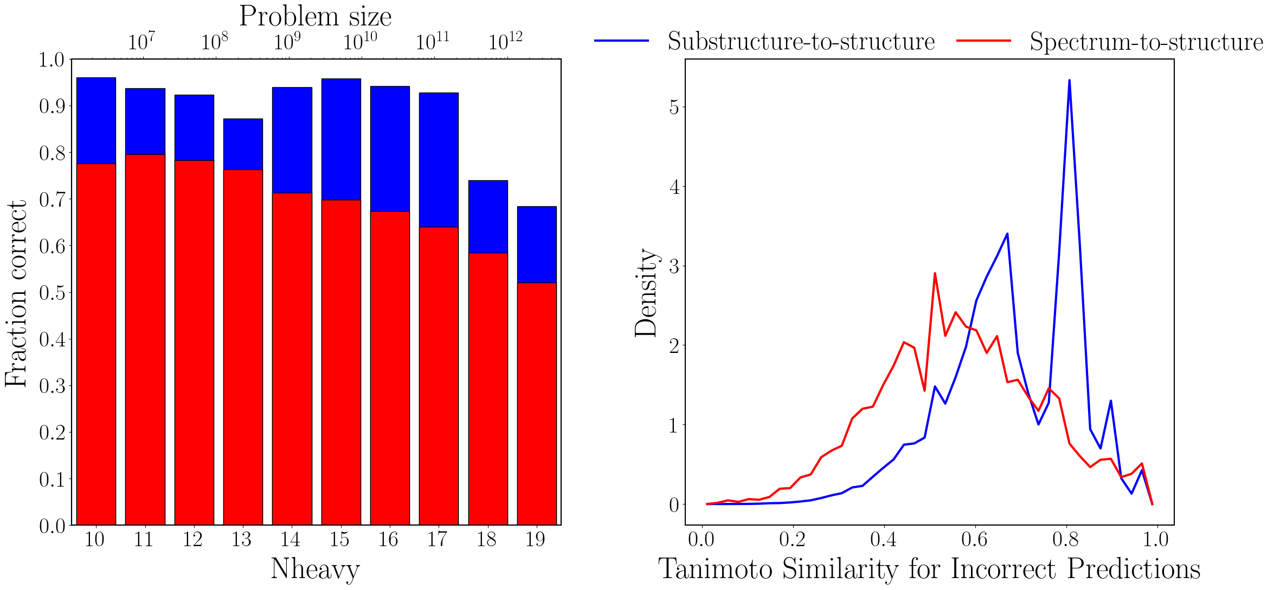
- 仅使用原始¹H和¹³C NMR谱图,该模型在最多含19个重原子的分子中,实现了69.6%的top-15结构预测准确率。
- 该框架将有效搜索空间缩小了高达11个数量级,使得对数万亿种可能结构的高效探索成为可能。
- 模型在不同分子尺寸下保持高性能,当可能分子数量增加5个数量级时,准确率仅下降25.5%。
- 仅使用预训练变换器对子结构输入进行结构重建,即可达到93.2%的top-15准确率,证明其在分子组装任务中的强大鲁棒性。
- 在标准CPU(AMD Ryzen 7 3700X)上,完整结构预测耗时不足3秒,使该方法在实际应用中高度可访问且实用。
- 该模型具备良好的泛化能力,可通过在训练数据中引入立体中心和双键构型信息,进一步扩展以预测立体化学。
更好的研究,从现在开始
从阅读论文到最终审阅,大幅缩短您的研究时间。
无需绑定信用卡
本解读由 AI 生成,并经人工编辑审核。