
[论文解读] Adaptive Trotterization for time-dependent Hamiltonian quantum dynamics using piecewise conservation laws
该论文提出 tADA-Trotter,一种用于时变量子哈密顿量的自适应 Trotter 化算法,利用有效时间无关哈密顿量的瞬时守恒律来界定局部和全局误差。通过根据测量到的能量与能量方差偏差动态调整时间步长,该方法抑制了 Trotter 引发的加热效应,并在减少线路深度的同时实现了比固定步长 Trotter 化更高的模拟精度。
Digital quantum simulation relies on Trotterization to discretize time evolution into elementary quantum gates. On current quantum processors with notable gate imperfections, there is a critical tradeoff between improved accuracy for finer timesteps, and increased error rate on account of the larger circuit depth. We present an adaptive Trotterization algorithm to cope with time-dependent Hamiltonians, where we propose a concept of piecewise "conserved" quantities to estimate errors in the time evolution between two (nearby) points in time; these allow us to bound the errors accumulated over the full simulation period. They reduce to standard conservation laws in the case of time-independent Hamiltonians, for which we first developed an adaptive Trotterization scheme [PRX Quantum 4, 030319]. We validate the algorithm for a time-dependent quantum spin chain, demonstrating that it can outperform the conventional Trotter algorithm with a fixed step size at a controlled error.
研究动机与目标
- 为在噪声中等规模量子(NISQ)设备上进行时变哈密顿量的数字量子模拟时,解决模拟精度与线路深度之间的平衡挑战。
- 将自适应 Trotter 化——此前仅限于时间无关系统——扩展至时变场景,通过引入时间步长自适应的判据。
- 通过全局误差控制抑制 Trotter 引发的加热效应,实现可靠的长时间模拟。
- 提供一种基于反馈的算法,利用可测量量(能量与能量方差)实时引导时间步长自适应。
- 在受驱动的量子自旋链上验证该方法,证明其性能优于固定步长 Trotter 化。
提出的方法
- 该方法将时间演化离散化为区间 [t, t+δt],在每个区间内通过 δt 的微扰 Magnus 展开定义一个有效的时间无关哈密顿量 H_{[∞]}^{t,δt}。
- 在每个区间内,算法强制实施瞬时守恒律:H_{[∞]}^{t,δt} 及其方差的期望值在演化后应保持不变。
- 自适应时间步长 δt 通过测量 Trotter 化演化前后这些期望值的偏差来确定,δt 在误差保持有界的前提下被最大化。
- 全局误差被定义为瞬时守恒律中局部误差的累积和,通过反馈机制加以约束,以防止误差累积。
- 该算法使用截断的 Magnus 展开 H_{[k]}^{t,δt} 来近似 H_{[∞]}^{t,δt},并应用 Trotter 分解 U_{[λ]}(t+δt,t) 进行时间演化。
- 反馈回路动态调整 δt,当局部误差超过阈值时减小 δt,当误差较小时则增加 δt,尤其在动力学缓慢区域表现更优。
![Figure 1: Schematics of tADA-Trotter for a time-dependent Hamiltonian. (a) The expectation values of the instantaneous conserved Hamiltonian $H_{[\infty]}^{t,\delta t}$ coincide at times $t$ and $t+\delta t$ . We maximize $\delta t$ as long as errors in this conservation law are bounded, i.e., devia](https://ar5iv.labs.arxiv.org/html/2307.10327/assets/x1.png)
实验结果
研究问题
- RQ1能否利用有效时间无关哈密顿量的瞬时守恒律来定义时变系统中自适应 Trotter 化的可靠误差度量?
- RQ2如何控制局部 Trotter 误差引起的全局误差累积,以在长时间模拟中抑制 Trotter 引发的加热效应?
- RQ3基于测量到的能量与能量方差的自适应步长能否在精度和线路深度方面优于固定步长 Trotter 化?
- RQ4该算法在强时变驱动和复杂多体动力学下是否仍能保持精度?
- RQ5该框架能否推广至开放量子系统或更高阶的 Trotter 方案?
主要发现
- tADA-Trotter 通过约束瞬时守恒律中误差的累积,成功抑制了 Trotter 引发的加热效应,实现了可靠的长时间模拟。
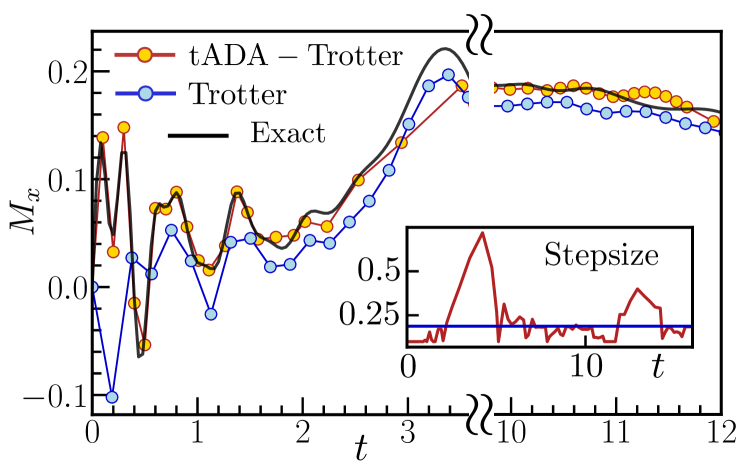
- 该算法在精度上显著优于固定步长 Trotter 化,模拟误差在 t > 11 时才变得明显,而固定步长误差在更早时间(t > 5)即已显现。
- 自适应时间步长在 [0.1, 0.7] 范围内动态变化,在快速变化的动力学区域减小至 0.1,而在平静区域增加至 0.7,展现出良好的灵活性。
- 在大部分模拟过程中,H_{[k]} 及其方差的期望值累积误差保持在指定阈值以下,偶尔出现超出阈值的情况,主要源于早期时间容忍度过紧。
- 该方法在保持精度的同时减少了线路深度,如红色(全局有界)数据紧密跟随精确解所示,而蓝色(固定步长)数据则早期即发生偏离。
- 对于驱动参数为 ω = 0.8 且 τ = 30 的自旋链系统,tADA-Trotter 实现了约 t ~ 20 的总模拟时间,仅使用 N = 100 次 Trotter 步骤,证明了其实际可行性。
更好的研究,从现在开始
从阅读论文到最终审阅,大幅缩短您的研究时间。
无需绑定信用卡
本解读由 AI 生成,并经人工编辑审核。