
[论文解读] Atmospheric Reconnaissance of TRAPPIST-1 b with JWST/NIRISS: Evidence for Strong Stellar Contamination in the Transmission Spectra
本研究首次公布了TRAPPIST-1 b的JWST/NIRISS透射光谱,揭示了未掩星黑子和白区对信号的强烈恒星污染,主导了观测结果。尽管确认了不存在无云氢丰富大气,但恒星模型在低重力和磁场效应方面的不准确,限制了可靠的大气表征,凸显了未来对低温恒星系系外行星研究中的关键挑战。
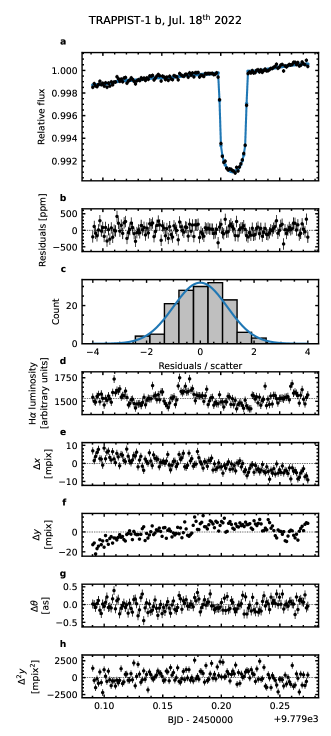
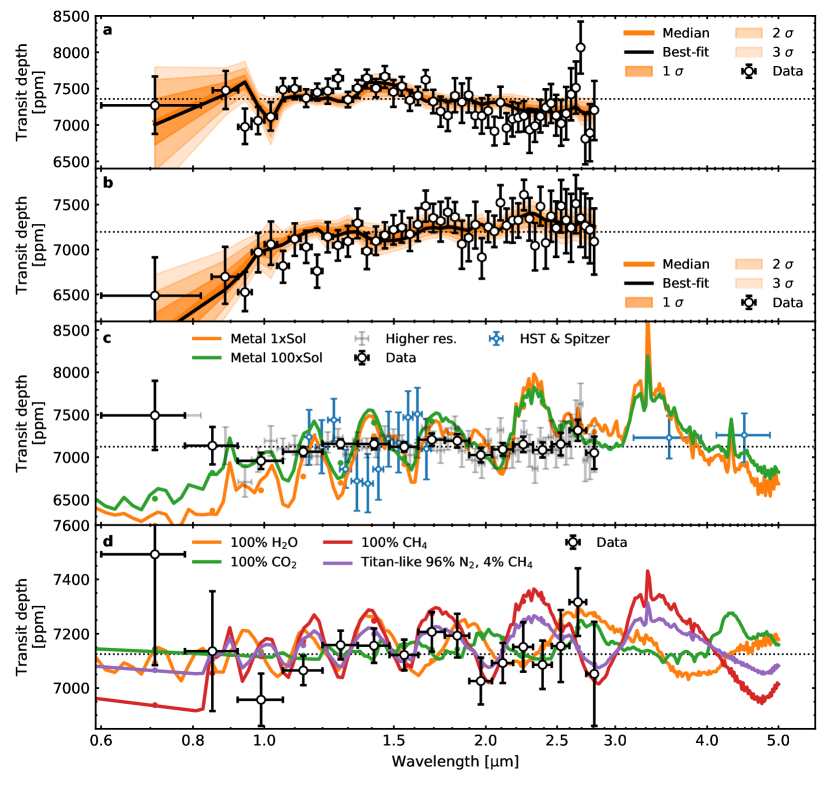
TRAPPIST-1 is a nearby system of seven Earth-sized, temperate, rocky exoplanets transiting a Jupiter-sized M8.5V star, ideally suited for in-depth atmospheric studies. Each TRAPPIST-1 planet has been observed in transmission both from space and from the ground, confidently rejecting cloud-free, hydrogen-rich atmospheres. Secondary eclipse observations of TRAPPIST-1 b with JWST/MIRI are consistent with little to no atmosphere given the lack of heat redistribution. Here we present the first transmission spectra of TRAPPIST-1 b obtained with JWST/NIRISS over two visits. The two transmission spectra show moderate to strong evidence of contamination from unocculted stellar heterogeneities, which dominates the signal in both visits. The transmission spectrum of the first visit is consistent with unocculted starspots and the second visit exhibits signatures of unocculted faculae. Fitting the stellar contamination and planetary atmosphere either sequentially or simultaneously, we confirm the absence of cloud-free hydrogen-rich atmospheres, but cannot assess the presence of secondary atmospheres. We find that the uncertainties associated with the lack of stellar model fidelity are one order of magnitude above the observation precision of 89 ppm (combining the two visits). Without affecting the conclusion regarding the atmosphere of TRAPPIST-1 b, this highlights an important caveat for future explorations, which calls for additional observations to characterize stellar heterogeneities empirically and/or theoretical works to improve model fidelity for such cool stars. This need is all the more justified as stellar contamination can affect the search for atmospheres around the outer, cooler TRAPPIST-1 planets for which transmission spectroscopy is currently the most efficient technique.
研究动机与目标
- 利用来自两次独立凌日的JWST/NIRISS数据,表征TRAPPIST-1 b的大气透射光谱。
- 研究恒星非均质性——特别是未掩星黑子和白区——对透射光谱信号的影响。
- 评估在存在恒星污染和模型保真度限制的情况下,大气反演结果的可靠性。
- 评估当前恒星大气模型(PHOENIX和SPHINX)是否能准确再现TRAPPIST-1的观测恒星光谱。
- 识别由于未解析的恒星活动,未来对M型恒星周围类地温带系外行星进行透射光谱研究的关键注意事项。
提出的方法
- 利用JWST/NIRISS在两次独立凌日中获取了TRAPPIST-1 b的高精度透射光谱。
- 使用POSEIDON进行大气反演,结合恒星污染模型,对观测光谱进行行星大气与恒星污染的联合拟合。
- 在有效温度范围(2300–2800 K)和表面重力范围(2.5–5.5 dex)内,将观测的SOSS光谱与PHOENIX和SPHINX恒星大气模型进行比较。
- 使用emcee和PyMultiNest进行马尔可夫链蒙特卡洛(MCMC)方法,同步拟合恒星污染和行星大气参数。
- 通过计算观测光谱与模型光谱之间的χ²来量化模型保真度,识别关键光谱区域中的系统性不匹配。
- 采用数据驱动和理论方法,评估因恒星模型不完善,特别是在低重力和磁场效应方面引起的不确定性。
实验结果
研究问题
- RQ1未掩星黑子和白区在JWST/NIRISS观测中对TRAPPIST-1 b透射光谱的污染程度如何?
- RQ2当前恒星大气模型(PHOENIX和SPHINX)能否在NIRISS波长范围内准确再现TRAPPIST-1的观测光谱?
- RQ3恒星模型保真度的不确定性如何影响TRAPPIST-1 b大气反演结果的可靠性?
- RQ4恒星非均质性对M型恒星周围类地温带系外行星透射光谱解释有何影响?
- RQ5观测到的光谱不匹配是否可归因于模型中缺失的物理因素,如磁场或非均匀重力?
主要发现
- 首次观测访问的透射光谱显示出强烈的未掩星黑子证据,而第二次访问则表现出未掩星白区的特征。
- 两次访问中,恒星污染均主导了信号,模型保真度带来的不确定性比观测精度高出一个数量级(89 ppm)。
- 最佳拟合的PHOENIX模型的有效温度为2600 K,表面重力为3.5 dex,但无法再现0.7至0.8 μm之间的特征。
- SPHINX模型在0.9–1.1 μm范围内提供更好的拟合,但在1.5–1.7 μm水带翼区域表现不佳,原因在于光谱分辨率较低且重力覆盖范围有限。
- 在测试的所有恒星模型(PHOENIX或SPHINX)中,均无法以足够精度再现完整的SOSS光谱,表明存在缺失的物理因素,如磁场或非均匀重力。
- 尽管存在污染,分析仍确认TRAPPIST-1 b不存在无云氢丰富大气,但由于恒星模型的限制,无法约束次级大气。
更好的研究,从现在开始
从阅读论文到最终审阅,大幅缩短您的研究时间。
无需绑定信用卡
本解读由 AI 生成,并经人工编辑审核。