
[论文解读] Emergence of Debye scaling in the density of states of liquids under nanoconfinement
本研究通过实验和分子动力学模拟证明,纳米限域可使水和甘油等液体在低频段(1–4 meV)的振动态密度(VDOS)呈现类固体重波标度($g(\omega) \propto \omega^2$),从液态的$\omega$-标度过渡而来。该行为的出现与非阻尼集体剪切波的出现相关联,并伴随自扩散系数降低,与弗伦克尔判据及k-间隙理论相联系,从而为短尺度下液体与固体之间的连续性提供了直接证据。
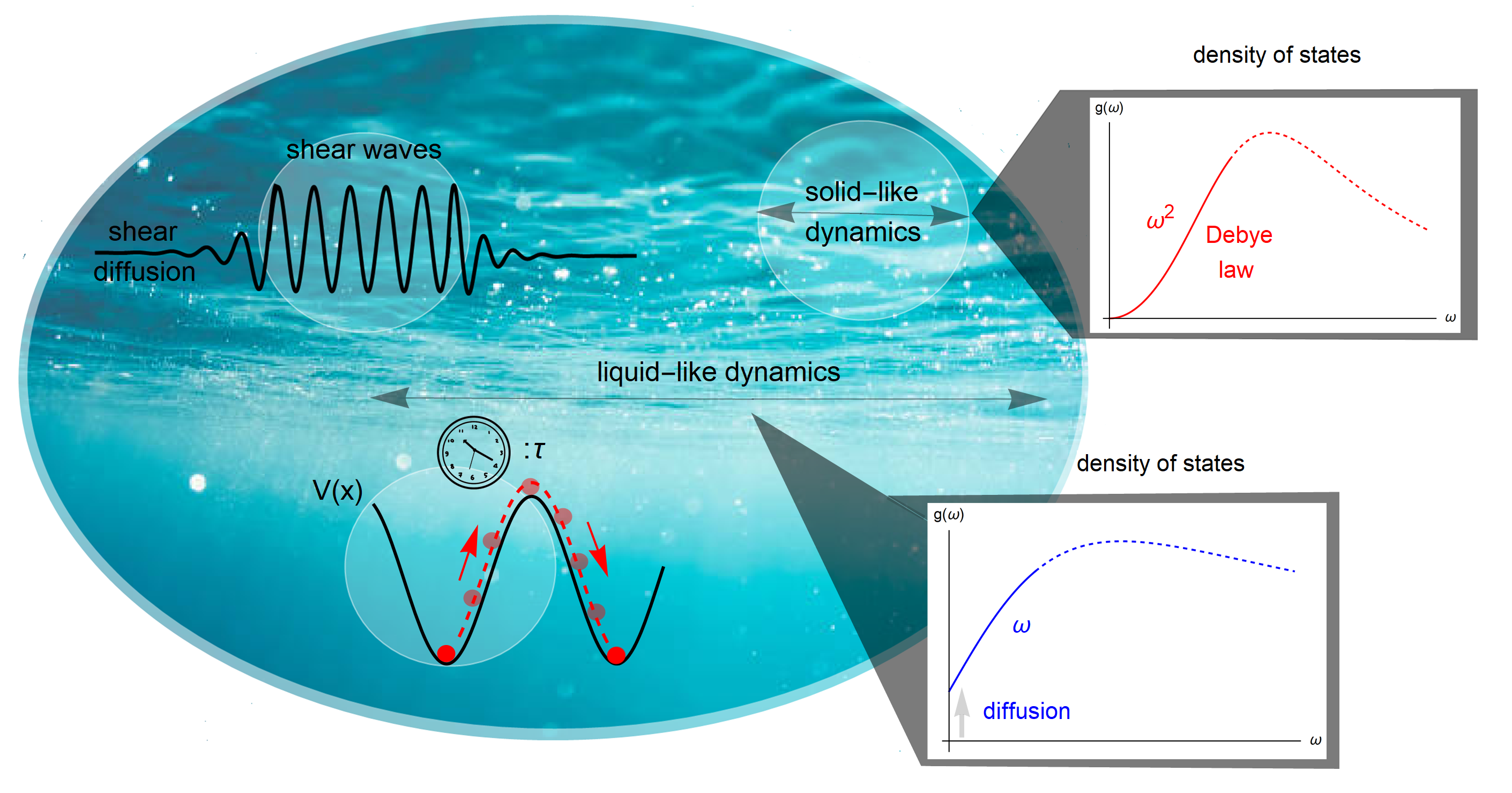
In the realm of nanoscience, the dynamic behaviors of liquids at scales beyond the conventional structural relaxation time, $τ$, unfold a fascinating blend of solid-like characteristics, including the propagation of collective shear waves and the emergence of elasticity. However, in classical bulk liquids, where $τ$ is typically of the order of 1 ps or less, this solid-like behavior remains elusive in the low-frequency region of the density of states (DOS). Here, we provide evidence for the emergent solid-like nature of liquids at short distances through inelastic neutron scattering measurements of the low-frequency DOS in liquid water and glycerol confined within graphene oxide membranes. In particular, upon increasing the strength of confinement, we observe a transition from a liquid-like DOS (linear in the frequency $ω$) to a solid-like behavior (Debye law, $\simω^2$) in the range of $1$-$4$ meV. Molecular dynamics simulations confirm these findings and reveal additional solid-like features, including propagating collective shear waves and a reduction in the self-diffusion constant. Finally, we show that the onset of solid-like dynamics is pushed towards low frequency along with the slowing-down of the relaxation processes upon confinement. This nanoconfinement-induced transition, aligning with k-gap theory, underscores the potential of leveraging liquid nanoconfinement in advancing nanoscale science and technology, building more connections between fluid dynamics and materials engineering.
研究动机与目标
- 研究纳米限域是否能在液体中诱导类固体动力学,特别是其低频振动态密度(VDOS)的行为。
- 检验假设:弗伦克尔判据($\omega > 1/\tau$)控制受限液体中类固体行为的出现。
- 确定受限条件下是否如k-间隙理论与电报方程模型所预测的那样,从液态的($g(\omega) \propto \omega$)到类固体的($g(\omega) \propto \omega^2$)VDOS标度发生转变。
- 建立结构弛豫时间($\tau$)、集体剪切波动力学与受限液体中重波行为出现之间的定量关联。
提出的方法
- 通过在氧化石墨烯膜中限域的液态水和甘油进行非弹性中子散射(INS)测量,探测其低频VDOS。
- 利用分子动力学(MD)模拟对受限液体的动力学行为进行建模,包括剪切波传播与自扩散系数。
- 从MD数据中提取集体剪切波的色散关系,并拟合至电报方程模型,以描述非阻尼与阻尼动力学。
- 利用k空间中的德拜球近似,从波色散关系计算VDOS,得到$g(\omega) \propto \omega \sqrt{4\omega^2 + \gamma^2}/v^3$,其中$\gamma = 1/\tau_g$。
- 以弗伦克尔频率$\omega_F = 1/\tau_g$作为交叉尺度,识别从弛豫动力学到振荡动力学的转变。
- 理论分析将重波标度的出现与条件$\omega \gg 1/\tau$联系起来,其中$\tau$为结构弛豫时间,并将结果与k-间隙理论进行比较。
实验结果
研究问题
- RQ1纳米限域是否在液体中诱导从液态($\omega$-标度)到类固体($\omega^2$-标度)振动态密度的转变?
- RQ2在受限液体中,集体剪切波从阻尼状态向非阻尼状态转变的频率尺度为何?该尺度与弗伦克尔判据有何关联?
- RQ3VDOS中重波标度的出现能否与结构弛豫的减缓及传播波的出现实现定量关联?
- RQ4分子动力学模拟在多大程度上再现了实验的INS数据,并证实了受限条件下集体剪切模态的存在?
- RQ5类固体力学行为出现的长度尺度是否与k-间隙理论及具有能隙的动量态概念的预测一致?
主要发现
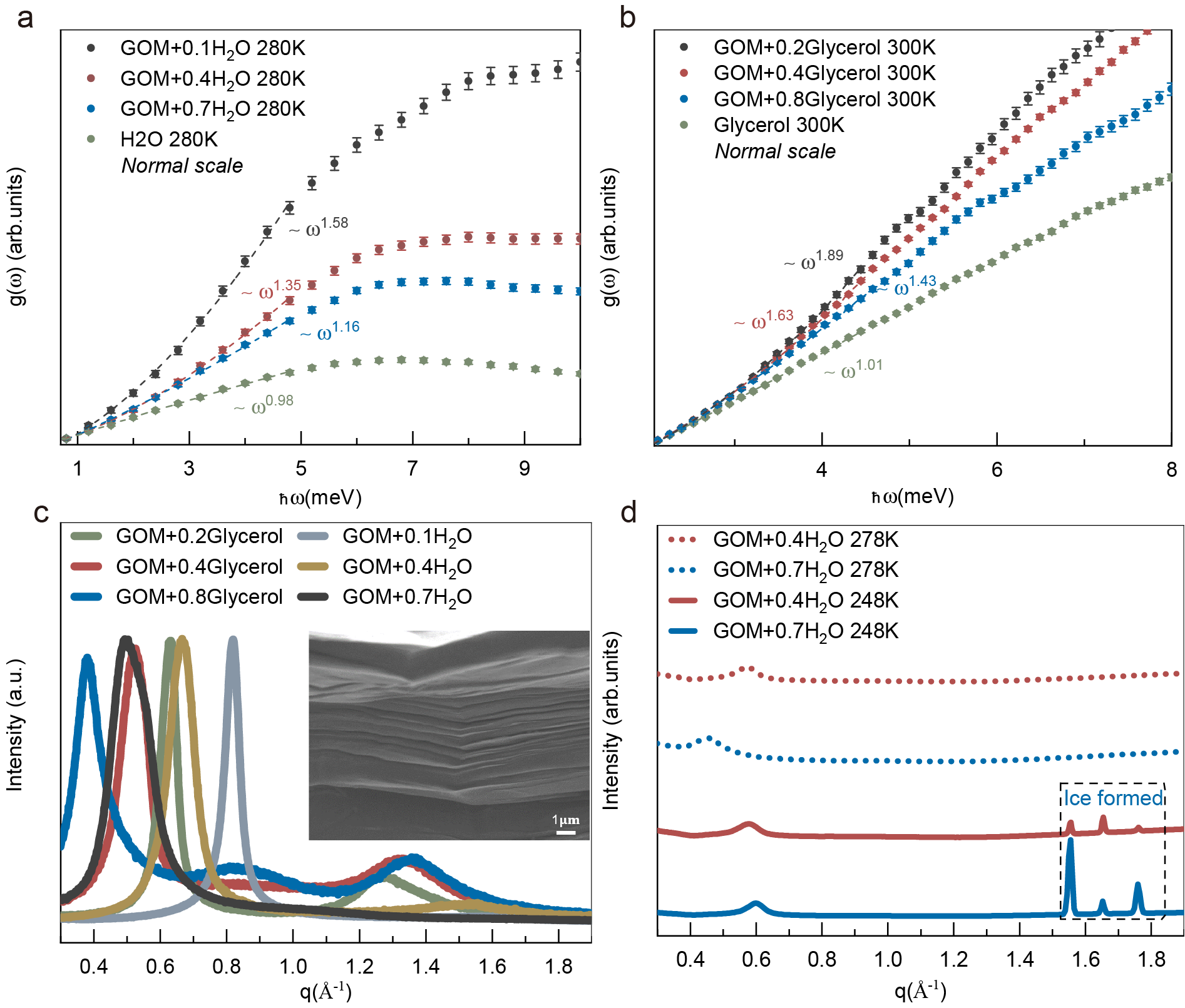
- 非弹性中子散射结果显示,在1–4 meV频率范围内,受限水和甘油的VDOS中清晰地出现从液态$g(\omega) \propto \omega$到类固体$g(\omega) \propto \omega^2$的标度转变。
- 重波标度的出现与非阻尼集体剪切波的出现一致,该结果经MD模拟与色散分析验证。
- 在限域条件下,结构弛豫时间$\tau$增加,导致弗伦克尔频率$\omega_F = 1/\tau$降低,从而使实验可探测频率范围内可观测到类固体行为。
- MD模拟显示自扩散常数在限域下显著降低,表明长程输运被抑制,且局域有序性增强。
- 从液态标度到重波标度的交叉频率与弗伦克尔判据$\omega \approx 1/\tau_g$一致,支持基于电报方程的理论模型。
- 所观测到的类固体力学行为出现的尺度与k-间隙理论定性一致,提示具有能隙的动量态与受限系统中液-固转变之间存在根本联系。
更好的研究,从现在开始
从阅读论文到最终审阅,大幅缩短您的研究时间。
无需绑定信用卡
本解读由 AI 生成,并经人工编辑审核。