
[论文解读] Full-Atom Protein Pocket Design via Iterative Refinement
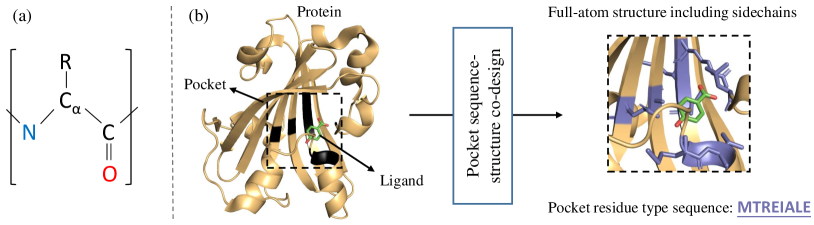
FAIR 是一种新颖的深度生成框架,用于全原子蛋白袋设计,通过迭代的粗到精细化过程共同设计残基序列与三维结构。它通过端到端的 E(3)-等变优化建模侧链原子、配体柔性以及序列-结构一致性,实现了最先进的性能,相较于先前方法在平均 AAR 上提升 15.5%,RMSD 提升 13.5%。
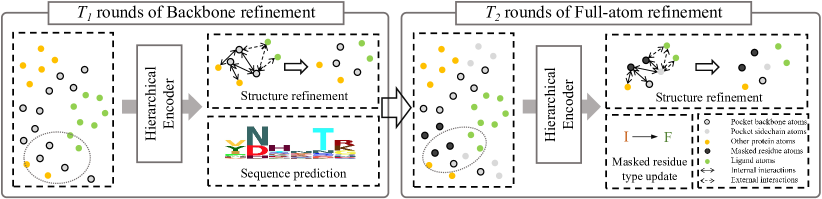
The design of \emph{de novo} functional proteins that bind specific ligand molecules is paramount in therapeutics and bio-engineering. A critical yet formidable task in this endeavor is the design of the protein pocket, which is the cavity region of the protein where the ligand binds. Current methods are plagued by inefficient generation, inadequate context modeling of the ligand molecule, and the inability to generate side-chain atoms. Here, we present the Full-Atom Iterative Refinement (FAIR) method, designed to address these challenges by facilitating the co-design of protein pocket sequences, specifically residue types, and their corresponding 3D structures. FAIR operates in two steps, proceeding in a coarse-to-fine manner (transitioning from protein backbone to atoms, including side chains) for a full-atom generation. In each iteration, all residue types and structures are simultaneously updated, a process termed full-shot refinement. In the initial stage, the residue types and backbone coordinates are refined using a hierarchical context encoder, complemented by two structure refinement modules that capture both inter-residue and pocket-ligand interactions. The subsequent stage delves deeper, modeling the side-chain atoms of the pockets and updating residue types to ensure sequence-structure congruence. Concurrently, the structure of the binding ligand is refined across iterations to accommodate its inherent flexibility. Comprehensive experiments show that FAIR surpasses existing methods in designing superior pocket sequences and structures, producing average improvement exceeding 10\% in AAR and RMSD metrics. FAIR is available at \url{https://github.com/zaixizhang/FAIR}.
研究动机与目标
- 解决针对特定配体结合的功能性蛋白袋从头设计这一关键挑战,以服务于治疗和生物工程应用。
- 克服现有方法的局限性,包括生成效率低下、对配体柔性建模不足以及忽略侧链原子。
- 在端到端、迭代的框架中共同设计蛋白袋的序列与三维结构,确保序列-结构一致性。
- 实现高保真度的全原子蛋白-配体复合物生成,提升几何互补性与结合亲和力。
提出的方法
- FAIR 采用两阶段、粗到精的迭代细化流程:首先优化主链坐标与残基类型,随后引入侧链原子并细化全原子结构。
- 使用分层上下文编码器,包含残基级与原子级编码器,以建模蛋白-配体复合物中的多尺度结构依赖关系。
- 采用两个结构细化模块:一个用于残基间相互作用,另一个用于口袋-配体相互作用,两者在迭代中持续更新。
- 应用全 shot 细化——在每次迭代中同时更新所有残基类型与坐标,提升效率与收敛性。
- 引入掩码残基类型更新机制,通过基于邻近残基预测缺失残基,确保序列-结构一致性。
- 通过迭代方式细化配体的三维结构,以考虑构象柔性,提升结合兼容性。
实验结果
研究问题
- RQ1与自回归或单次生成方法相比,对序列与结构进行迭代的全 shot 细化是否能显著提升从头蛋白袋设计的质量?
- RQ2侧链原子与配体柔性在提升设计口袋的结合亲和力与几何互补性方面,贡献程度如何?
- RQ3通过掩码残基类型预测实现的序列-结构一致性建模,在提升设计准确性方面有多有效?
- RQ4分层编码器与 E(3)-等变设计是否能提升蛋白-配体复合物生成中的泛化能力与表征学习能力?
- RQ5在 AAR、RMSD 与 Vina 分数等关键指标上,FAIR 与基于物理、模板匹配及深度生成基线方法相比表现如何?
主要发现
- 在 CrossDocked 数据集上,FAIR 实现 40.17% 的平均氨基酸恢复率(AAR),在 Binding MOAD 上为 43.75%,相较于基线方法平均提升 15.5%。
- 在 CrossDocked 上,FAIR 将 RMSD 降低至 1.42 Å,在 Binding MOAD 上为 1.35 Å,结构精度平均提升 13.5%。
- 消融研究证实,若移除分层编码器,性能下降最显著(AAR:25.30% vs. 40.17%),凸显其在表征学习中的关键作用。
- 全原子细化与配体结构细化的引入显著提升性能,若移除,AAR 分别降至 35.52% 与 33.16%。
- 若将全 shot 细化替换为自回归解码,CrossDocked 上 AAR 降至 31.04%,表明迭代联合优化在效率与准确性上更优。
- FAIR 生成高质量口袋的速度快于自回归方法,平均每个口袋生成时间仅 1.8 秒,在速度与准确性上均优于基线方法。
更好的研究,从现在开始
从阅读论文到最终审阅,大幅缩短您的研究时间。
无需绑定信用卡
本解读由 AI 生成,并经人工编辑审核。