
[论文解读] Magic of quantum hypergraph states
该论文提出了一种分析框架,利用稳定器R{\'e}nyi-\alpha熵(SRE)对量子超图态中的魔术——非稳定性——进行量化。研究证明,平均度恒定的超图态无法实现最大魔术,但典型随机超图态会集中在最大魔术附近。出人意料的是,高度对称的3-完全超图态在\alpha \geq 2时仅表现出常数或指数级小的魔术,揭示了对称性与魔术资源丰富性之间存在非平凡的权衡。
Magic, or nonstabilizerness, characterizes the deviation of a quantum state from the set of stabilizer states and plays a fundamental role from quantum state complexity to universal fault-tolerant quantum computing. However, analytical or even numerical characterizations of magic are very challenging, especially in the multi-qubit system, even with a moderate qubit number. Here we systemically and analytically investigate the magic resource of archetypal multipartite quantum states -- quantum hypergraph states, which can be generated by multi-qubit Controlled-phase gates encoded by hypergraphs. We first give the magic formula in terms of the stabilizer R$\mathrm{\acute{e}}$nyi-$α$ entropies for general quantum hypergraph states and prove the magic can not reach the maximal value, if the average degree of the corresponding hypergraph is constant. Then we investigate the statistical behaviors of random hypergraph states and prove the concentration result that typically random hypergraph states can reach the maximal magic. This also suggests an efficient way to generate maximal magic states with random diagonal circuits. Finally, we study some highly symmetric hypergraph states with permutation-symmetry, such as the one whose associated hypergraph is $3$-complete, i.e., any three vertices are connected by a hyperedge. Counterintuitively, such states can only possess constant or even exponentially small magic for $α\geq 2$. Our study advances the understanding of multipartite quantum magic and could lead to applications in quantum computing and quantum many-body physics.
研究动机与目标
- 系统表征多体量子超图态中的魔术资源,这类态是图态的推广,在量子优越性和测量依据的量子计算中具有关键作用。
- 解决在高度纠缠、多量子比特态中量化魔术的挑战,现有方法因指数级缩放而失效。
- 确定高度对称的超图态(如3-完全态)是否可作为通用量子计算的高魔术资源态。
- 通过SRE度量建立超图结构特性(如度分布、对称性)与结果魔术含量之间的联系。
提出的方法
- 作者将魔术表达为稳定器R{\'e}nyi-\alpha熵(SRE),该度量量化了态在泡利字符串投影上的权重分布。
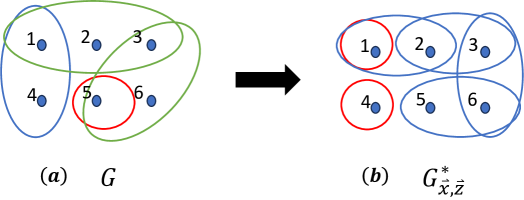
- 他们推导出一种图示表示,将SRE与原始超图诱导的子超图联系起来,从而实现泡利字符串重叠的解析处理。
- 研究采用二元向量空间中的计数技术,将魔术的统计特性转化为组合问题。
- 对于如3-完全超图等对称态,他们利用置换对称性简化泡利-李维拉算子矩的迹计算。
- 通过迹矩的解析推导,精确计算了不同\alpha下的SRE值,尤其针对\alpha = 2和\alpha = 1/2。
- 通过分析随机对角电路中泡利字符串重叠的典型行为,证明了随机超图态中魔术的集中性。
实验结果
研究问题
- RQ1量子超图态能否实现最大魔术,其结构条件是什么?
- RQ2超图的平均度如何影响对应超图态魔术的上界?
- RQ3高度对称的超图态(如3-完全态)是否尽管具有对称性,仍具备高魔术?
- RQ4随机超图态在多大程度上集中在最大魔术附近,能否用作高效的资源态?
- RQ5不同SRE度量(如\alpha = 2与\alpha = 1/2)在对称性和纠缠性方面对超图态魔术含量的敏感性有何差异?
主要发现
- 平均度恒定的超图态无法实现最大魔术,因为SRE存在上界,且不会达到理论最大值。
- 由随机对角电路生成的典型随机超图态集中在最大魔术附近,其行为类似于哈尓随机态。
- 对于3-完全超图态,\alpha = 2时的SRE被常数有界;而\alpha = 1/2时,其增长为2^{(2n-7-(-1)^n)/4},显示出不同\alpha度量之间的指数级分离。
- 3-完全态在\alpha = 2与\alpha = 1/2时的SRE存在指数级差异,表明不同SRE度量可能对魔术含量得出截然不同的结论。
- 泡利-李维拉算子矩\mathbf{m}_2(\ket{G_{3\textrm{-com}}})被有界于\frac{1}{8} + \frac{7}{2^{n+\frac{3-(-1)^n}{2}}},当n较大时趋近于\frac{1}{8}。
- 3-完全态在\alpha = 1/2时的SRE为\mathbf{m}_{1/2}(\ket{G_{3\textrm{-com}}}) = 2^{\frac{2n-7-(-1)^n}{4}} + 1 - 2^{-n+\frac{1+(-1)^n}{2}},其随n增长但保持非最大值。
更好的研究,从现在开始
从阅读论文到最终审阅,大幅缩短您的研究时间。
无需绑定信用卡
本解读由 AI 生成,并经人工编辑审核。