
[论文解读] Measurement-efficient quantum Krylov subspace diagonalisation
该论文提出了一种测量高效的量子Krylov子空间对角化算法,通过将哈密顿量幂次-高斯函数表示为实时间演化算符的积分,实现统计误差的指数抑制,从而显著降低测量成本。与现有方法相比,该方法将测量成本降低了10⁴至10¹²倍,尤其通过高效的投影算符构造实现基态投影。
The Krylov subspace methods, being one category of the most important classical numerical methods for linear algebra problems, can be much more powerful when generalised to quantum computing. However, quantum Krylov subspace algorithms are prone to errors due to inevitable statistical fluctuations in quantum measurements. To address this problem, we develop a general theoretical framework to analyse the statistical error and measurement cost. Based on the framework, we propose a quantum algorithm to construct the Hamiltonian-power Krylov subspace that can minimise the measurement cost. In our algorithm, the product of power and Gaussian functions of the Hamiltonian is expressed as an integral of the real-time evolution, such that it can be evaluated on a quantum computer. We compare our algorithm with other established quantum Krylov subspace algorithms in solving two prominent examples. To achieve an error comparable to that of the classical Lanczos algorithm at the same subspace dimension, our algorithm typically requires orders of magnitude fewer measurements than others. Such an improvement can be attributed to the reduced cost of composing projectors onto the ground state. These results show that our algorithm is exceptionally robust to statistical fluctuations and promising for practical applications.
研究动机与目标
- 解决量子Krylov子空间对角化(KSD)中因统计波动导致的高测量成本问题。
- 建立一个通用的理论框架,用于分析量子KSD算法中的统计误差与测量成本。
- 最小化在构建哈密顿量幂次Krylov子空间过程中用于基态能量估计的测量开销。
- 通过降低近场量子设备中对统计噪声的敏感性,实现鲁棒且实用的量子模拟。
提出的方法
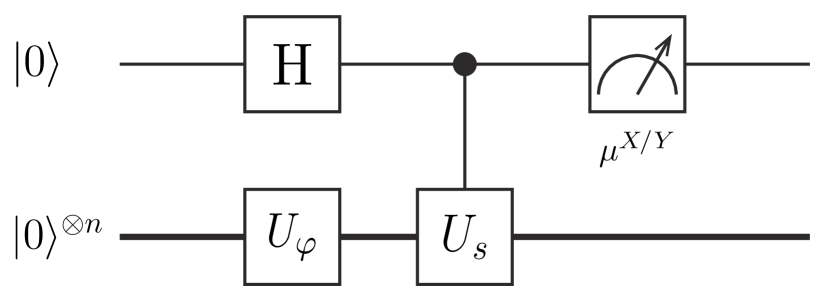
- 将哈密顿量幂次与高斯函数的乘积表示为实时间演化算符的积分,从而通过时间演化量子线路实现量子评估。
- 利用切比雪夫多项式构造投影算符,以在区间[-1, 1]内隔离基态并抑制激发态。
- 将切比雪夫投影算符展开为哈密顿量幂次(H - E₀)^(k-1)的线性组合,从而实现高效的量子线路实现。
- 推导多项式展开系数的上界,以控制开销并确保测量效率。
- 将该框架应用于反铁磁海森堡模型与 Hubbard 模型等基准模型,在多种晶格上比较测量成本。
- 利用谱分解与切比雪夫多项式性质,确保随着多项式阶数增加,激发态贡献被指数抑制。
![Figure 1: Empirical distribution of the measurement overhead $\gamma$ for algorithms listed in Table 1 . In the Gaussian-power algorithm, we take a random $E_{0}$ in the interval $[E_{g}-0.1\|H\|_{2},E_{g}+0.1\|H\|_{2}]$ , i.e. we assume that we have a preliminary estimation of the ground-state ener](https://ar5iv.labs.arxiv.org/html/2301.13353/assets/x1.png)
实验结果
研究问题
- RQ1在实际测量约束下,如何严格界定并最小化量子Krylov子空间对角化中的统计误差?
- RQ2给定精度下,量子KSD算法所需测量次数的理论上限是什么?
- RQ3能否利用实时间演化积分高效构建哈密顿量幂次Krylov子空间,从而降低测量成本?
- RQ4所提算法在代表性量子多体模型中的测量成本与现有量子KSD方法相比如何?
- RQ5基于切比雪夫多项式的投影算符在多大程度上可减少基态能量估计中的有效测量开销?
主要发现
- 所提算法相比现有量子Krylov子空间对角化方法,将测量成本降低了10⁴至10¹²倍。
- 由于切比雪夫多项式对激发态贡献的指数抑制,统计误差随多项式阶数呈指数下降。
- 该框架为所有量子KSD算法提供了通用的测量次数上界,支持系统性的成本比较。
- 该算法对统计波动的鲁棒性源于利用时间演化积分高效构造基态投影算符。
- 在反铁磁海森堡模型与Hubbard模型上的基准测试结果证实了该方法在不同晶格尺寸下的可扩展性与优越性。
- 多项式展开中的开销因子γ被几何级数所界定,确保了资源随系统尺寸的可控缩放。
更好的研究,从现在开始
从阅读论文到最终审阅,大幅缩短您的研究时间。
无需绑定信用卡
本解读由 AI 生成,并经人工编辑审核。