
[论文解读] Nonequilibrium Seebeck and spin Seebeck effects in nanoscale junctions
本研究利用数值重整化群(NRG)方法处理强耦合情形、微扰理论处理弱耦合情形,研究了量子点与铁磁电极非对称耦合系统中的非平衡热电效应与自旋塞贝克效应。研究揭示了由交换场引起的Kondo共振劈裂导致的Seebeck系数新奇符号变化,这些变化在有限电压与温度梯度下表现出显著特征,并识别出自旋偏置引起的自旋Seebeck系数符号变化,其与Kondo峰以外的谱函数特征密切相关。
The spin-resolved thermoelectric transport properties of correlated nanoscale junctions, consisting of a quantum dot/molecule asymmetrically coupled to external ferromagnetic contacts, are studied theoretically in the far-from-equilibrium regime. One of the leads is assumed to be strongly coupled to the quantum dot resulting in the development of the Kondo effect. The spin-dependent current flowing through the system, as well as the thermoelectric properties, are calculated by performing a perturbation expansion with respect to the weakly coupled electrode, while the Kondo correlations are captured accurately by using the numerical renormalization group method. In particular, we determine the differential and nonequilibrium Seebeck effects of the considered system in different magnetic configurations and uncover the crucial role of spin-dependent tunneling on the device performance. Moreover, by allowing for spin accumulation in the leads, which gives rise to finite spin bias, we shed light on the behavior of the nonequilibrium spin Seebeck effect.
研究动机与目标
- 理解在非平衡条件下,强关联纳米结中Kondo关联与自旋依赖输运的相互作用。
- 研究来自铁磁电极的交换场如何改变Kondo共振并影响热电响应。
- 分析在有限电压与温度梯度下,微分与非平衡Seebeck系数的行为。
- 研究自旋积累与自旋偏置在产生非线性自旋塞贝克效应中的作用。
- 识别在热电功率与自旋塞贝克响应中,Kondo共振劈裂与抑制的特征信号。
提出的方法
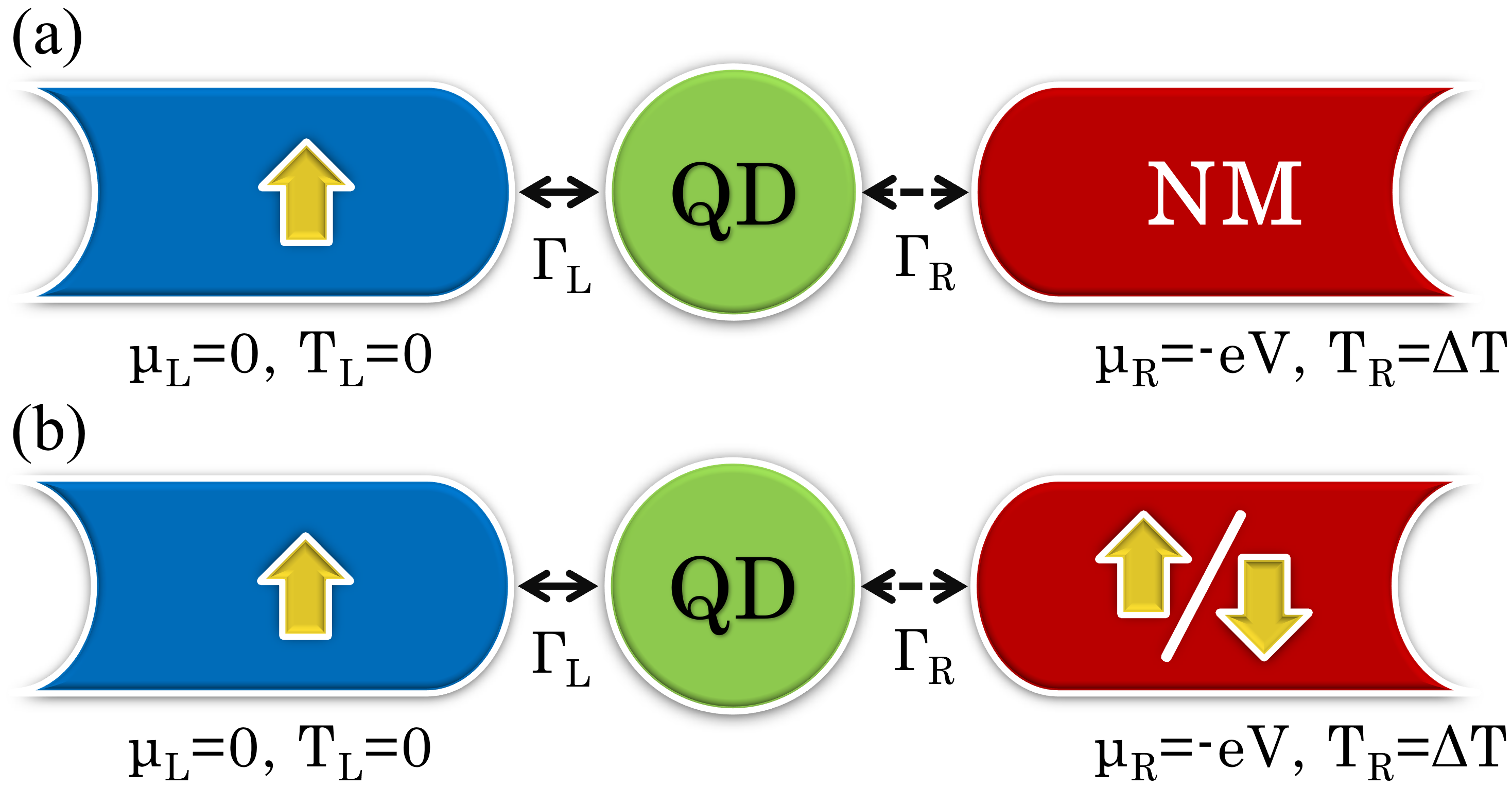
- 量子点与强耦合铁磁电极(Kondo物理占主导)和弱耦合电极(非磁性或铁磁性)非对称耦合。
- 强耦合子系统采用数值重整化群(NRG)方法,以精确捕捉Kondo关联。
- 弱耦合电极通过隧穿幅度的微扰展开处理,支持非线性响应计算。
- 利用自旋分辨输运形式,计算Seebeck系数作为偏置电压、温度梯度与自旋偏置的函数。
- 从包含局域库仑相互作用与交换劈裂的完整哈密顿量中推导谱函数与输运系数。
- 分析电极在平行与反平行磁构型下的自旋塞贝克与电荷Seebeck系数。
实验结果
研究问题
- RQ1由交换场引起的Kondo共振劈裂如何影响有限偏置下的微分与非平衡Seebeck系数?
- RQ2在温度梯度下,Kondo抑制与共振劈裂在热电功率中的特征表现为何?
- RQ3由电极中自旋积累引起的自旋偏置如何影响非线性自旋塞贝克效应?
- RQ4铁磁电极的磁构型(平行与反平行)在Seebeck系数符号变化中起何种作用?
- RQ5Kondo关联与自旋依赖隧穿在非线性响应区间的相互作用如何体现?
主要发现
- Seebeck系数随偏置电压变化表现出新的符号变化,这些变化直接与铁磁电极交换场引起的Kondo共振劈裂相关。
- 这些符号变化在Kondo温度量级的温度梯度下依然存在,表明其为Kondo物理的稳健非平衡特征。
- 电荷Seebeck系数在自旋偏置 $V_s$ 上表现出第二组符号变化,分别出现在 $V_s \approx -0.15U$ 与 $V_s \approx 0.03U$,且随 $\Delta T$ 增大而分离。
- 自旋Seebeck系数在正自旋偏置区域约 $V_s \approx U/4$ 处表现出单次符号变化,且随 $\Delta T$ 增大向更高值移动。
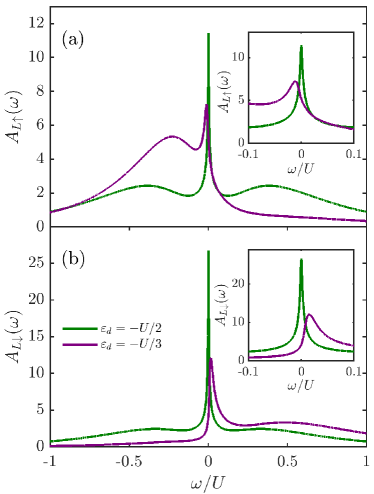
- 在平行构型中,约 $V_s \approx 0.2U$ 至 $V_s \approx U/2$ 的区域出现额外的小范围符号变化,归因于Kondo峰与Hubbard峰之间的谱特征。
- 自旋Seebeck系数的行为在很大程度上与磁构型无关,仅存在微小振幅差异,表明其主要受非Kondo谱特征主导。
更好的研究,从现在开始
从阅读论文到最终审阅,大幅缩短您的研究时间。
无需绑定信用卡
本解读由 AI 生成,并经人工编辑审核。