
[论文解读] On the archetypal `flavours', indices and teleconnections of ENSO revealed by global sea surface temperatures
本文将典型分析(AA)引入全球海表温度(SST)和海平面距平(SLA)数据,以识别厄尔尼诺-南方涛动(ENSO)的多种‘类型’,揭示了传统EP/CP分类之外的多种显著不同的ENSO类型。该方法在SST单独判断模糊时,提升了ENSO相位检测与遥相关图谱的准确性,并通过捕捉事件的细微动态与非平稳性,增强了次季节至季节预测系统的能力。
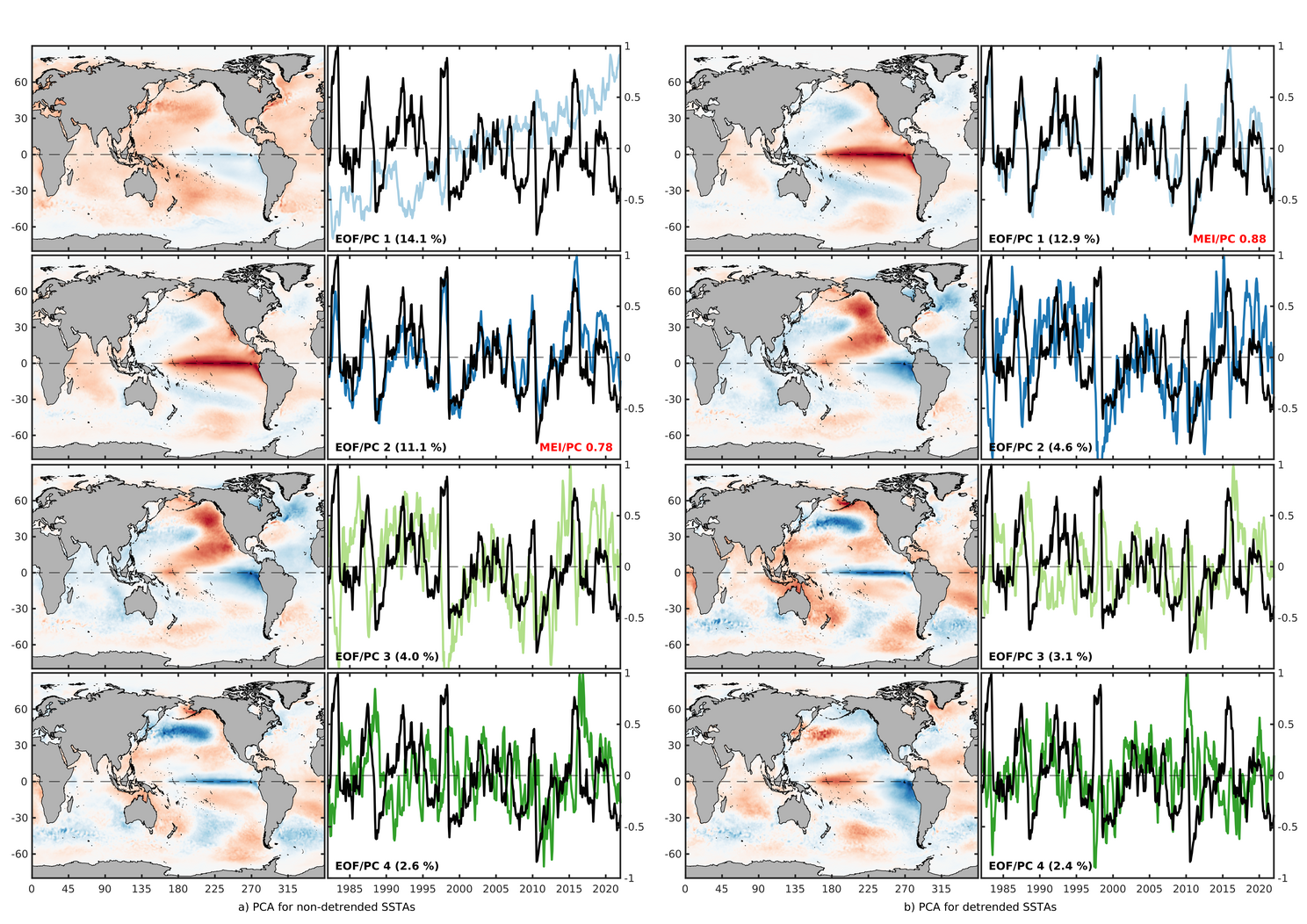
El Niño-Southern Oscillation global (ENSO) imprint on sea surface temperature comes in many guises. To identify its tropical fingerprints and impacts on the rest of the climate system, we propose a global approach based on archetypal analysis (AA), a pattern recognition method based on the identification of extreme configurations in the dataset under investigation. Relying on detrended sea surface temperature monthly anomalies over the 1982 to 2022 period, the technique recovers central and eastern Pacific ENSO types identified by more traditional methods and allows one to hierarchically add extra flavours and nuances to both persistent and transient phases of the phenomenon. Archetypal patterns found compare favorably to phase identification from K-means, fuzzy C-means and recently published network-based machine-learning algorithms. The AA implementation is modified for the identification of ENSO phases in sub-seasonal-to-seasonal prediction systems and complements current alert systems in characterising the diversity of ENSO and its teleconnections. Tropical and extra-tropical teleconnection composites from various oceanic and atmospheric fields derived from the analysis are shown to be robust and physically relevant. Extending AA to sub-surface ocean fields improves the discrimination between phases when the characterisation of ENSO based on sea surface temperature is uncertain. We show that AA on detrended sea-level monthly anomalies provides a clearer expression of ENSO types.
研究动机与目标
- 解决传统ENSO分类系统依赖单一指标、无法捕捉ENSO事件全部多样性的局限性。
- 开发一种数据驱动的无监督方法,识别1982–2022年期间热带SST异常中多种显著不同的ENSO原型(类型)。
- 通过整合海平面距平(SLA)以解决SST分类在判别性不足时的模糊性,提升ENSO相位检测与遥相关分析能力。
- 评估典型分析在表征ENSO起始、持续与衰减阶段方面的稳健性与可扩展性,并将其应用拓展至其他气候模态。
提出的方法
- 对1982–2022年期间去趋势化的月度海表温度(SST)异常应用典型分析(AA),以识别ENSO的极端与代表性模式(原型)。
- 将AA方法扩展至包含去趋势化的海平面距平(dSLA),以在SST模式模糊或重叠时提升ENSO相位的判别能力。
- 利用AA生成的隶属概率矩阵作为ENSO类型表达的概率指标,实现对大气与海洋场中遥相关关系的条件期望分析。
- 通过与K均值、模糊C均值及基于网络的机器学习算法等既定方法对比,验证AA识别的原型在一致性和性能上的表现。
- 基于原型隶属关系的条件期望生成遥相关合成图,以映射热带与副热带区域的大气与海洋影响。
- 评估该方法在不同时间段与地理区域的稳健性,并评估其作为下游统计与机器学习模型降维工具的实用性。
实验结果
研究问题
- RQ1典型分析在多大程度上能从全球SST异常中恢复已知的ENSO类型,如东太平洋(EP)与中太平洋(CP)事件?
- RQ2在SST分类存在不确定性或模糊性时,引入海平面距平(SLA)在多大程度上提升了ENSO相位的判别能力?
- RQ3典型分析能否在ENSO周期的起始、主相位与衰减阶段检测并表征细微的ENSO相位?
- RQ4与传统合成分析相比,AA生成的遥相关图谱在物理合理性与稳健性方面表现如何?
- RQ5AA的概率特性在多大程度上能够揭示1982–2022年期间ENSO事件序列中的非平稳性?
主要发现
- 典型分析成功恢复了已知的ENSO类型,如EP与CP事件,其结果与K均值、模糊C均值及基于网络的机器学习方法相当。
- 引入去趋势化的海平面距平(dSLA)显著提升了ENSO类型的清晰度与判别能力,尤其在SST模式不清晰或重叠时效果更明显。
- 该方法揭示了在1982–2022年期间,即使去除了线性趋势,也不存在两个完全相同的ENSO事件序列,表明ENSO行为具有非平稳动力学特征。
- 基于AA生成的遥相关合成图具有良好的物理一致性与稳健性,清晰展示了与不同ENSO原型相关联的大气与海洋响应。
- AA生成的隶属概率矩阵提供了一套概率框架,用于条件期望分析,使对均值与方差中遥相关关系的理解更加细致。
- 将AA应用于层结海洋场(如dSLA)可增强ENSO相位的表征能力,在仅使用表层指标无法区分事件类型时,提供了一种可行的替代方案。
![Figure 2: AA results for cardinality 4 based only on dSSTAs first 2 PCs multiplied by their respective eigenvalues, $\textbf{X}_{2\times t}=[\lambda_{1}PC_{1},\lambda_{2}PC_{2}]$ . The 2D convex hull is the black polygon. Points in the pointset are represented by coloured dots if they lay within the](https://ar5iv.labs.arxiv.org/html/2406.08694/assets/fig2.png)
更好的研究,从现在开始
从阅读论文到最终审阅,大幅缩短您的研究时间。
无需绑定信用卡
本解读由 AI 生成,并经人工编辑审核。