
[论文解读] Physics Informed Deep Learning for Flow and Transport in Porous Media
本文提出了一种物理信息深度学习框架,利用神经网络训练以满足多孔介质中流动与运移的控制偏微分方程(PDE),特别是Buckley-Leverett方程。通过将物理定律和边界条件直接嵌入损失函数,该模型在1D和2D双曲问题中准确捕捉了激波和膨胀波,即使在存在不连续性的情况下也实现了稳健收敛,取得了最先进性能。
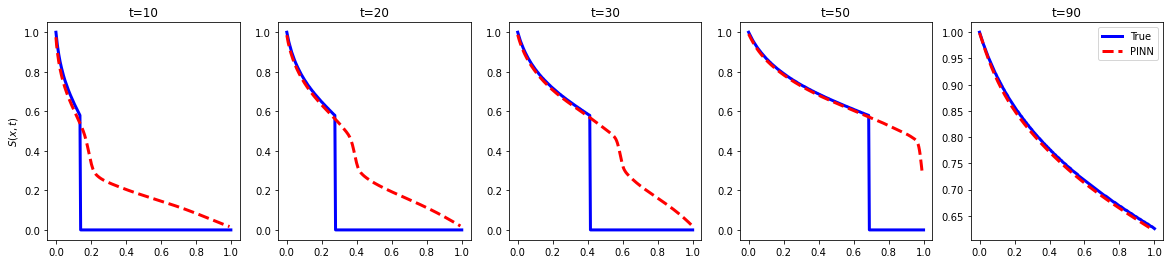
We present our progress on the application of physics informed deep learning to reservoir simulation problems. The model is a neural network that is jointly trained to respect governing physical laws and match boundary conditions. The methodology is hereby used to simulate a 2-phase immiscible transport problem (Buckley-Leverett). The model is able to produce an accurate physical solution both in terms of shock and rarefaction and honors the governing partial differential equation along with initial and boundary conditions. We test various hypothesis (uniform and non-uniform initial conditions) and show that with the proper implementation of physical constraints, a robust solution can be trained within a reasonable amount of time and iterations. We revisit some of the limitations presented in previous work \cite{Fuks2020} and further the applicability of this method in a forward, pure hyperbolic setup. We also share some practical findings on the application of physics informed neural networks (PINN). We review various network architectures presented in the literature and show tips that helped improve their convergence and accuracy. The proposed methodology is a simple and elegant way to instill physical knowledge to machine-learning algorithms. This alleviates the two most significant shortcomings of machine-learning algorithms: the requirement for large datasets and the reliability of extrapolation. The principles presented can be generalized in innumerable ways in the future and should lead to a new class of algorithms to solve both forward and inverse physical problems.
研究动机与目标
- 为地球系统中具有复杂物理特性和有限数据的场景,解决缺乏鲁棒且物理解释一致的机器学习方法的问题。
- 开发一种在训练过程中直接施加守恒定律和边界条件的深度学习框架。
- 在无需大规模标注数据集的情况下,提升机器学习模型在地下水流模拟中的泛化能力和可靠性。
- 在具有不连续解的非线性双曲PDE(如Buckley-Leverett问题)上展示该方法的有效性。
- 探索能够提升物理信息神经网络(PINNs)收敛性和准确性的网络架构与训练策略。
提出的方法
- 通过最小化包含残差PDE项、初始条件和边界条件的复合损失函数,训练深度神经网络以逼近Buckley-Leverett PDE的解。
- 损失函数整合了熵条件和通量连续性等物理约束,以确保在不连续处的物理解释有效解。
- 渗透率场通过一个神经网络代理进行建模,与流动解联合训练,但不通过其反向传播梯度,以避免引入伪影。
- 评估了包括傅里叶网络、DGM和SiRen(周期性网络)在内的多种网络架构,结果表明简单全连接网络在此问题上表现更优。
- 采用无网格、配点法采样空间和时间域中的点,实现在每次训练迭代中对全空间-时间域进行优化。
- 损失分量的合理加权以及熵约束的实现,对稳定训练和提升收敛性至关重要。
实验结果
研究问题
- RQ1物理信息神经网络能否准确模拟多孔介质流动中具有不连续解(如激波和膨胀波)的非线性双曲PDE?
- RQ2在求解Buckley-Leverett问题时,不同神经网络架构(如傅里叶网络、SiRen、DGM)在准确性和收敛性方面表现如何?
- RQ3物理约束(如熵条件和通量连续性)在稳定训练和提升解的保真度方面起到何种作用?
- RQ4在缺乏大规模标注数据的情况下,PINNs能否有效泛化至具有非均匀初始条件和复杂非均质性的场景?
- RQ5流动解与渗透率场代理的联合训练如何影响解的质量和训练稳定性?
主要发现
- 该模型在1D Buckley-Leverett问题中以高精度成功捕捉了激波和膨胀波,创下新的最先进水平。
- 通过引入熵条件和合理的损失加权,显著提升了训练收敛性,尤其在存在陡峭不连续性时效果明显。
- 2D模拟在Tesla V100 GPU上约需400,000次迭代和3小时训练时间,每次迭代处理全空间-时间域。
- 通过阻止梯度流经代理渗透率网络,避免了渗透率场中的伪影,保持了其静态特性。
- 简单全连接网络在该问题上优于傅里叶网络和SiRen网络等更复杂的架构,表明在此类问题中架构简洁性可能更具优势。
- 由于每次迭代均进行全域优化,该方法支持早期推理——在训练完全完成前即可获得可用结果。
![Figure 2: Triple-Valued Saturation Distribution (Source Buckley and Leverett, 1942 [ 5 ] )](https://ar5iv.labs.arxiv.org/html/2104.02629/assets/figures/BL_triple_sat.png)
更好的研究,从现在开始
从阅读论文到最终审阅,大幅缩短您的研究时间。
无需绑定信用卡
本解读由 AI 生成,并经人工编辑审核。