
[论文解读] Quantum complexity phase transitions in monitored random circuits
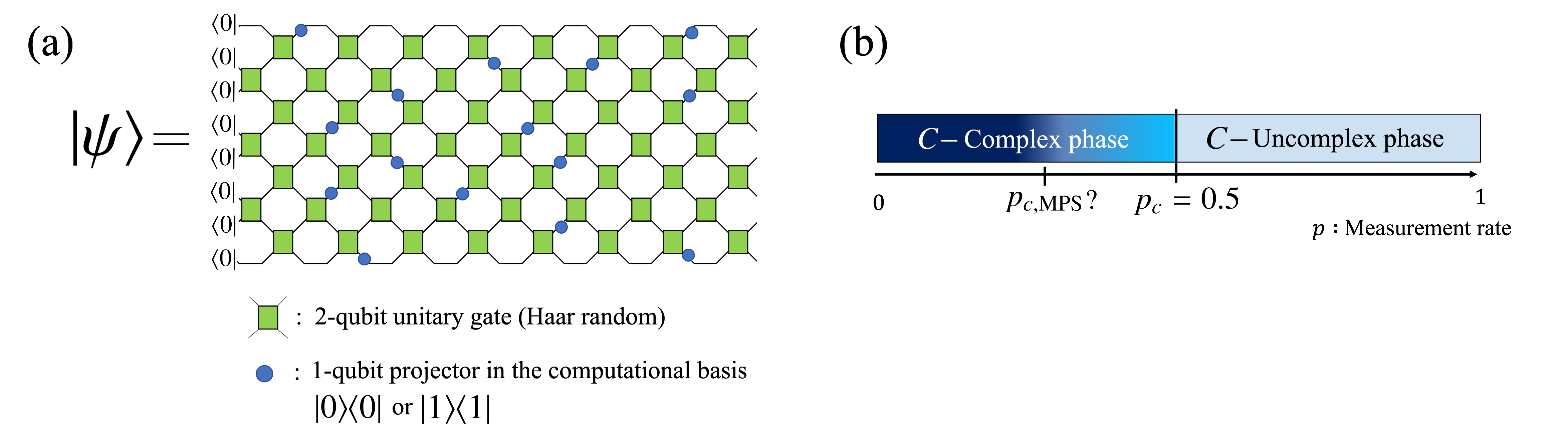
本文研究了在监测随机电路中的量子复杂度,其中量子比特经历随机酉演化和随机测量。在临界测量速率 $ p_c = 0.5 $ 处识别出相变:低于此速率时,复杂度随时间呈指数增长($ e^{\text{poly}(n)} $),而高于此速率时则保持多项式增长($ \text{poly}(n) $),该结论通过渗滤理论和代数几何技术得以确立。
Recently, the dynamics of quantum systems that involve both unitary evolution and quantum measurements have attracted attention due to the exotic phenomenon of measurement-induced phase transitions. The latter refers to a sudden change in a property of a state of $n$ qubits, such as its entanglement entropy, depending on the rate at which individual qubits are measured. At the same time, quantum complexity emerged as a key quantity for the identification of complex behaviour in quantum many-body dynamics. In this work, we investigate the dynamics of the quantum state complexity in monitored random circuits, where $n$ qubits evolve according to a random unitary circuit and are individually measured with a fixed probability at each time step. We find that the evolution of the exact quantum state complexity undergoes a phase transition when changing the measurement rate. Below a critical measurement rate, the complexity grows at least linearly in time until saturating to a value $e^{Ω(n)}$. Above, the complexity does not exceed $\operatorname{poly}(n)$. In our proof, we make use of percolation theory to find paths along which an exponentially long quantum computation can be run below the critical rate, and to identify events where the state complexity is reset to zero above the critical rate. We lower bound the exact state complexity in the former regime using recently developed techniques from algebraic geometry. Our results combine quantum complexity growth, phase transitions, and computation with measurements to help understand the behavior of monitored random circuits and to make progress towards determining the computational power of measurements in many-body systems.
研究动机与目标
- 理解在具有随机测量的监测随机电路中,量子复杂度如何演化。
- 识别并确定量子复杂度是否以及在何处随测量速率发生相变。
- 利用代数几何和渗滤理论,建立精确量子态复杂度的严格下界。
- 阐明测量诱导动力学在多体量子系统中计算能力的作用。
提出的方法
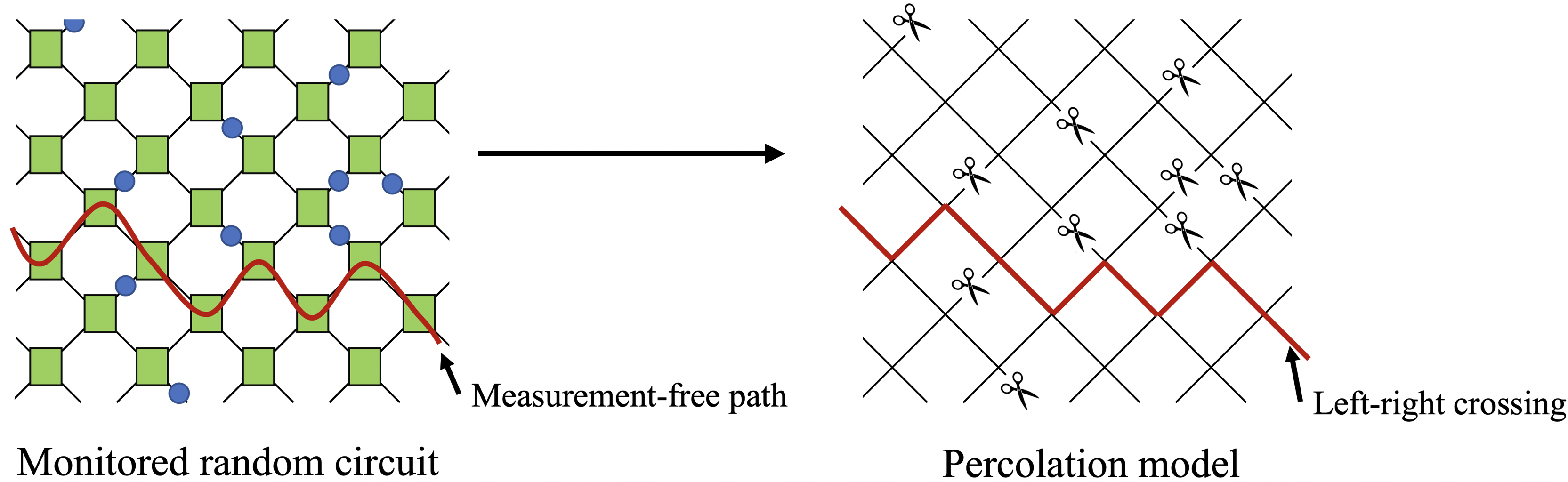
- 将监测电路的动力学映射到正方形晶格上的键渗滤问题,以分析无测量路径。
- 利用渗滤理论证明在临界测量速率 $ p_c = 0.5 $ 以下,存在长度为线性的无测量路径。
- 应用代数几何工具以界定量子电路可访问维度,从而获得精确量子复杂度的下界。
- 使用FKG不等式关联倾斜与非倾斜晶格上的渗滤,确保临界点的等价性。
- 通过随机晶格中左右交叉的概率,推导出复杂度的指数下界。
- 通过证明所有簇在高概率下均较小,证明在临界速率以上,复杂度被限制在 $ \text{poly}(n) $ 以内。
实验结果
研究问题
- RQ1在监测随机电路中,量子复杂度是否随测量速率表现出相变?
- RQ2在临界测量速率以下和以上,精确量子复杂度的标度行为如何?
- RQ3渗滤理论能否用于识别支持指数复杂度增长的长无测量路径?
- RQ4代数几何如何用于对随机电路的精确量子复杂度进行下界估计?
- RQ5测量诱导的态重置在临界速率以上限制复杂度的作用是什么?
主要发现
- 在临界测量速率 $ p_c = 0.5 $ 处发生量子复杂度的相变,将两种不同的动力学行为区分开来。
- 在 $ p_c $ 以下,精确量子复杂度至少随时间线性增长,并趋于 $ e^{\text{poly}(n)} $,表明其具有指数复杂度。
- 在 $ p_c $ 以上,复杂度被限制在 $ \text{poly}(n) $ 以内,意味着可被经典高效模拟。
- 在 $ p_c $ 以下存在 $ \Omega(n) $ 条无测量路径,支持指数级长的量子计算。
- 渗滤理论确保在高概率下,电路晶格中存在 $ \Omega(n) $ 条左右交叉路径,支持指数复杂度。
- 在 $ p_c $ 以上,所有开放簇在高概率下均较小,导致复杂度被重置,从而阻止指数增长。
更好的研究,从现在开始
从阅读论文到最终审阅,大幅缩短您的研究时间。
无需绑定信用卡
本解读由 AI 生成,并经人工编辑审核。