
[论文解读] Quantum Simulation of Lattice QCD with Improved Hamiltonians
本文提出了一种基于相似性重整化群(SRG)的改进哈密顿量,用于格点量子色动力学(QCD)的量子模拟,以减少规范场截断带来的误差。在1+1维中,该方法可实现对低色电场截断的精确模拟;在3+1维中,成功在IBM的Perth处理器上实现了两味QCD的量子模拟,展示了在不增加量子比特数量超过标准截断限制的前提下,显著提升模拟精度。
Quantum simulations of lattice gauge theories are anticipated to directly probe the real time dynamics of QCD, but scale unfavorably with the required truncation of the gauge fields. Improved Hamiltonians are derived to correct for the effects of gauge field truncations on the SU(3) Kogut-Susskind Hamiltonian. It is shown in $1+1D$ that this enables low chromo-electric field truncations to quantitatively reproduce features of the untruncated theory over a range of couplings and quark masses. In $3+1D$, an improved Hamiltonian is derived for lattice QCD with staggered massless fermions. It is shown in the strong coupling limit that the spectrum qualitatively reproduces aspects of two flavor QCD and simulations of a small system are performed on IBM's { t Perth} quantum processor.
研究动机与目标
- 解决由于规范场截断导致格格规范理论量子模拟中的缩放问题。
- 开发改进的哈密顿量,以在不增加量子比特需求的前提下减轻低电场截断带来的误差。
- 将该方法从1+1维扩展到3+1维,用于两味格点QCD与域激荡费米子。
- 通过改进的哈密顿量框架,在近场量子处理器上实现QCD实时动力学模拟的可行性。
- 通过张量网络模拟与在IBM量子硬件上的实验实现,验证该方法的有效性。
提出的方法
- 应用相似性重整化群(SRG)推导出能解耦高能规范场态的有效哈密顿量,从而减少截断引起的误差。
- 该方法首先应用于1+1维的SU(3) Kogut-Susskind哈密顿量,包含单味域激荡费米子,得到改进的有效哈密顿量。
- 在3+1维中,为包含域激荡费米子的两味格点QCD推导出改进的哈密顿量,整合了平面元项的影响。
- 通过Jordan-Wigner费米子到量子比特映射,将所得哈密顿量映射为量子比特哈密顿量,实现量子线路的构建。
- 在IBM的Perth量子处理器上实现单个Trotter步长,采用自校正电路以减少噪声影响。
- 通过张量网络模拟,在不同系统尺寸和参数下验证1+1维中改进哈密顿量的准确性。
实验结果
研究问题
- RQ1通过SRG推导出的改进哈密顿量是否能在不增加量子比特数量的前提下减少格点QCD模拟中的截断误差?
- RQ2这些改进的哈密顿量在1+1维中多大程度上能再现未截断QCD的能谱与动力学特性?
- RQ3SRG驱动的改进方法能否扩展到包含两味QCD与域激荡费米子的3+1维体系?
- RQ4能否利用改进的哈密顿量框架在近场量子硬件上模拟QCD的实时动力学?
- RQ5在当前的含噪声中等规模量子(NISQ)设备上,单个Trotter步长在模拟时间演化时的性能极限是什么?
主要发现
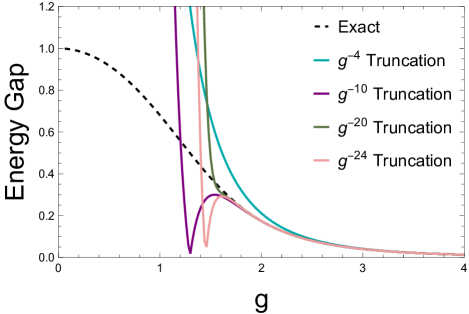
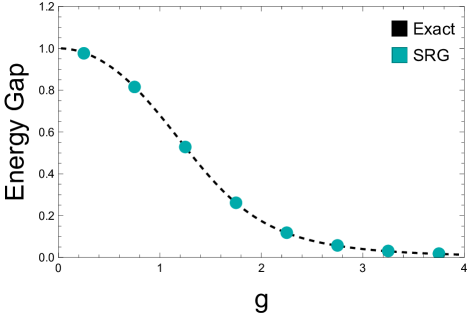
- 在1+1维中,改进的哈密顿量可对低色电场截断实现定量再现未截断理论的特征,覆盖多种耦合常数与夸克质量。
- 张量网络模拟证实,随着系统尺寸增大,改进哈密顿量仍保持高精度,优于标准截断方法。
- 在3+1维中,为两味QCD推导出的改进哈密顿量在强耦合极限下定性再现了能谱的关键特征。
- 在IBM的Perth处理器上实现的单个Trotter步长模拟成功捕捉了平凡真空态的早期动力学,且在t < 1时与精确结果高度一致。
- 模拟结果表明,当t > 1时误差增加,凸显了对更深电路或更强误差缓解技术的需求。
- 使用Jordan-Wigner编码实现了高效的量子比特映射,但未来工作可能受益于更高效的编码方式(如Bravyi-Kitaev编码),以进一步降低电路深度。
更好的研究,从现在开始
从阅读论文到最终审阅,大幅缩短您的研究时间。
无需绑定信用卡
本解读由 AI 生成,并经人工编辑审核。