
[论文解读] Redback: A Bayesian inference software package for electromagnetic transients
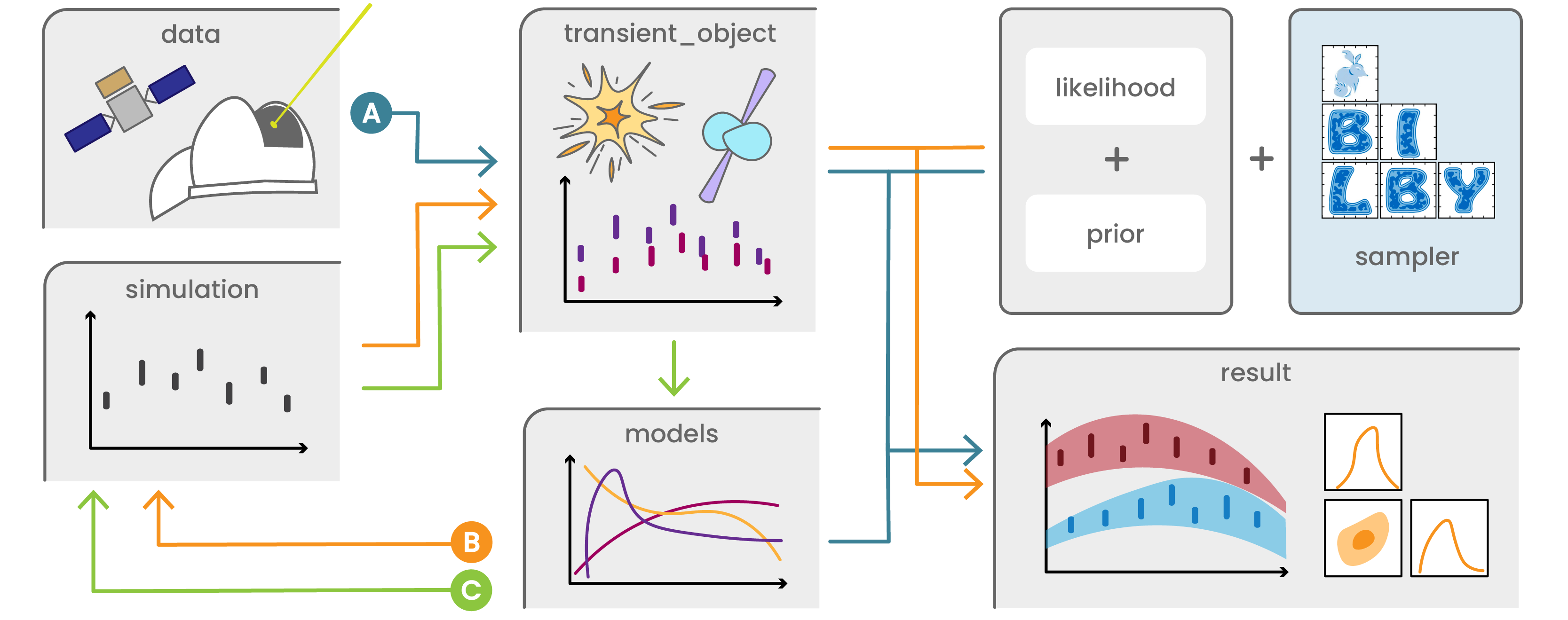
Redback 是一个开源的面向电磁暂现源的贝叶斯推断面向对象 Python 软件包,支持使用超过 100 种模型和 12 种以上采样器,对千新星、超新星、伽马射电暴余晖及其他暂现源实现端到端建模、仿真与拟合。它支持从主要星表中导入数据,进行真实观测条件下的巡天仿真(如 LSST、ZTF),并支持多信使联合推断,具有模块化设计,便于扩展,并可与 Bilby 和 SNCosmo 集成。
Fulfilling the rich promise of rapid advances in time-domain astronomy is only possible through confronting our observations with physical models and extracting the parameters that best describe what we see. Here, we introduce {\sc Redback}; a Bayesian inference software package for electromagnetic transients. {\sc Redback} provides an object-orientated {\sc python} interface to over 12 different samplers and over 100 different models for kilonovae, supernovae, gamma-ray burst afterglows, tidal disruption events, engine-driven transients among other explosive transients. The models range in complexity from simple analytical and semi-analytical models to surrogates built upon numerical simulations accelerated via machine learning. {\sc Redback} also provides a simple interface for downloading and processing data from various catalogs such as extit{Swift} and Fink. The software can also serve as an engine to simulate transients for telescopes such as the Zwicky Transient Facility and Vera Rubin with realistic cadences, limiting magnitudes, and sky-coverage or a hypothetical user-constructed survey or a generic transient for target-of-opportunity observations with different telescopes. As a demonstration of its capabilities, we show how {\sc Redback} can be used to jointly fit the spectrum and photometry of a kilonova, enabling a more powerful, holistic probe into the properties of a transient. We also showcase general examples of how {\sc Redback} can be used as a tool to simulate transients for realistic surveys, fit models to real, simulated, or private data, multi-messenger inference with gravitational waves, and serve as an end-to-end software toolkit for parameter estimation and interpreting the nature of electromagnetic transients.
研究动机与目标
- 为解释来自电磁暂现源的时域测光数据,应对日益增长的对灵活、可扩展且稳健的软件工具包的需求。
- 克服现有软件包的局限性,例如模型库受限、接口不灵活,或仿真与推断之间缺乏集成。
- 实现端到端的贝叶斯推断工作流,包括模型拟合、参数估计和巡天优化,适用于多种暂现现象。
- 通过支持与引力波事件(如 GW170817)的联合推断,推动多信使天文学的发展。
- 提供一个现代化、持续维护且由社区驱动的开源平台,基于天体物理应用的最佳软件开发实践。
提出的方法
- Redback 实现了一个面向对象的 Python 接口,将模型、似然函数、先验分布和采样器解耦,允许用户在不修改源代码的情况下插入自定义组件。
- 它与 Bilby 集成,可访问超过 12 种开源马尔可夫链蒙特卡洛和嵌套采样采样器,支持交叉验证和高性能推断。
- 该软件包含一个巡天仿真引擎,可复现 LSST、ZTF 和用户自定义巡天的真实观测条件(如观测周期、极限星等、天区覆盖)。
- 它提供内置接口,可从 Swift、Fink、Lasair、BATSE 和开放访问星表等公共星表中下载和处理数据。
- 模型涵盖解析和半解析表达式,以及基于数值模拟训练的机器学习加速代理模型。
- 它利用标准科学 Python 库(astropy、SNCosmo、matplotlib、corner),并支持贝叶斯分层建模、模型选择和重要性采样。
实验结果
研究问题
- RQ1一个模块化、开源的软件包在多大程度上能提升电磁暂现源天文学中贝叶斯推断的可靠性与可复现性?
- RQ2Redback 在实际巡天观测条件下模拟真实暂现光曲线的能力如何,从而实现准确的巡天设计与选择函数建模?
- RQ3Redback 的灵活接口能否支持多种暂现类型及多信使事件(如千新星与引力波)的联合推断?
- RQ4与传统软件包相比,Redback 通过集成现代软件实践(CI/CD、单元测试、持续开发)在长期可维护性方面有何提升?
- RQ5Redback 在拟合真实与模拟数据方面,对包括潮汐撕裂事件和磁星驱动超新星在内的多种暂现类型,其性能与准确性如何?
主要发现
- Redback 支持对超过 100 种电磁暂现源模型(包括千新星、超新星、GRB 余晖和潮汐撕裂事件)实现端到端贝叶斯推断,全面支持自定义模型与先验定义。
- 该软件成功在 LSST 和 ZTF 的真实巡天条件下模拟了暂现源,包括观测周期、深度和天区覆盖,支持准确的巡天设计与选择函数建模。
- Redback 已被用于已发表研究中对潮汐撕裂事件(Sarin & Metzger, 2023)、SN 2018ibb(Schulze et al., 2023)以及 GRB-千新星联合事件(Levan et al., 2023)的参数推断,证明了其在真实场景中的实用性。
- 与 Bilby 的集成使得多种采样器可无缝使用,支持交叉验证与高效推断,同时支持多进程计算和高级采样技术。
- 该软件的模块化架构与活跃的开发团队确保了长期可维护性与可扩展性,通过社区贡献可轻松支持新模型与数据类型。
- 所有结果、示例脚本和绘图笔记本均通过 GitHub 和 Zenodo(DOI: 10.5281/zenodo.8273145)公开,且该软件包已托管于 PyPI,并提供完整的文档(https://redback.readthedocs.io/en/latest/)。
更好的研究,从现在开始
从阅读论文到最终审阅,大幅缩短您的研究时间。
无需绑定信用卡
本解读由 AI 生成,并经人工编辑审核。