
[论文解读] Simulation of ODMR Spectra from Nitrogen-Vacancy Ensembles in Diamond for Electric Field Sensing
本文提出了一款开源的Python仿真工具,用于在任意电场和磁场下建模金刚石中氮-vacancy(NV)中心的光学生测磁共振(ODMR)谱。该工具可精确预测ODMR跃迁强度和散粒噪声极限灵敏度,揭示了最优电场传感需仔细对齐偏置磁场与微波偏振方向,并提出一种无需动态旋转磁场的全矢量电磁测量新方案,显著降低了实验复杂度。
Solid state spins in diamond, in particular negatively charged nitrogen-vacancy centers (NV), are leading contenders in the field of quantum sensing. While addressing of single NVs offers nanoscale spatial resolution, many implementations benefit from using large ensembles to increase signal magnitude and therefore sensitivity. However, sensing with ensembles brings its own challenges given the random orientation of the spin quantization axis within the diamond crystal lattice. Here, we present an open source simulation tool that models the influence of arbitrary electric and magnetic fields on the electronic and nuclear spin states of NV ensembles, and can be extended to other color centers. Specifically, the code computes the transition strengths and predicts the sensitivity under shot-noise-limited optically-detected magnetic resonance. We illustrate the use of the code in the context of electric field sensing, a promising emerging functionality of NV centers with applications in biosensing and electronics, and bring several subtle features to light that are due to the interplay between different NV orientations and the external electric and microwave fields. Moreover, we show that our code can be used to optimize sensitivity in situations where usual arguments based on neglecting terms in the full Hamiltonian would give sub-optimal results. Finally, we propose a novel sensing scheme which allows to perform full vector electrometry without the need for precise bias magnetic field alignment, thus reducing the experimental complexity and speeding up the measurement procedure.
研究动机与目标
- 开发一个全面的、开源的仿真工具,用于在任意电场和磁场下建模NV系综的ODMR谱。
- 实现对NV基量子传感器中散粒噪声极限灵敏度的精确预测。
- 解决由于NV取向随机和环境扰动导致的NV系综ODMR谱解析难题。
- 在解析近似失效的场景下优化传感配置,特别是电场传感场景。
- 提出一种新型电磁测量方案,消除对动态偏置磁场方向重定向的需求,从而降低实验复杂度。
提出的方法
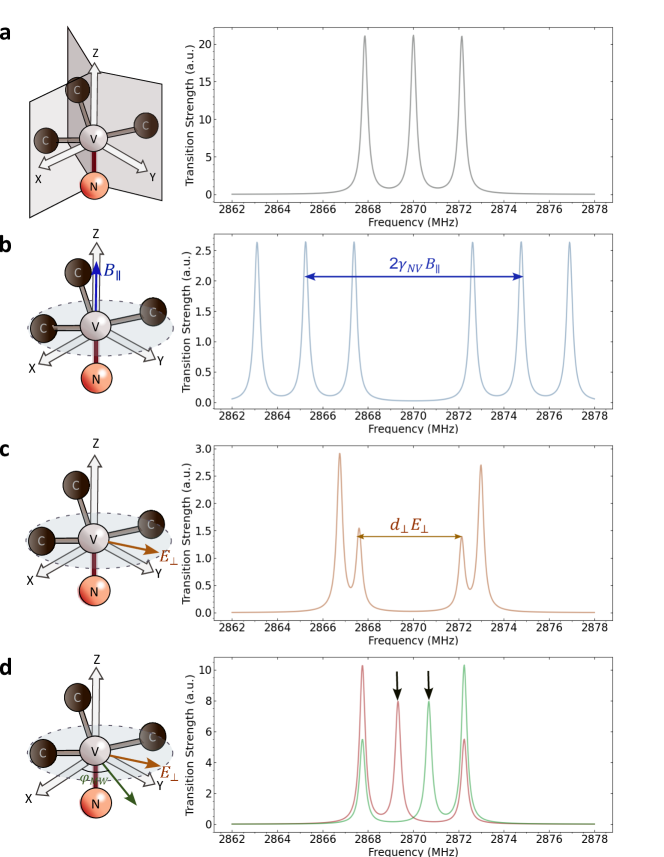
- 该仿真计算12C和14N同位素金刚石中NV中心的电子能级和跃迁强度,涵盖所有四种NV晶体学取向及NV/VN构型。
- 在任意外部电场和磁场下,建模包含Zeeman、超精细及Stark相互作用的完整哈密顿量。
- 计算连续波激发下的ODMR谱,以微波频率和偏振角为变量计算跃迁振幅。
- 在散粒噪声极限条件下计算灵敏度,并对偏置磁场的大小和方向进行优化。
- 该方法可模拟单个NV和系综响应,支持用户自定义磁场方向和实验参数。
- 该工具可扩展至其他色心,并可适配不同切割方式(如<111>表面)或同位素组成(如15N注入)。
实验结果
研究问题
- RQ1NV中心的取向与偏置磁场方向如何影响NV系综中电场传感的灵敏度?
- RQ2在何种实验配置下,ODMR灵敏度的标准解析近似会失效,以及数值仿真如何改善优化?
- RQ3是否可以在不动态重定向偏置磁场的情况下实现全矢量电磁测量,若可以,如何实现?
- RQ4微波偏振角对不同NV取向的ODMR跃迁振幅有何影响,该影响如何用于传感?
- RQ5实验缺陷(如偏置磁场方向错位)如何降低电场传感性能?
主要发现
- 仿真结果表明,电场传感的灵敏度强烈依赖于偏置磁场与电场之间的相对取向,最优配置需要精确对齐,而这一特性在简化模型中未被捕捉。
- 对于沿<001>取向的NV中心,跃迁振幅随微波偏振角周期性变化,相位偏移可无歧义地确定NV参考系中横向电场分量。
- 通过将偏置磁场沿<011>方向设置,可使两个NV取向同时对横向电场敏感,从而仅通过单一测量装置实现矢量场重构。
- 该方法实现了无需动态重定向磁场的全矢量电磁测量,转而依赖电控微波偏振旋转,速度更快且更简单。
- 仿真识别出标准灵敏度解析公式失效的区域,证明通过该代码进行数值优化可显著优于启发式方法。
- 该代码成功预测,对于给定NV取向,特定微波偏振角下跃迁振幅达到最大值,该角度可用于高精度提取横向电场方向。
更好的研究,从现在开始
从阅读论文到最终审阅,大幅缩短您的研究时间。
无需绑定信用卡
本解读由 AI 生成,并经人工编辑审核。