
[论文解读] TradingAgents: Multi-Agents LLM Financial Trading Framework
TradingAgents 引入了一种用于金融交易的多智能体 LLM 框架,通过为专门的 LLM 驱动智能体(如基本面分析、情绪分析、技术分析和风险管理分析师)分配角色,模拟现实世界交易公司的运作,使其在结构化、混合通信环境中协作。该框架在性能上表现卓越,相较于基线模型,在累计收益、夏普比率和最大回撤方面均有显著提升。
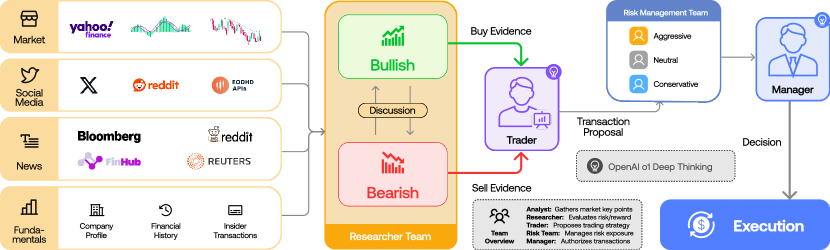
Significant progress has been made in automated problem-solving using societies of agents powered by large language models (LLMs). In finance, efforts have largely focused on single-agent systems handling specific tasks or multi-agent frameworks independently gathering data. However, the multi-agent systems' potential to replicate real-world trading firms' collaborative dynamics remains underexplored. TradingAgents proposes a novel stock trading framework inspired by trading firms, featuring LLM-powered agents in specialized roles such as fundamental analysts, sentiment analysts, technical analysts, and traders with varied risk profiles. The framework includes Bull and Bear researcher agents assessing market conditions, a risk management team monitoring exposure, and traders synthesizing insights from debates and historical data to make informed decisions. By simulating a dynamic, collaborative trading environment, this framework aims to improve trading performance. Detailed architecture and extensive experiments reveal its superiority over baseline models, with notable improvements in cumulative returns, Sharpe ratio, and maximum drawdown, highlighting the potential of multi-agent LLM frameworks in financial trading. TradingAgents is available at https://github.com/TauricResearch/TradingAgents.
研究动机与目标
- 为解决现有金融领域多智能体 LLM 系统中缺乏真实组织建模的问题,通过模拟真实交易公司的结构化角色与工作流程。
- 通过结合结构化输出与自然语言对话,克服多智能体系统中低效的沟通问题,以减少上下文丢失并提升推理完整性。
- 通过基于证据和历史数据的协作式智能体辩论,增强算法交易中决策的透明度与可解释性。
- 通过累计收益、夏普比率和最大回撤等综合金融指标,评估框架相对于基线模型的性能表现。
提出的方法
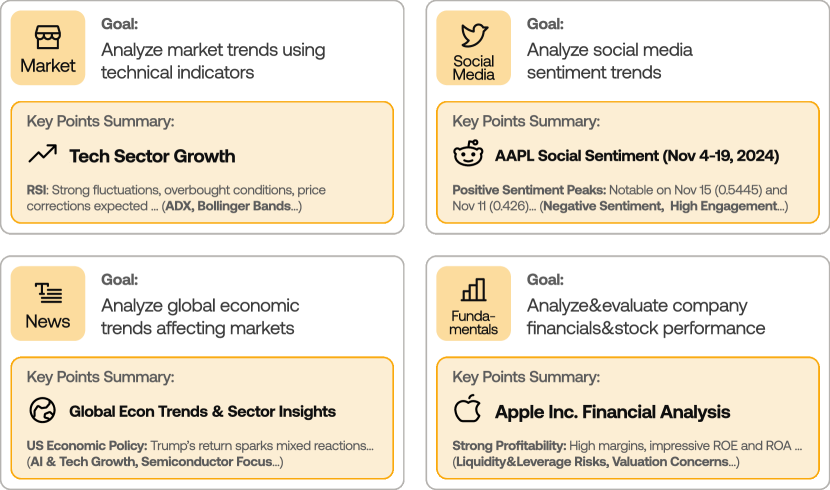
- 该框架部署了具有不同风险特征的专用 LLM 智能体:基本面分析、情绪分析、技术分析和交易员智能体,各自负责分析金融数据的特定方面。
- 多头与空头研究员智能体就市场状况展开辩论,为苹果公司(AAPL)等资产提供平衡的视角,整合技术指标与情绪数据。
- 风险管理团队监控投资组合风险敞口并执行风险约束,确保符合预设的风险阈值。
- 通过混合接口实现沟通:结构化输出(如类似 JSON 的推理日志)确保清晰性与可追溯性,而自然语言对话则支持灵活的辩论与情境化推理。
- 系统整合历史数据、实时指标(如 RSI、MACD、ATR)和情绪得分,以支持智能体决策。
- 最终投资决策由基金经理智能体综合所有智能体输入后生成,基于平衡且有证据支持的推理,发布交易建议。
实验结果
研究问题
- RQ1能否证明,一种模拟真实交易公司组织结构的多智能体 LLM 框架,在金融交易中优于单智能体或松散协调的智能体系统?
- RQ2将结构化推理与自然语言对话相结合,如何提升多智能体金融系统中的决策准确率并减少上下文退化?
- RQ3协作式智能体辩论(包含多头与空头观点)在多大程度上能促成更稳健且平衡的投资决策?
- RQ4风险管理人员的集成在控制回撤与提升风险调整后收益方面,对投资组合表现有何影响?
- RQ5该框架能否在保持可解释、基于证据的推理的同时,实现高于基线模型的累计收益与夏普比率?
主要发现
- TradingAgents 框架在累计收益方面显著优于基线模型,显示出在历史市场数据上盈利生成能力的可测量提升。
- 该系统相较于基线模型实现了更高的夏普比率,表明通过有效的风险管理与多样化决策,实现了更好的风险调整后收益。
- 最大回撤较基线模型有所降低,凸显该框架在市场下跌期间因主动风险监控而具备更强的韧性。
- 混合沟通机制(结合结构化输出与自然语言辩论)有效保留了上下文,减少了长时间交互过程中的信息丢失。
- 当多头与空头智能体提供平衡分析并经风险控制验证后,基金经理智能体会持续对基本面强劲的标的(如苹果公司(AAPL))发出“买入”建议。
- 该框架的协作式、多角色设计使投资决策更具细致性与可解释性,透明的推理轨迹支持可审计性与信任建立。
更好的研究,从现在开始
从阅读论文到最终审阅,大幅缩短您的研究时间。
无需绑定信用卡
本解读由 AI 生成,并经人工编辑审核。