
[论文解读] What Guides Our Choices? Modeling Developers' Trust and Behavioral Intentions Towards GenAI
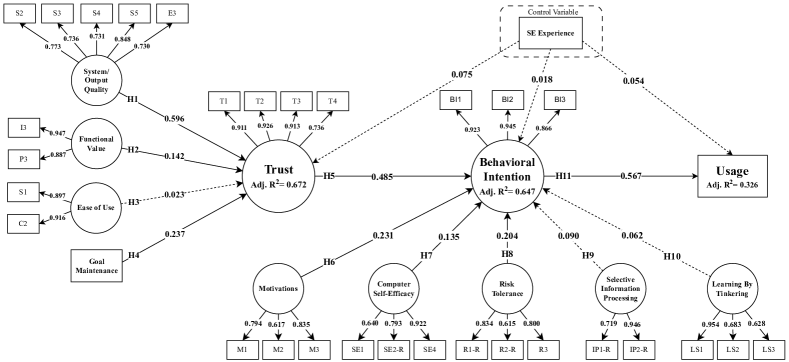
本研究开发并验证了一个理论模型,表明生成式AI(genAI)的系统/输出质量、功能价值以及目标一致性显著预测开发者对工具的信任,而这种信任又与认知风格(动机、自我效能感、风险态度)共同驱动开发者使用这些工具的行为意图。研究结果基于来自全球科技公司238名开发者的调查数据的PLS-SEM分析。
Generative AI (genAI) tools, such as ChatGPT or Copilot, are advertised to improve developer productivity and are being integrated into software development. However, misaligned trust, skepticism, and usability concerns can impede the adoption of such tools. Research also indicates that AI can be exclusionary, failing to support diverse users adequately. One such aspect of diversity is cognitive diversity -- variations in users' cognitive styles -- that leads to divergence in perspectives and interaction styles. When an individual's cognitive style is unsupported, it creates barriers to technology adoption. Therefore, to understand how to effectively integrate genAI tools into software development, it is first important to model what factors affect developers' trust and intentions to adopt genAI tools in practice? We developed a theoretically grounded statistical model to (1) identify factors that influence developers' trust in genAI tools and (2) examine the relationship between developers' trust, cognitive styles, and their intentions to use these tools in their work. We surveyed software developers (N=238) at two major global tech organizations: GitHub Inc. and Microsoft; and employed Partial Least Squares-Structural Equation Modeling (PLS-SEM) to evaluate our model. Our findings reveal that genAI's system/output quality, functional value, and goal maintenance significantly influence developers' trust in these tools. Furthermore, developers' trust and cognitive styles influence their intentions to use these tools in their work. We offer practical suggestions for designing genAI tools for effective use and inclusive user experience.
研究动机与目标
- 识别影响软件开发中开发者对生成式AI(genAI)工具信任的关键因素。
- 检验开发者对genAI的信任、认知风格与其采用genAI工具行为意图之间的关系。
- 构建一个基于实证数据的、关于软件工程中genAI信任与行为意图的理论模型。
- 通过将认知多样性视为技术采纳的关键因素,推动AI设计的包容性。
- 提供实用的设计指南,以支持genAI工具在开发工作流中公平且高效的整合。
提出的方法
- 基于信任(PICSE框架)和认知多样性相关文献,构建理论模型。
- 从两家主要全球科技组织中收集了238名软件开发者的调查数据。
- 采用偏最小二乘法-结构方程建模(PLS-SEM)检验假设并评估构念之间的关系。
- 使用经过验证的量表测量信任相关因素、认知风格及行为意图。
- 对调查构念进行心理测量学验证(信度、收敛效度与区分效度)。
- 通过注意力检查、随机化问题模块及预测试提升数据质量并减少响应偏差。
实验结果
研究问题
- RQ1哪些因素能够预测开发者在软件开发中对生成式AI工具的信任?
- RQ2开发者对genAI的信任与认知风格如何关联到其使用genAI工具的意图?
- RQ3系统/输出质量、功能价值及目标维护在多大程度上影响开发者对genAI工具的信任?
- RQ4认知风格——特别是内在动机、在同龄人中的计算机自我效能感以及风险态度——如何影响开发者对genAI的行为意图?
- RQ5信任与认知风格如何共同预测开发者实际的使用意图与行为?
主要发现
- genAI的系统/输出质量——包括性能、安全性及输出准确性——显著预测开发者对工具的信任。
- 功能价值,包括教育与实际应用优势,是开发者对genAI工具信任的强有力预测因子。
- 目标维护——即开发者当前目标与genAI行为之间的对齐程度——对信任形成具有显著的正面影响。
- 开发者对genAI工具的信任是其在实践中使用这些工具行为意图的关键驱动力。
- 认知风格,尤其是内在动机、在同龄人中的计算机自我效能感以及风险态度,显著影响行为意图。
- 信任与认知风格的结合能够解释开发者报告的使用genAI工具工作意图中相当大一部分的方差。
更好的研究,从现在开始
从阅读论文到最终审阅,大幅缩短您的研究时间。
无需绑定信用卡
本解读由 AI 生成,并经人工编辑审核。