
[論文レビュー] 1100 days in the life of the supernova 2018ibb -- The best pair-instability supernova candidate, to date
SN 2018ibb は現時点でペア不安定性超新星(PISN)の最良候補として識別され、長い拡散時間とニッケル質量がPISN予測と一致しており、中心エンジンによる駆動の証拠はない。
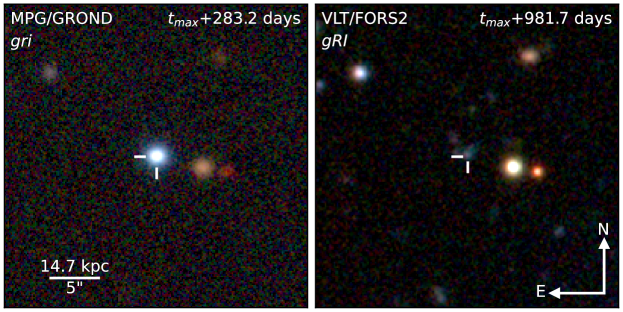
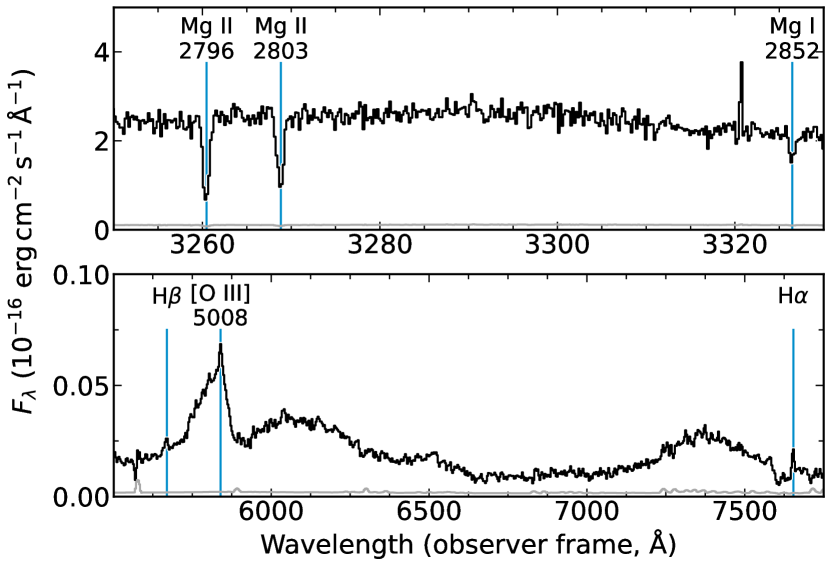
Abridged - Stars with ZAMS masses between 140 and $260 M_\odot$ are thought to explode as pair-instability supernovae (PISNe). During their thermonuclear runaway, PISNe can produce up to several tens of solar masses of radioactive nickel, resulting in luminous transients similar to some superluminous supernovae (SLSNe). Yet, no unambiguous PISN has been discovered so far. SN2018ibb is a H-poor SLSN at $z=0.166$ that evolves extremely slowly compared to the hundreds of known SLSNe. Between mid 2018 and early 2022, we monitored its photometric and spectroscopic evolution from the UV to the NIR with 2-10m class telescopes. SN2018ibb radiated $>3 imes10^{51} m erg$ during its evolution, and its bolometric light curve reached $>2 imes10^{44} m erg\,s^{-1}$ at peak. The long-lasting rise of $>93$ rest-frame days implies a long diffusion time, which requires a very high total ejected mass. The PISN mechanism naturally provides both the energy source ($^{56}$Ni) and the long diffusion time. Theoretical models of PISNe make clear predictions for their photometric and spectroscopic properties. SN2018ibb complies with most tests on the light curves, nebular spectra and host galaxy, potentially all tests with the interpretation we propose. Both the light curve and the spectra require 25-44 $M_\odot$ of freshly nucleosynthesised $^{56}$Ni, pointing to the explosion of a metal-poor star with a He-core mass of 120-130 $M_\odot$ at the time of death. This interpretation is also supported by the tentative detection of [Co II]$λ$1.025$μ$m, which has never been observed in any other PISN candidate or SLSN before. Powering by a central engine, such as a magnetar or a black hole, can be excluded with high confidence. This makes SN2018ibb by far the best candidate for being a PISN, to date.
研究の動機と目的
- 水素欠乏のSLSNeに対する包絡明確なPISN同定の探索を動機付ける。
- SN 2018ibb の長期フォトメトリック・スペクトロスコピー数据セットに対してPISN予測を検証する。
- PISNの性質を評価するために前駆体特性とニッケル生成量を推定し、SN 2018ibb のPISN性を評価する。
提案手法
- UV から NIR まで約1100の静止系日数にわたり、マルチウェーブ長フォトメトリックとスペクトロスコピーのモニタリングを実施。
- 多数の施設からのデータを同質化するためにs-補正と機器間較正を適用。
- スペクトルのホスト銀河 subtraction および絶対フラックス較正を実施し、フォトメトリーを統合してボロメトリック特性を導出。
- 観測された光曲線と星雲スペクトルをPISNモデル予測と比較。
- 代替の電源源(中心エンジン)や周囲物質との相互作用の痕跡を捜索し、純粋なPISN解釈に異論を唱える証拠を探す。
実験結果
リサーチクエスチョン
- RQ1SN 2018ibb は非常に大質量・金属欠如前駆体として予測されるペア不安定性超新星機構によって主に駆動されているのか。
- RQ2観測によって必要とされるニッケル-56質量とエジェクタ/ヘリウム核質量はどれか、これらはPISNの期待と一致するのか。
- RQ3フォトメトリックとスペクトロスコピーのデータは中心エンジンエネルギー源や周囲物質との ejecta 相互作用の痕跡を示しており、純粋なPISN解釈に挑戦するのか。
- RQ4ホスト銀河環境(金属量、質量)はSN 2018ibb のPISNシナリオをどのように支持または制約するのか。
主な発見
- SN 2018ibb は>3×10^51 erg を放射し、ボロメトリックピークは>2×10^44 erg s^-1 に達した。
- 長い静止系日数の上昇(>93日)は非常に高い全質量のエジェクタと長い拡散時間を示唆する。
- 光曲線とスペクトルを説明するには新たに合成された56Ni が25–44 M⊙必要であるとモデリングは示唆。
- 死去時のヘリウム核質量が120–130 M⊙の金属欠乏前駆体を指す。
- [Co II] 1.025 μm の暫定的検出はPISN解釈を補強する特徴であり、他のPISN候補やSLSNe には見られない。
- エミッションの寄与として爆発的な質量損失エピソードとその後の ejecta-CSM 相互作用の証拠が観測的に示唆され、いくつかのPISNモデルとの不一致を説明する可能性がある。
- 中心エンジン(磁気星やブラックホール)による駆動は高い信頼度で排除され、PISN の主張を強化している。
より良い研究を、今すぐ始めましょう
論文設計から論文執筆まで、研究時間を劇的に削減しましょう。
クレジットカード登録不要
このレビューはAIが作成し、人間の編集者が確認しました。