
[論文レビュー] 3D-Var Data Assimilation using a Variational Autoencoder
本稿では、変分オートエノード(VAE)を用いて低次元の潜在空間で3D-Varデータ同化を実行する、ニューラルネットワークデータ同化(NNDA)フレームワークを提案する。この手法により、自動微分による勾配を用いた効率的な最適化が可能となり、流れに依存する季節変動のある背景誤差共分散を捉える。潜在空間では準対角的(quasi-diagonal)なB行列が得られ、1つのモデルで熱帯および極域の誤差構造を正確に表現でき、1つの温度変数についても高精度な解析補正が可能である。
Data assimilation of atmospheric observations traditionally relies on variational and Kalman filter methods. Here, an alternative neural-network data assimilation (NNDA) with variational autoencoder (VAE) is proposed. The three-dimensional variational (3D-Var) data assimilation cost function is utilised to determine the analysis that optimally fuses simulated observations and the encoded short-range persistence forecast (background), accounting for their errors. The minimisation is performed in the reduced-order latent space, discovered by the VAE. The variational problem is auto-differentiable, simplifying the computation of the cost function gradient necessary for efficient minimisation. We demonstrate that the background-error covariance ($\mathbf{B}$) matrix measured and represented in the latent space is quasi-diagonal. The background-error covariances in the grid-point space are flow-dependent, evolving seasonally and depending on the current state of the atmosphere. Data assimilation experiments with a single temperature observation in the lower troposphere indicate that the $\mathbf{B}$-matrix simultaneously describes both tropical and extratropical background-error covariances.
研究の動機と目的
- 3D-Varにおける従来の背景誤差共分散モデルを、変分オートエノード(VAE)を用いて学習された低次元表現で置き換えるニューラルネットワークベースのデータ同化(NNDA)フレームワークの開発を目的とする。
- 短い範囲の予報(パーシステンス)からエンコードされた背景状態と、観測値を潜在空間に射影することで、VAEが学習した潜在空間で3D-Varのコスト関数を最適化することにより、効率的な最小化を実現する。
- 1つのVAEで学習された潜在空間における背景誤差共分散(B行列)が、熱帯および極域の気象動態を同時に表現できるかどうかを検証すること。
- VAE-NNDAフレームワークが、風場およびジオポテンシャル場を含む多次元設定において、地衡的バランスの取れた解析補正をどの程度正確に生成できるかを評価すること。
- 将来の4D-Varやスタンドアロンのニューラルネットワーク予報への拡張を可能にする基盤を構築すること。具体的には、確率的オートエノードとハイブリッド予報モデルを統合する。
提案手法
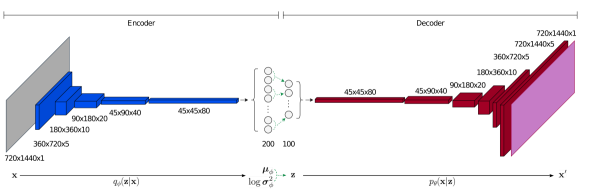
- ERA5再解析データを用いて変分オートエノード(VAE)を訓練し、大気状態フィールド(例:850 hPaの温度)の低次元かつガウス分布に従う潜在表現を学習する。
- 3D-Varのコスト関数を再定式化し、背景状態を短い範囲の予報(パーシステンス)からエンコードし、観測値を潜在空間に射影することで、潜在空間で最適化を実行する。
- 背景誤差共分散行列(B)は潜在空間に暗黙的に表現され、準対角的であることが判明しており、複雑な誤差構造の有効な低ランク近似を示している。
- コスト関数の勾配は自動微分により計算され、L-BFGSなどの標準的な非線形ソルバーを用いた効率的な最適化が可能になる。
- 解析補正は潜在空間で計算され、その後グリッド点空間に復号されて評価される。
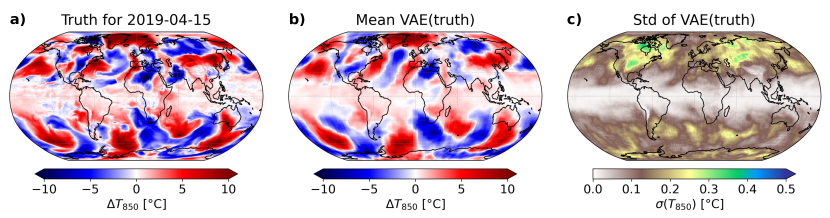
- 合成観測(850 hPa温度)を用いてフレームワークをテストし、解析補正の構造と背景誤差共分散の性質を検証する。
実験結果
リサーチクエスチョン
- RQ1VAEで学習された潜在空間は、3D-Varデータ同化に必要な背景誤差共分散構造を効果的に表現できるか?
- RQ2潜在空間におけるB行列は、同時に熱帯および極域の流れに依存する背景誤差特性を捉えられるか?
- RQ3VAEに基づく3D-Varフレームワークの自動微分性により、コスト関数の効率的かつ高精度な最小化が可能になるか?
- RQ4VAE-NNDA手法は、多次元設定においてどの程度、地衡的バランスの取れた解析補正を生成できるか?
- RQ5本フレームワークは、最小限のアーキテクチャ的追加コストで、4D-Varやスタンドアロンのニューラルネットワーク予報に拡張可能か?
主な発見
- 潜在空間における背景誤差共分散行列(B)は準対角的であることが判明し、VAEが低次元で滑らかな表現により主要な誤差構造を捉えていることを示している。
- VAEで学習されたB行列は、1つのモデルで熱帯および極域の背景誤差共分散を成功裏に表現しており、流れに依存し、季節的に変化する特性を示している。
- 中緯度200 hPaの風場およびジオポテンシャル場において、地衡的バランスの取れた解析補正が生成されており、多次元同化における物理的整合性が裏付けられている。
- VAEの自動微分性により、勾配計算が効率的に行えるようになり、潜在空間における最適化プロセスが簡素化された。
- 本フレームワークは多次元背景誤差共分散を表現可能であるが、複数の変数および垂直層にわたる完全な検証にはさらなる拡張が必要である。
- 本手法は、将来的に4D-Varやハイブリッド予報モデルへの統合に有望であり、特に確率的オートエノードとノーマライジングフローを用いて潜在空間モデリングを改善することで、その可能性が高まる。
より良い研究を、今すぐ始めましょう
論文の読解から最終レビューまで、研究時間を劇的に削減しましょう。
クレジットカード登録不要
このレビューはAIが作成し、人間の編集者が確認しました。