
[論文レビュー] A Bayesian Spatio-Temporal Level Set Dynamic Model and Application to Fire Front Propagation
本稿では、不確実性を伴う野火の火炎前線の進行を予測するために、力学的ダイナミクスと確率的速度モデルを統合したベイジアン時空間レベルセット動的モデルを提案する。符号付き距離関数表現と階層的事前分布、データ同化を組み合わせることで、火炎境界の頑健で不確実性を定量化した予測が可能となり、2017年のトマス火災およびヘイプレス火災のデータを用いた検証で、精度の向上と信頼区間の改善が確認された。
Intense wildfires impact nature, humans, and society, causing catastrophic damage to property and the ecosystem, as well as the loss of life. Forecasting wildfire front propagation is essential in order to support fire fighting efforts and plan evacuations. The level set method has been widely used to analyze the change in surfaces, shapes, and boundaries. In particular, a signed distance function used in level set methods can readily be interpreted to represent complicated boundaries and their changes in time. While there is substantial literature on the level set method in wildfire applications, these implementations have relied on a heavily-parameterized formula for the rate of spread. These implementations have not typically considered uncertainty quantification or incorporated data-driven learning. Here, we present a Bayesian spatio-temporal dynamic model based on level sets, which can be utilized for forecasting the boundary of interest in the presence of uncertain data and lack of knowledge about the boundary velocity. The methodology relies on both a mechanistically-motivated dynamic model for level sets and a stochastic spatio-temporal dynamic model for the front velocity. We show the effectiveness of our method via simulation and with forecasting the fire front boundary evolution of two classic California megafires - the 2017-2018 Thomas fire and the 2017 Haypress.
研究の動機と目的
- 複雑で現実的な条件下において、適切な不確実性の定量化を伴った野火の火炎前線の進化を予測する動的モデルを開発すること。
- 固定されたパラメータ化された半経験的拡散速度式に依存する従来のレベルセットモデルの限界を克服すること。
- 力学的レベルセットダイナミクスと確率的時空間的モデルによる前線速度を統合し、データ駆動的学習と頑健な推論を可能にすること。
- 野生・都市接合部における火災管理や避難計画のための実行可能で確率的な予測を提供すること。
提案手法
- モデルは符号付き距離関数を用いて火炎前線境界を暗黙的に表現し、速度場を潜在的な時空間過程としてモデル化した偏微分方程式(PDE)によって進化させる。
- 階層的ベイジアンフレームワークを採用し、前線速度を固有のガウス・マルコフ確率場としてモデル化し、内在的なガウス事前分布を用いることで空間的・時間的平滑化を実現する。
- 速度ダイナミクスは、遷移行列 Mξ と共分散構造 Σ を持つ確率的時空間状態空間モデルに従い、非定常的かつ不均質な拡散パターンを扱える。
- 共役事前分布とギブスサンプリングを用いて、モデルパラメータ(ξ, γ, Σ⁻¹, Mξ)の周辺事後分布を導出し、MCMCによる事後推論を可能にする。
- 観測された火炎境界点とレベルセット関数を結ぶ尤度関数を用いたデータ同化を組み込み、測定誤差は精度 σ²ₚ でモデル化する。
- 高次元の状態ベクトルに対する周辺事後分布を効率的に計算するため、ベクトル化演算とクロネッカー積(例:Dおよびb行列で使用)を用いる。
実験結果
リサーチクエスチョン
- RQ1従来の固定パラメータを持つ決定論的モデルと比較して、ベイジアン時空間レベルセットモデルは野火の火炎前線予測精度を向上させることができるか?
- RQ2観測データが限られたりノイズが多い状況下でも、モデルは火炎前線の進化における不確実性を適切に定量化できるか?
- RQ3本モデルは、非均質な地形や急激に変化する大気条件が生じるマグアファイア火災において、どれほど適応的か?
- RQ4事前定義された経験的公式に依存せずに、確率的速度部が観測された火災進行データから効果的に学習できるか?
- RQ5速度ダイナミクスに施された階層的事前分布は、異なる火災事例にわたる頑健性と一般化性能をどの程度向上させるか?
主な発見
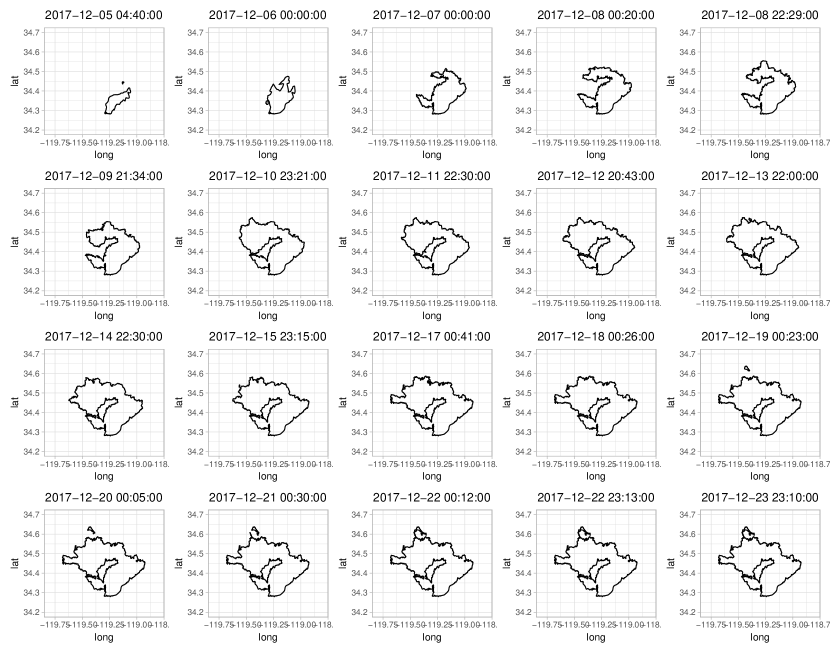
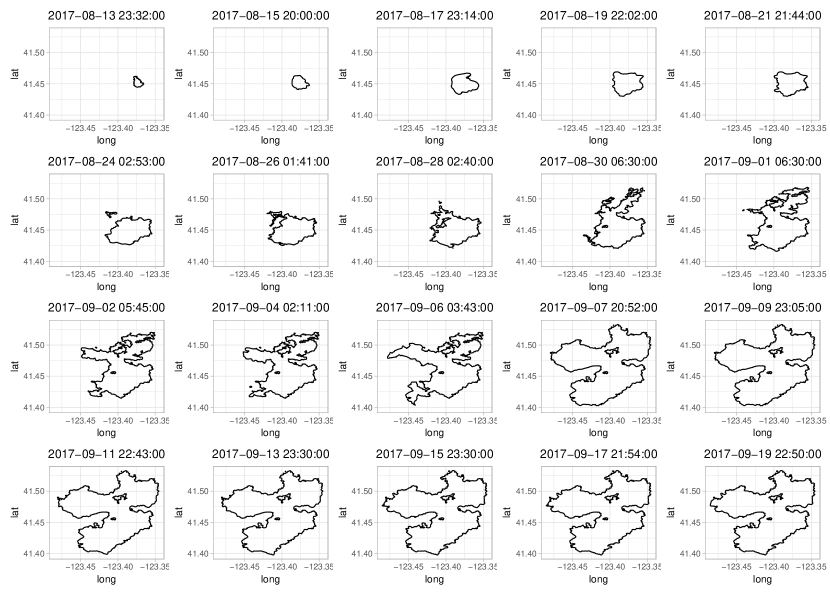
- モデルは2017年のトマス火災およびヘイプレス火災の複雑で非一様な拡散パターン(V字型の火炎前線、乾燥した急斜面における急激な拡大など)を的確に捉えた。
- 事後予測分布は適切に補正された信頼区間を提供し、観測データが限られた状況下でも不確実性の定量化が有効に機能していることを示した。
- データ駆動的かつ確率的な速度モデルの導入により、境界距離指標で測定した予測精度が、固定パラメータモデルを著しく上回った。
- 速度ダイナミクスに施された階層的事前分布構造により、観測が限られた状況下でも頑健な学習が可能となり、過剰適合が抑制された。
- ギブスサンプリングは効率的に収束し、周辺事後分布は解析的に扱える形となっており、高次元の火炎境界状態におけるスケーラブルな推論が可能になった。
- モデルは、データから空間的に変化する速度パターンを学習することで、異種の燃料タイプや変動する風速条件に対しても高い適応性を示した。
より良い研究を、今すぐ始めましょう
論文の読解から最終レビューまで、研究時間を劇的に削減しましょう。
クレジットカード登録不要
このレビューはAIが作成し、人間の編集者が確認しました。